
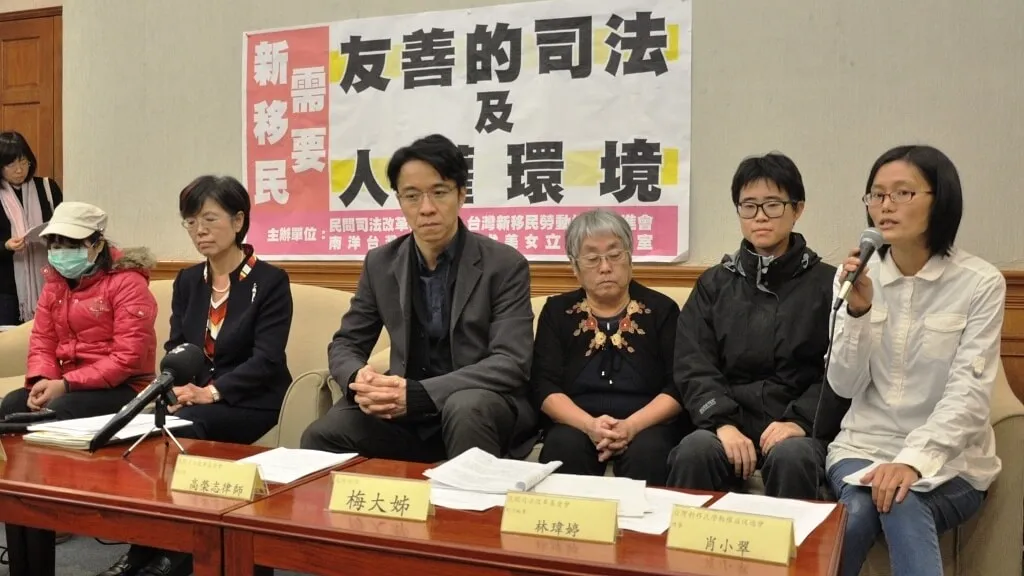
New Immigrants Need a Friendly Judicial and Human Rights Environment ~ Press Conference on the Judicial and Human Rights Situation of New Immigrants
Last edited: 2026-08-28
Regarding the case in which Ms. Mei, a spouse from mainland China, was accused of embezzlement, the JRF assisted her in filing for a retrial. The Keelung District Court opened a retrial under 103-Sui-Tzu-No. 1, and today finally delivered a not-guilty verdict under 103-Chien-Shang-Tsu-No. 1. This represents a significant and commendable change in Taiwan's judicial system, which has been extremely unfriendly to new immigrants.
Ms. Mei was accused of embezzlement by a man named Hsiao-Chan, who claimed to be the son of her deceased husband, because she intended to sell a water heater and a washing machine left behind by her deceased husband. The court of first instance accepted Hsiao-Chan's claims, thereby convicting Ms. Mei of embezzlement and sentencing her to twenty days of short-term imprisonment with a two-year suspension of sentence.
The turning point in the retrial verdict was the court's finding, after investigation, that Hsiao-Chan was not the son of Ms. Mei's deceased husband and had no right of inheritance. Whether Hsiao-Chan was a person with a right of inheritance was a prerequisite for the establishment of the crime of embezzlement. Ms. Mei had repeatedly raised this defense before the court of first instance, but the court failed to investigate it.
This illustrates the judicial predicament that new immigrants may face when entangled in petty offense cases: courts are not necessarily willing to seriously investigate petty offenses, making it difficult for disadvantaged defendants to effectively present evidence in their favor to the court.

Once a conviction is secured, even for a petty offense, the impact on a new immigrant is extremely severe. This is because Article 3, Paragraph 1, Subparagraph 3 of the current Nationality Act and Article 17, Paragraph 5, Subparagraph 2 of the Act Governing Relations Between People of the Taiwan Area and the Mainland Area both stipulate "no criminal record" as a requirement for new immigrants to obtain a Taiwan ID card.
Taking the case of Hsiao-Yen, a Vietnamese spouse, as an example: she was sentenced by the Taichung District Court under 98-Chung-Chien-Shang-Tsu-No. 23 to three months of imprisonment for the offense of aiding and abetting attempted intimidation for extortion. According to Hsiao-Yen's account, after her husband passed away, she met a man who intended to court her. The man claimed he needed multiple mobile phone numbers for business purposes and asked Hsiao-Yen to provide her residence permit to register them. Unexpectedly, the man used those mobile phone numbers to commit extortion, implicating Hsiao-Yen. Because of this conviction, Hsiao-Yen cannot obtain an ID card, will lose her right of residence the moment she leaves Taiwan, and will be deported once her children reach adulthood.

The acquisition of an ID card involves fundamental rights of citizens and the protection of social welfare, and should not be restricted absent significant reasons. New immigrants may accidentally incur criminal charges due to various life circumstances. Depriving new immigrants of their right to obtain an ID card across the board, regardless of the severity of the criminal circumstances, constitutes a severe violation of human rights. Coupled with the current perfunctory handling by courts of petty offense cases involving disadvantaged defendants, stripping individuals of their right to obtain an ID card on the grounds of a petty offense clearly lacks legitimacy.
Legislator Yu Mei-nu pointed out that the naturalization of nationality profoundly affects the rights and interests of the parties involved, and one of the current naturalization requirements, "good moral character and no criminal record," is prone to arbitrary interpretation and sets overly stringent standards. Legislator Yu cited examples of petty offense cases previously encountered by the Trans-Asian Sisters Association, Taiwan (TASAT): for instance, Ms. Chiang, a Vietnamese spouse, was commuting to work when, due to slippery roads in the rain, she failed to brake in time on her scooter and collided with a pedestrian who had already been knocked to the ground by a preceding vehicle, resulting in the pedestrian's fatal injuries. When Ms. Chiang applied for naturalization, her application was rejected because the aforementioned negligent homicide case was deemed to violate the requirement of "good moral character and no criminal record." Another foreign national, Ms. Hung, placed a glass window leaning against a corridor wall while working; a pedestrian accidentally collided with the glass, causing it to fall and injure someone. Ms. Hung was convicted of negligent injury, and likewise could not apply for naturalization due to failing to meet the requirement of "good moral character and no criminal record."

Therefore, we jointly call upon the Ministry of the Interior and the Ministry of Justice to squarely face immigrants' human rights and cease obstructing legal amendments. Furthermore, the Mainland Affairs Council, which is the competent authority for the Act Governing Relations Between People of the Taiwan Area and the Mainland Area, should also expeditiously review the relevant draft amendments concerning spouses from mainland China and submit them to the Legislative Yuan for review, in order to uphold immigrants' human rights.
Attachments
- Keelung District Court, 103-Sui-Tzu-No. 1 Criminal Ruling
- Draft Amendment to the Nationality Act Proposed by Legislator Yu Mei-nu and Others (Excerpt)
Attendees
Party Involved / Ms. Mei (Mainland Chinese Spouse), Ms. Hsiao-Yen (Vietnamese Spouse)
Legislator / Yu Mei-nu
Board Member, Taiwan New Immigrants Labor Rights Association / Hsiao Hsiao-ts'ui
Executive Secretary, Trans-Asian Sisters Association, Taiwan / Hung Man-chih
CEO, Judicial Reform Foundation / Kao Jung-chih
Executive Secretary, Judicial Reform Foundation / Lin Wei-ting
Press Contacts
Lin Wei-ting, Executive Secretary, Judicial Reform Foundation 02-25231178#21
This article is an AI-generated translation of the original Chinese text. In the event of any discrepancy, the Chinese version shall prevail.
