
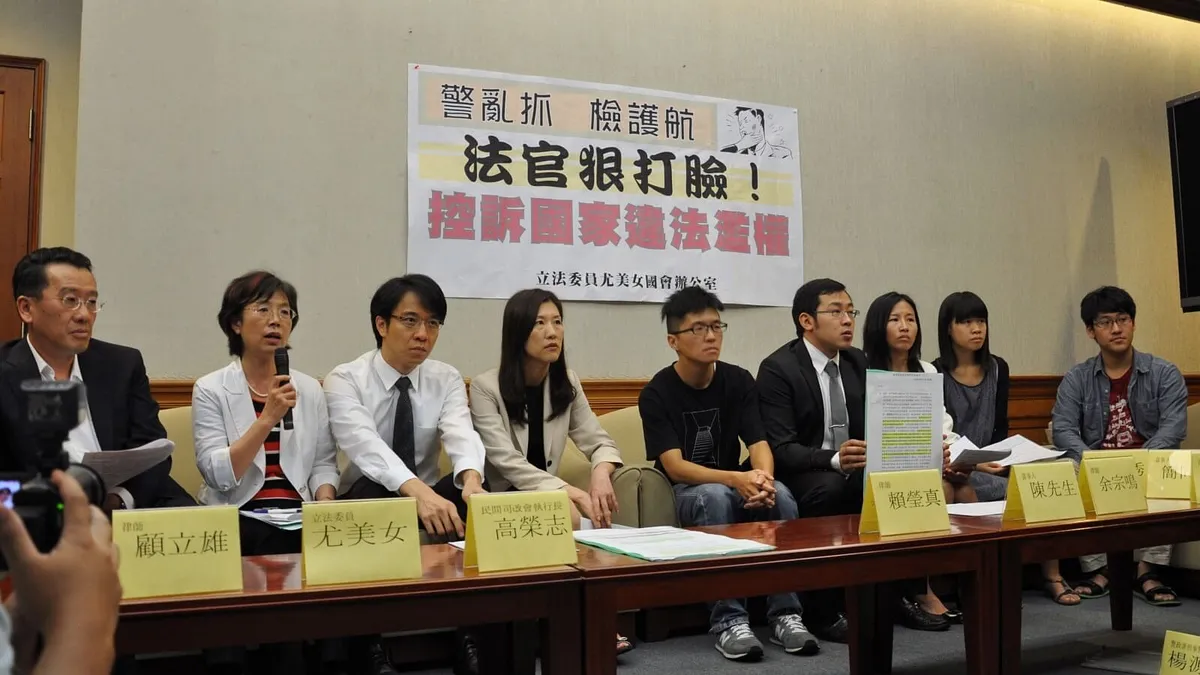
Police Make Arbitrary Arrests, Prosecutors Cover for Them, and the Court Overrules Them! ~ Press Conference Denouncing Abuse of State Power
Last edited: 2026-11-08
Since the March 18 occupation of the Legislative Yuan, police have repeatedly abused their power by arresting people taking part in the civil disobedience movement. Yet when these cases were referred to prosecutors, we found that prosecutors, who style themselves as representatives of the public interest, not only failed to defend the people's rights but instead covered for the police. At today's press conference we present two cases in which prosecutors of the Taipei District Prosecutors Office, after taking on the cases and without clarifying the facts or having any supporting evidence, imposed the compulsory measure of residence restriction on the parties concerned. Recently, in both cases, pro bono lawyers filed quasi-appeals with the Taipei District Court and succeeded in having the prosecutors' residence restriction orders revoked.
Case 1: A Bystander Who Took No Part Was Thrown to the Ground by Police, Handcuffed, and Arrested
Overruled by the court! Taipei District Court Criminal Ruling 103-Sheng No. 1086
On April 29, an incident occurred near the Legislative Yuan in which protesters blocked legislators' cars. Mr. Chen was only watching from the side and moved wherever police instructed him to stand. In the commotion, he saw someone pushed to the ground by police and went to help the person up, only to be thrown over a police officer's shoulder on the spot, suffering injuries and property damage. He was immediately handcuffed, arrested, taken away, and held. The police then barred Mr. Chen from contacting a lawyer, and even after pro bono lawyer Lai Ying-chen finally arrived, they waited six hours before the police began taking his statement.
Case 2: Students Peacefully Protesting the Forced Eviction of Losheng Sanatorium Residents Were Handcuffed and Arrested
Overruled by the court! Taipei District Court Criminal Rulings 103-Sheng Nos. 1226–1231
On the morning of May 9, in front of Taipei City Hall, students Chang, Chien, and others peacefully sought to deliver a "safety pledge" to Mayor Hau, calling on the city government to guarantee the safety of the MRT Xinzhuang Depot and Losheng Sanatorium and opposing the forced eviction of elderly Losheng residents. They were blocked and pushed by a large police force. As protesters, unable to stay on their feet, fell to the ground or piled up on one another, police handcuffed and arrested eight students, claiming they had committed the offense of obstructing public officials.
Prosecutors Cover for Police with Residence Restrictions, Making the Police Even More Reckless
These cases were then referred to prosecutors of the Taipei District Prosecutors Office for further questioning. In Case 1, the prosecutor played the police's evidence-collection footage in the hearing room, which clearly showed that the suspect identified by police differed from Mr. Chen in build, hairstyle, and shoe color. Although the prosecutor knew that Mr. Chen had committed no crime, and that there was neither a ground nor a need for detention, the prosecutor nevertheless placed him under residence restriction. In Case 2, although Chang, Chien, and the others were at the scene, they had done nothing unlawful, yet the prosecutor unlawfully ordered residence restrictions even though no ground for detention existed. Because residence restriction is a substitute for detention, it can be imposed only when there is a ground for detention. The defendants were not even reasonably suspected of a crime, let alone meeting the requirements for detention, so the prosecutors' orders flatly violated the Code of Criminal Procedure!
Court Rulings Show the Police Arrested the Wrong People and Prosecutors Covered for Them
With the help of pro bono lawyers, quasi-appeals were filed in these cases, and the Taipei District Court revoked the residence restrictions imposed on Mr. Chen and on Chang and the others. The court's reasoning clearly identified the prosecutors' errors. In Case 1, Taipei District Court Criminal Ruling 103-Sheng No. 1086 held that the footage and police testimony offered by the prosecutor could not prove that Mr. Chen had committed an offense against personal liberty, nor did they show any sign that he would refuse to cooperate with the investigation. In Case 2, Taipei District Court Criminal Rulings 103-Sheng Nos. 1226, 1227, 1228, 1229, 1230, and 1231 held that the prosecutor had not examined at all whether Chang and the others met the requirements for detention, and that nothing in the photographs or other materials in the file showed any ground for detention, such as a risk of flight or of destroying evidence.
Structural Abuse of Investigative Power Cannot Be Tolerated
These cases are a microcosm of the many unlawful abuses of power by prosecutors and police in recent social movements. Police arbitrarily arrest people at the scene and, after questioning them, refer every one of them to the prosecutors office as a defendant, regardless of whether there is any relevant evidence, exposing them to the risk of criminal punishment. Prosecutors, who style themselves as representatives of the public interest, not only fail to correct the police's unlawful abuse of power but use their own power to impose compulsory measures to join in infringing people's rights. Such collusion between prosecutors and police not only unlawfully and improperly infringes the fundamental rights of the individuals concerned, but also gives the impression that prosecutors and police are working together to suppress the freedom of assembly and parade. Fortunately, the judiciary is the last line of defense for social fairness and justice, and the judges who guard that line issued these rulings, which deserve commendation. In response to these infringements and this suppression by prosecutors and police, JRF and the pro bono lawyers will file requests for evaluation of the prosecutors and help the parties file criminal complaints, pursuing accountability to the end in accordance with the law.
Attendees
Legislator Yu Mei-nu
Parties / Mr. Chen, student Chang, student Chien
Pro bono legal team / Attorneys Ku Li-hsiung, Yu Tsung-ming, Lai Ying-chen, and Chen Meng-hsiu
Executive Director of the Judicial Reform Foundation / Kao Jung-chih
Representative of the Department of Prosecutorial Affairs, Ministry of Justice
Deputy Commissioner of the Criminal Investigation Bureau, National Police Agency / Yang Yuan-ming
Press Contacts
Attorneys Yu Tsung-ming and Chen Meng-hsiu
Chu Wan-lin, Legislative Assistant, Office of Legislator Yu Mei-nu, 2358-8112
[Appendix 1] Excerpts from Taipei District Court Criminal Ruling 103-Sheng No. 1086 (Case 1):
"It is clear that bail, release into the custody of another, residence restriction, and detention are all compulsory measures against a defendant expressly provided for in the Code of Criminal Procedure. Moreover, the precondition for any of these measures, whether detention, bail, release into custody, or residence restriction, is the existence of one of the grounds for detention listed in Article 101, Paragraph 1 or Article 101-1, Paragraph 1 of the Code of Criminal Procedure. Absent such a statutory ground for detention, no compulsory measure may be imposed on the defendant."
"...After verifying the applicant's identity and informing him of his rights, the prosecutor immediately questioned the applicant about the suspected offense, but after the questioning neither examined whether any ground for detention existed nor, when announcing the residence restriction, explained what ground for detention existed... Furthermore, although the photographs taken from the evidence-collection footage, the prosecutor's inspection record, and the testimony of the witness and complainant and of officers Yu and Chen, who helped arrest the applicant, show that the applicant was at the scene at the time and was later arrested and handcuffed by police, neither the photographs nor the prosecutor's inspection reveal any conduct by the applicant suggesting an offense against personal liberty... and the witnesses, officers Yu and Chen, could not confirm whether the arrested applicant was the person suspected of the offense against personal liberty... In sum, since none of the grounds for detention listed in Article 101, Paragraph 1 or Article 101-1, Paragraph 1 of the Code of Criminal Procedure applies to the applicant, the prosecutor could not, after questioning, place the applicant under residence restriction. Accordingly, the residence restriction imposed by the prosecutor on April 29, 2014 is clearly unlawful; the application is well-founded, and this court shall revoke the original measure."
[Appendix 2] Excerpts from Taipei District Court Criminal Rulings 103-Sheng Nos. 1226, 1227, 1228, 1229, 1230, and 1231 (Case 2):
"...After verifying the identities of the above applicants and informing them of their rights, the prosecutor did immediately question them about the suspected offenses, but after the questioning did not examine whether any ground for detention existed, nor, when announcing the residence restrictions, explain which offense the applicants were strongly suspected of committing or what ground for detention existed, and instead announced in the hearing room that each was restricted to reside at the following addresses:... Even if the prosecutor, after questioning, believed the applicants were strongly suspected of the offense of obstructing public officials under the Criminal Code, since none of the grounds for detention listed in Article 101, Paragraph 1 of the Code of Criminal Procedure applies to them, the prosecutor could not, after questioning, place the six applicants under residence restriction. Accordingly, the residence restrictions imposed by the prosecutor on May 9, 2014 are clearly unlawful; the applications are all well-founded, and this court shall revoke the original measures."
[Appendix 3] Relevant Statutory Provisions:
Code of Criminal Procedure
Article 2
Public officials conducting criminal proceedings shall, in the cases under their charge, give equal attention to circumstances favorable and unfavorable to the defendant.
The defendant may request the officials referred to in the preceding paragraph to take measures necessary in his or her favor.
Article 101
After questioning by a judge, a defendant who is strongly suspected of having committed an offense may be detained if any of the following circumstances exists and prosecution, trial, or execution of sentence would clearly be difficult without detention:
1. The defendant has fled, or facts support a finding that the defendant is likely to flee.
2. Facts support a finding that the defendant is likely to destroy, fabricate, or alter evidence or to collude with co-offenders or witnesses.
3. The offense is punishable by death, life imprisonment, or a minimum sentence of imprisonment of five years or more.
When the judge conducts the questioning referred to in the preceding paragraph, the prosecutor may appear to state the reasons for the detention request and present the necessary evidence.
The facts on which each subparagraph of Paragraph 1 is based shall be communicated to the defendant and defense counsel and recorded in the transcript.
Article 101-1
After questioning by a judge, a defendant who is strongly suspected of having committed any of the following offenses may be detained if facts support a finding that the defendant is likely to commit the same offense repeatedly and detention is necessary:
1. Arson under Article 174, Paragraphs 1, 2, and 4 and Article 175, Paragraphs 1 and 2 of the Criminal Code, and quasi-arson under Article 176.
2. Forcible sexual intercourse under Article 221, forcible obscene acts under Article 224, aggravated forcible obscene acts under Article 224-1, taking advantage of a victim's condition to commit sexual intercourse or obscene acts under Article 225, sexual intercourse or obscene acts with a minor under Article 227, and bodily injury under Article 277, Paragraph 1 of the Criminal Code; however, this does not apply where the offense is prosecutable only upon complaint and no complaint has been filed, the complaint has been withdrawn, or the period for filing a complaint has expired.
3. Offenses against personal liberty under Article 302 of the Criminal Code.
4. Coercion under Article 304 and threatening the safety of others under Article 305 of the Criminal Code.
5. Theft under Articles 320 and 321 of the Criminal Code.
6. Snatching under Articles 325 and 326 of the Criminal Code.
7. Fraud under Articles 339 and 339-3 of the Criminal Code.
8. Extortion under Article 346 of the Criminal Code.
Paragraphs 2 and 3 of the preceding article shall apply mutatis mutandis to the circumstances in the preceding paragraph.
This article is an AI-generated translation of the original Chinese text. In the event of any discrepancy, the Chinese version shall prevail.
