
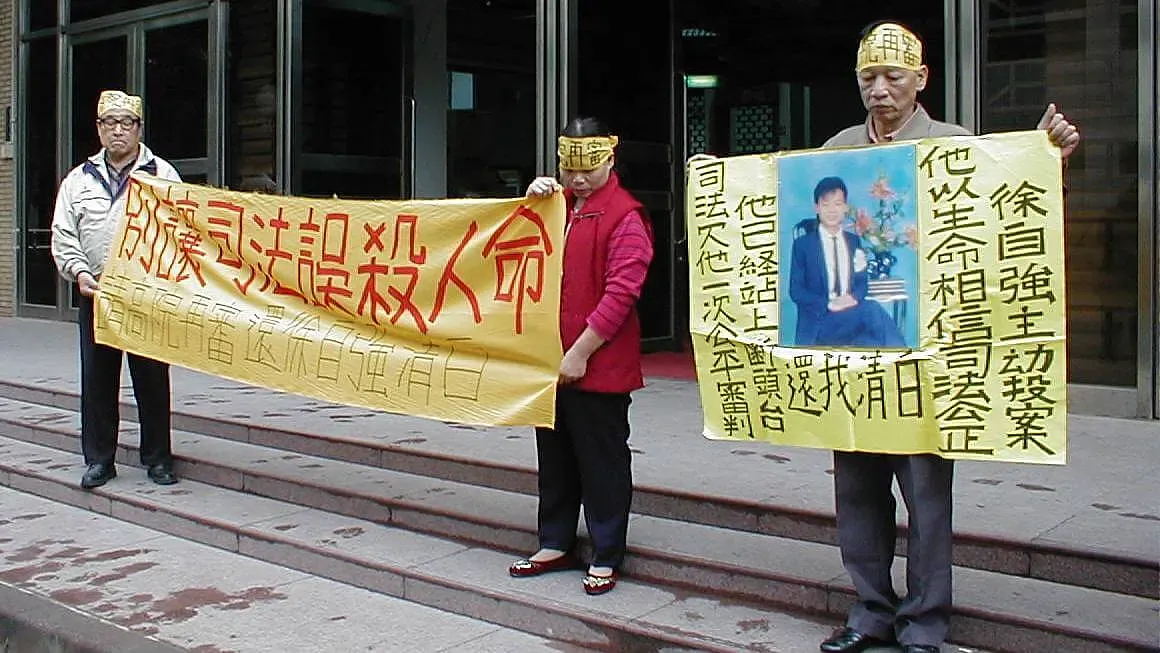
A Judicial Tragedy
Last edited: 2026-11-08
Nearly two years ago, in this same column, I wrote the true story of a young man named Hsu Tzu-chiang who turned himself in, only to be sentenced to death. The story drew the attention of then-Control Yuan Member Chiang Peng-chien, and the Control Yuan, at JRF's request, launched its own investigation into the case. A year later, its investigation report concluded that the case had been decided without evidence: favorable evidence was ignored and not investigated, the death sentence rested solely on co-defendants' confessions, and when the co-defendants recanted after being sentenced to death, saying Hsu was not an accomplice, the court did not investigate further. The Control Yuan therefore found the judicial proceedings flawed and recommended that the Supreme Prosecutors Office file an extraordinary appeal on behalf of the man already sentenced to death. Thanks to the lawyers' petitions and efforts, the Prosecutor-General filed an extraordinary appeal just before the execution could be carried out. But now, two years later, the Supreme Court has dismissed the Prosecutor-General's extraordinary appeal, meaning the protagonist of this story could be executed at any moment.
We simply cannot understand the Supreme Court's dismissal. The Supreme Court in principle reviews cases on the written record, yet the dispute in this case concerns findings of fact. The conviction rested on no evidence other than the co-defendants' confessions (note: not the defendant's own confession) and the judges' inferences. Witnesses who should have been examined were never summoned, physical evidence favorable to the defendant was not accepted, and the co-defendants recanted after their convictions became final at third instance (meaning the main basis for the conviction has already been shaken). Why did the Supreme Court refuse to remand the case to the High Court, refusing this death penalty case a chance for the facts and evidence to be re-examined at a fact-finding instance? Why does it insist that a review of the written record alone suffices to conclude that the case was not wrongly decided because of a failure to investigate what should have been investigated?
Since President Chen took office, human rights have become a slogan constantly on politicians' lips. Human rights are invoked not only in diplomacy; even the ever-stern Ministry of Justice has pledged to gradually abolish the death penalty. The problem is, if we cannot even carry out executions with care, what is the point of talking about abolition? We do not know by what right the judiciary can carry out executions when its standard of adjudication falls below what a death sentence requires. If we can execute someone without evidence, how can we prove to the world that we value human rights? Even harder to understand is the Supreme Court's mindset: when even the Prosecutor-General has filed an extraordinary appeal in a death penalty case, why refuse the defendant a clear and credible trial? Why insist on hastily carrying out an irreversible execution under murky circumstances?
The only explanation is that the Supreme Court's standard of evidence falls below society's expectations, below the trust defendants place in the judiciary, below the naive hope Hsu Tzu-chiang had when he turned himself in that the judiciary would clear his name. I wonder whether these honorable Supreme Court justices realize that, through a death row inmate convicted without evidence, they have killed the judiciary once again.
* Published in the Taiwan Daily.
This article is an AI-generated translation of the original Chinese text. In the event of any discrepancy, the Chinese version shall prevail.
