
Can the High Officials of the Judicial Yuan Hear the Cries of the Underprivileged?
Last edited: 2026-08-28
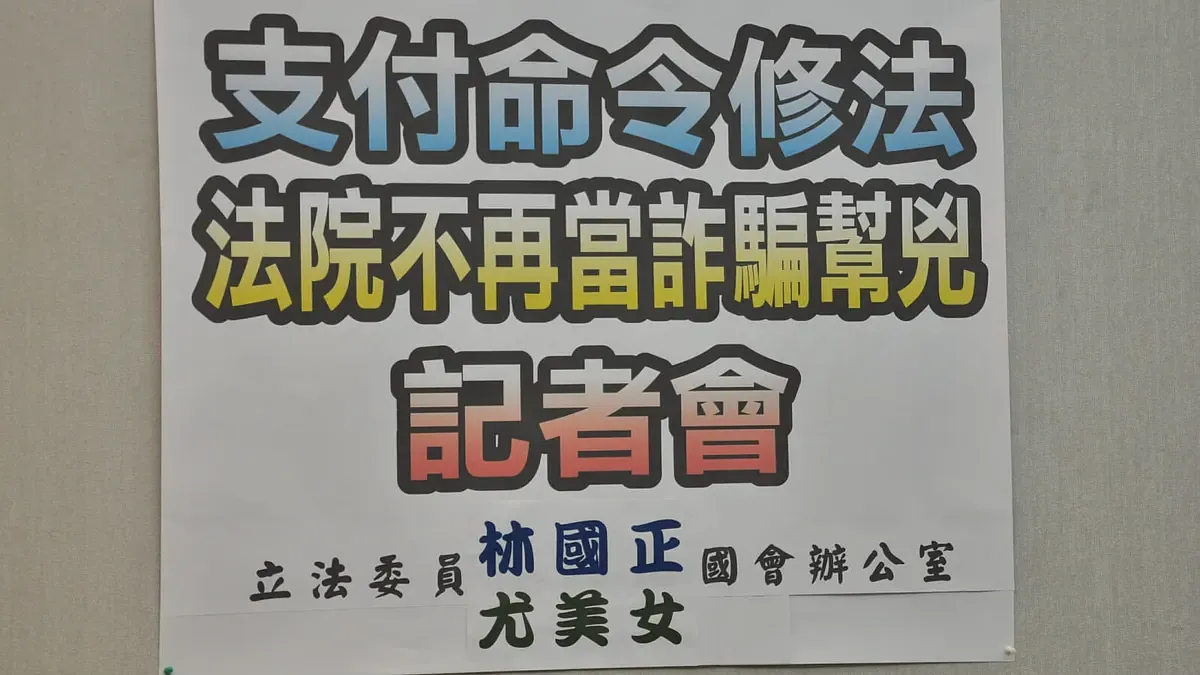
In recent years, order for payment procedures have repeatedly become tools for fraud rings and debt collection agencies to commit illegal crimes, especially affecting the underprivileged who often fail to file objections, causing the orders for payment to become final. Some have even been driven to desperate straits by these groundless and massive debts, committing suicide by charcoal burning with their entire families—a tragic scene too harrowing to bear. Consequently, calls to review this system and even demand its abolition have been continuous for a long time.
Recently, the Judiciary and Organic Laws and Statutes Committee of the Legislative Yuan finally scheduled a review of the "Draft Amendments to the Code of Civil Procedure" concerning the restriction of equating "orders for payment" with promissory notes. However, Secretary-General Lin Chin-Fang of the Judicial Yuan stated that there are 400,000 applications for "orders for payment" each year, among which over 300,000 are undisputed. He believes that the issuance of "orders for payment" can be made more rigorous, but the current regulations should be maintained and amendment is ill-advised to avoid compressing the space for other parties to utilize judicial resources. Therefore, the Judicial Yuan opposed the draft amendment and insisted on maintaining the current order for payment system.
According to Article 521 of the current Code of Civil Procedure, if the recipient of the service of an order for payment (the debtor) fails to object within twenty days, the order for payment becomes identical to a judgment obtained through a civil court across three instances and three tiers, possessing the same effect as a final judgment. Therefore, with the slightest inattention, or because vulnerable members of society simply do not know how to object, or because they do not live at their household registration address and service is deposited at a police station (meaning they are completely unaware of the existence of the order for payment), after twenty days this order for payment acquires the same effect as a final judgment, saddling them with debt for a lifetime. However, is such a system truly reasonable?
Taking the German Code of Civil Procedure, which is similar to our civil laws, as an example, the summary enforcement procedure (Mahnverfahren) under German law entails that after a creditor applies to the court for the issuance of an order for payment and the court reviews it, the court will issue an order for payment to the debtor, instructing them to pay. Upon receiving the order for payment, the debtor may file an objection thereto (Article 694 of the German Code of Civil Procedure). If no objection is filed, the legal consequence is: the creditor may apply to the court to issue an enforcement order. At this point, the debtor may still file an objection against the enforcement order (Article 700 of the German Code of Civil Procedure); if still not filed, the creditor may apply to proceed with compulsory execution. If the debtor files an objection, the creditor may initiate a civil lawsuit to claim repayment.
In other words, the German summary enforcement procedure requires that the debtor fails to object to the order for payment and also fails to object to the enforcement order—such a twofold failure to object allows the creditor to carry out compulsory execution against the debtor. Compared to our country, this legislation is not only more prudent, but also more thoughtful regarding the protection of the right to judicial remedy, avoiding unfortunate incidents like those frequently occurring in our practical legal circles where a debtor has not received the service of an order for payment yet the order for payment becomes final after twenty days.
Our order for payment system was inherited from Germany. However, the summary enforcement procedure under German law has undergone considerable revision following review and introspection. After all, the ultimate purpose of the existence of law is to ensure that everyone can receive equal respect and freedom, rather than serving as a tool for the strong to bully the underprivileged people of society. How can the fact that there are 400,000 applications for "orders for payment" each year, of which over 300,000 are undisputed, be used as an excuse to block reform?
Looking around the globe, apart from our country, how many other countries still embrace such a backward and inhumane system? Could it be that the cries of these disputed cases and the underprivileged people driven to family suicide by charcoal burning by the order for payment system are not worth taking seriously?
This article is an AI-generated translation of the original Chinese text. In the event of any discrepancy, the Chinese version shall prevail.
