
The Unjust Effects of Payment Orders
Last edited: 2026-08-28
"Don't let your rights sleep," is a promotional slogan frequently used to popularize legal knowledge. While this phrase certainly has the effect of arousing public awareness, it also implicitly carries a cruel and cheap pre-allocation of responsibility: when your rights are harmed because you do not understand the law, it is actually your own fault, not a problem with the system.
The cruelty of this presupposition lies in its display of an indifferent attitude toward how one can reasonably expect the people to possess the necessary legal knowledge; its cheapness lies in providing an easy escape route for the responsibilities the state ought to bear. The combination of cruelty and cheapness in this context is the arrogance of power and expertise.
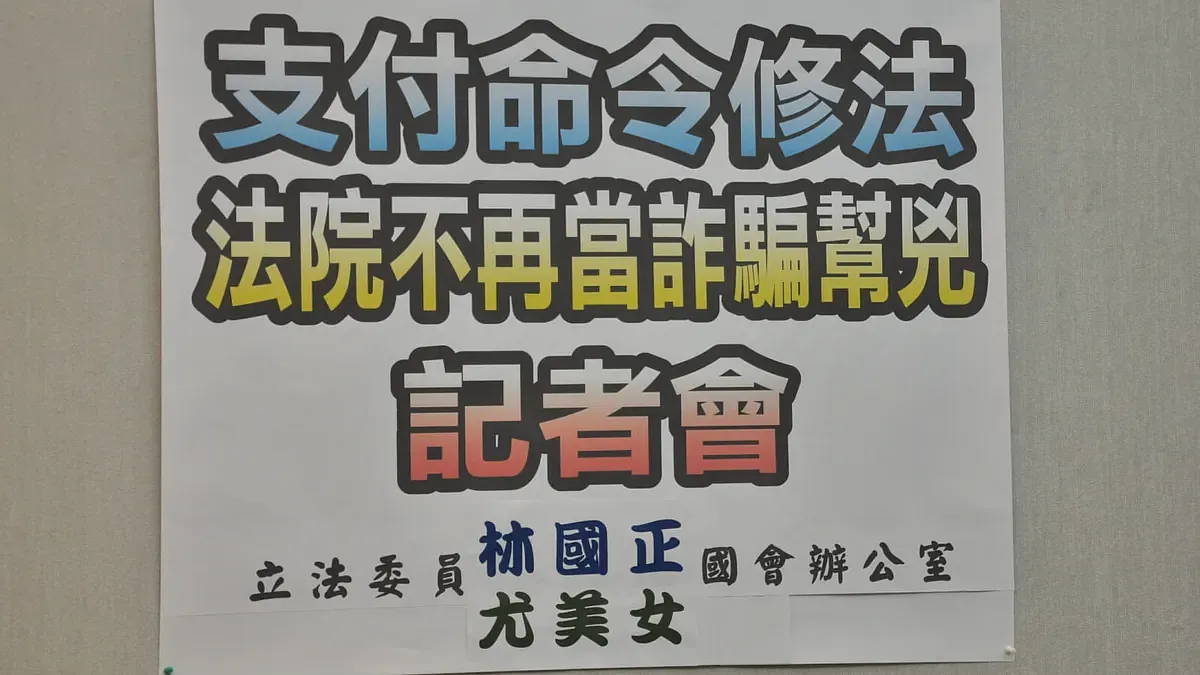
Such arrogance certainly needs to be reviewed; however, what is even more unacceptable is that when the harm to people's rights and interests results from unjust laws, the state instead turns around and blames the victims for neglecting to seek remedies according to the law, as if everything were originally the victims' own fault. The news reported by the media a few days ago about a scam syndicate using a "payment order" to suddenly saddle a female victim with NT$50 million in debt is a typical example.
A payment order is a system established under the Code of Civil Procedure for the rapid realization of claims. A creditor submits a written application to the court requesting the debtor to pay a certain amount. The creditor only needs to explain the reason why the debtor owes the money without attaching any evidence, and the court will issue the payment order without holding a hearing. If the debtor, upon receiving the payment order, denies the existence of the debt, they must file an objection within 20 days; otherwise, the payment order will produce "the same effect as a final and conclusive judgment." This means that the creditor who obtained the payment order can not only apply to the court for compulsory execution against the debtor's property, but the debtor is also barred from subsequently disputing that the debt did not actually exist.
The legislator who assisted that female victim in holding a press conference criticized that the Code of Civil Procedure does not compulsorily require creditors to submit relevant evidentiary documents, leading courts to potentially issue payment orders based solely on the creditor's application. This is an obvious legislative omission, and in the next session, they will promote legal amendments to require creditors applying for payment orders to bear a certain degree of the burden of proof rather than relying solely on their unilateral statements. The Judicial Yuan responded by stating that debtors can object without stating reasons to prevent a payment order from being established, and that the Judicial Yuan will also strengthen advocacy to teach citizens how to protect their own rights and interests.
Fairly speaking, the response of the Judicial Yuan is undeniably an irresponsible passing of the buck, and the legal amendments the legislators intend to promote completely fail to grasp the core of the problem. The real crux is: granting payment orders the same substantive finality as a final and conclusive judgment is fundamentally an unjust legal system design, and our country's provision in this regard can be described as uniquely absurd globally.
How so? When a judgment is final and conclusive, unless grounds for a retrial exist within a heavily restricted scope (such as a judge being convicted of accepting bribes), the losing party cannot deny the contents determined by the judgment, nor can they subsequently dispute that the final judgment was wrong. From this perspective, a final and conclusive judgment ordering a debtor to pay money is equivalent to producing the effect of depriving a party of their property rights, with very serious consequences. Precisely for this reason, contemporary rule-of-law states emphasize that before producing such severe legal effects, strict procedural safeguards must first be afforded to the parties—usually referring to a formal litigation procedure that allows the defendant debtor to participate in the proceedings and express their opinions.
Conversely, for the institutional purpose of achieving "speed and convenience," when a creditor applies for the issuance of a payment order, the debtor is not given any opportunity to participate in the proceedings at all. All the debtor has left is to quickly file an objection within twenty days upon receiving the order. Under circumstances where the court does not execute any adjudication procedures at all and affords no necessary procedural safeguards to the debtor, the severe consequence of deprivation of property rights is produced merely because the debtor neglected to object within 20 days. This is fundamentally the injustice of state institutional design.
For the purpose of handling "uncontested claims" "rapidly and on a large scale," payment orders for which debtors fail to object within 20 days only need to be endowed with the effect of allowing creditors to apply for compulsory execution. If such a claim is false and fictitious, debtors should be given the opportunity to subsequently initiate litigation to claim that the debt does not actually exist, rather than endowing payment orders with the same effect as final and conclusive judgments and unjustly cutting off the debtor's opportunities for relief.
In fact, when the Judicial Yuan deliberated on amendments to the Code of Civil Procedure in the year 2000, participating scholars all recognized that "payment orders lacking procedural safeguards for debtors should not be endowed with the same effect as final and conclusive judgments." Everyone knew that payment orders had become tools for manufacturing false debts, and everyone knew that Germany and Japan, which have similar systems, do not endow payment orders with such strong effects like our country does. It is baffling why the Judicial Yuan ultimately decided not to amend this inherently unjust system, causing people to continuously fall victim to it over the past dozen years. The woman in the aforementioned news report is just one example.
From the perspective of the actual operational effects of the system, granting payment orders such an unjust and strong effect benefits banks that frequently use payment orders and judges who process the cases. Neither needs to worry that debtors can subsequently deny the existence of the debt through litigation. Those who suffer are a group of uninformed citizens who themselves neglected to object—not only is their property subjected to execution, but they even lack avenues for subsequent relief.
The author can boldly predict that if necessary legal amendments are not swiftly undertaken, no matter how the Judicial Yuan "advocates," people will continue to fall victim in the future. At the same time, this serves as a kindly reminder to the honorable legislators that if the real problem is not grasped and the wrong prescription is taken, tragedies will not end even if the law is amended.
This article is an AI-generated translation of the original Chinese text. In the event of any discrepancy, the Chinese version shall prevail.
