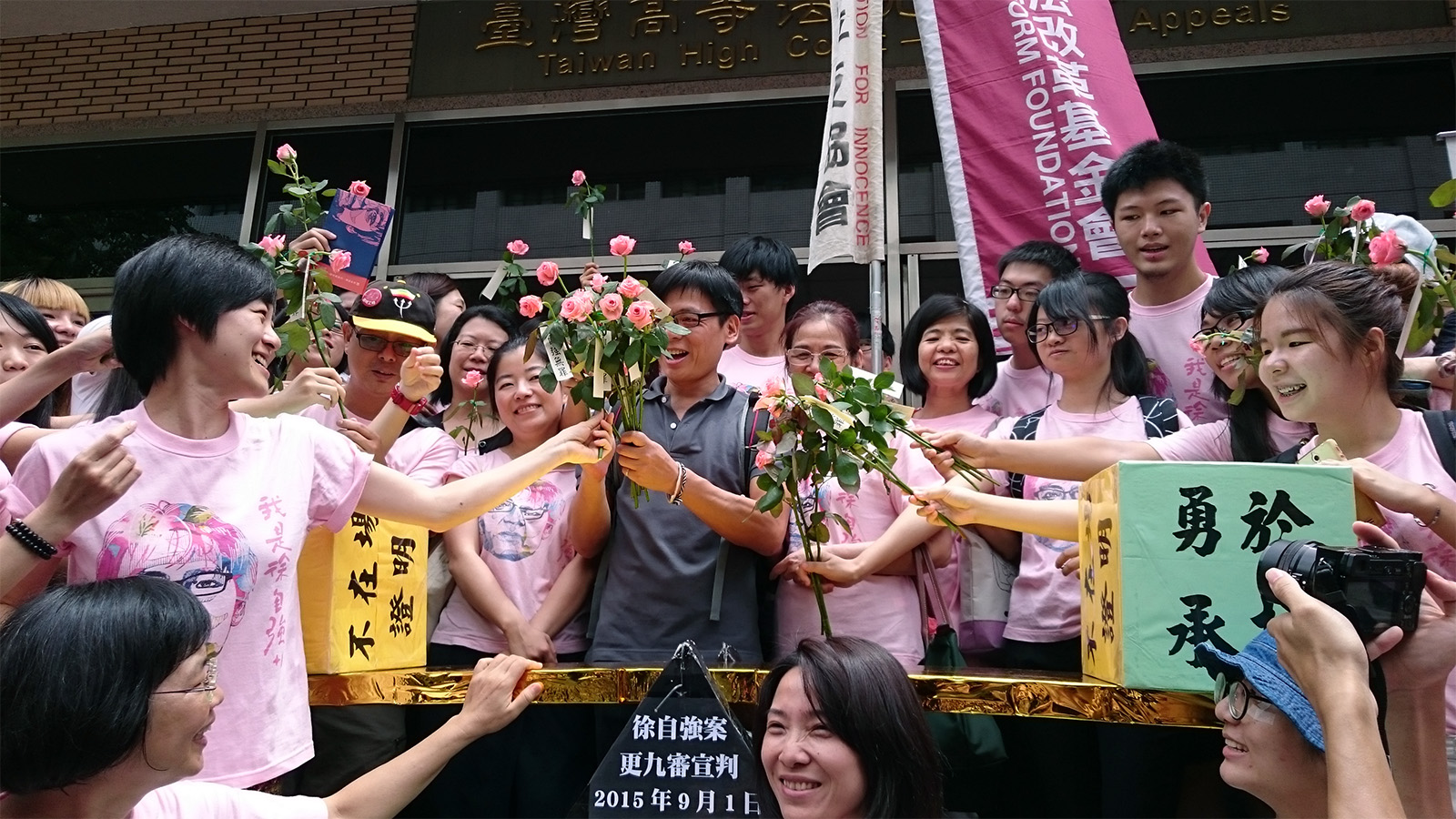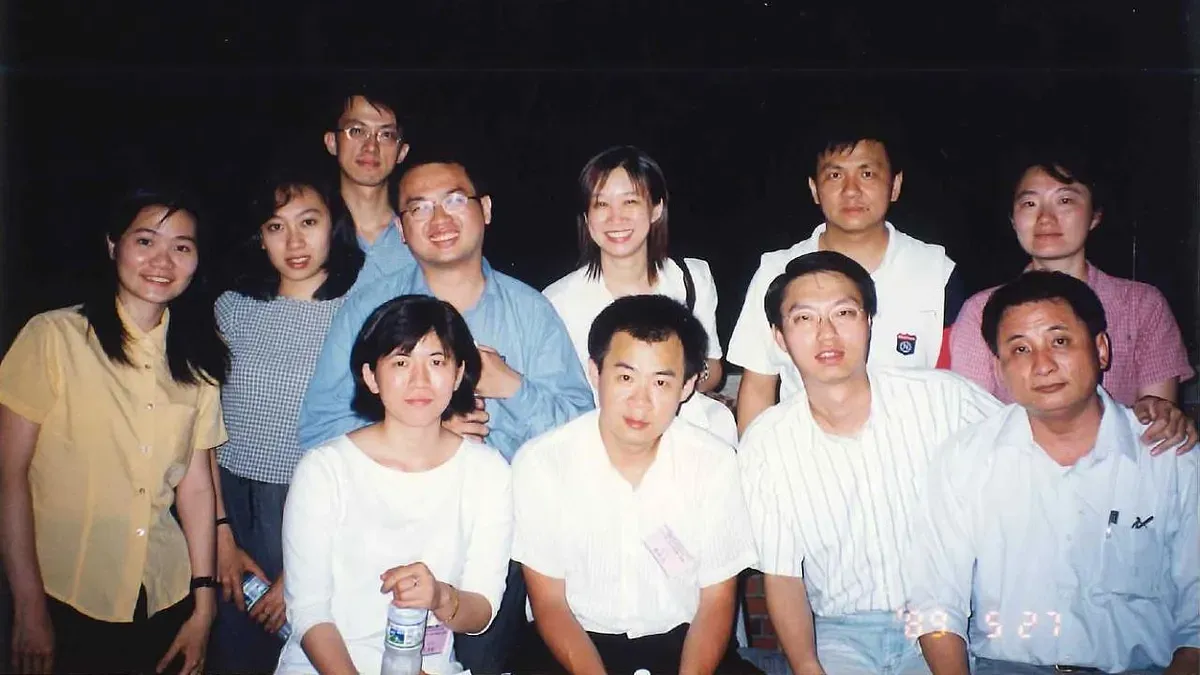
An Idealist Ahead of His Time: Remembering Prosecutor Lai Ching-Hsiang
Last edited: 2026-08-29
Prosecutor Lai Ching-Hsiang: I'm really sorry, I finished my cigarettes, so I have to bum one of yours... hee hee. After eleven years as a prosecutor, I'm still at the seventh recommended rank, just like a prosecutor who has newly arrived. Among my peers, some are already chief prosecutors. I feel I am a failure, with nothing to show for ten years, and I am deeply disappointed. Battered and bruised. I can only influence one or two people. I'm very lonely, and I don't have many friends....
Wang Chin-Shou: No, I have always believed that based solely on the Hualien vote-rigging case, you have earned a place in Taiwan's democratic history. I believe that one day the prosecutorial system will grant you justice.
I was wrong. Before Prosecutor Lai Ching-Hsiang passed away, he never received justice from the prosecutorial system.
************
Lai Ching-Hsiang originally practiced as an attorney. He could have been a lucrative attorney leading a comfortable and wealthy life, but to fulfill his father's wish, he entered the Judges and Prosecutors Training Institute (30th cohort). He had confidently planned to first spend two years as a prosecutor in Hualien as his top choice, then transfer to a district prosecutors office in western Taiwan for two years, followed by two years at the Taipei District Prosecutors Office, allowing him to be promoted to chief prosecutor within six years.
However, the storm of Taiwan's political transition disrupted his life plan.
The Hualien Vote-Rigging Case
During the martial law era, the Kuomintang (KMT) was frequently suspected of rigging votes. However, no KMT-affiliated individuals had ever been prosecuted for vote-rigging. Even during the 1989 elections, when Democratic Progressive Party (DPP) Tainan County Magistrate candidate Li Tsung-Fan and his supporters occupied the highway for several hours to protest electoral fraud, the investigative authorities still failed to take any serious investigative action.
During the 1992 legislative elections, DPP Chairman Huang Hsin-Chieh launched a "campaign expedition to the east" to run for a legislative seat in the Hualien constituency. Few expected Huang to win a seat. On the day of the vote counting, Huang's vote count was very close to that of the candidate who won the second seat. Huang had already planned to return to Taipei, but various rumors of vote-rigging were spreading.
Huang Hsin-Chieh and his supporters, much like during the 1989 Tainan County magistrate election, went to the election commission to protest, demand a recount, and investigate whether votes had been rigged. Election commission officials did not dare make any decisions and told Huang he must first obtain the consent of a prosecutor. Huang and thousands of supporters thus went to the district prosecutors office. For most prosecutors at the time, election day was a time to rest rather than diligently crack down on vote-buying. The prosecutor on duty at the district prosecutors office was a young prosecutor named Hung Cheng-Ho. Although Lai Ching-Hsiang was a rookie prosecutor who had only reported to the Hualien District Prosecutors Office a few months prior, he took the initiative to assist Hung Cheng-Ho. Lai calmly faced the thousands of demonstrators surrounding the prosecutors office and coordinated with DPP politicians.
However, the two prosecutors believed that deciding whether to recount the ballots should be the responsibility of the county election commission. During the period when Huang Hsin-Chieh and thousands of supporters traveled back and forth between the county election commission and the district prosecutors office several times, the two prosecutors tried to contact their superiors, only to find that the mobile phones of all the key commanding officers were turned off. After intense debate, Huang and the district prosecutors office reached a consensus to recount only the ballots for Hualien City, rather than the entire county.
During the recount process, every group of counting personnel included representatives from each candidate. Hung Cheng-Ho made a crucial decision: the entire recount process was opened to media coverage. Ultimately, it was discovered that the number of counted ballots exceeded the number of ballots collected, which meant someone had stamped blank ballots and thrown them into the ballot boxes. Over the next few days, while some prosecutors went on vacation, Hung Cheng-ho and Lai Ching-Hsiang, with the primary mobilization of police support, gradually clarified the case. Hung and Lai did not receive recognition from the prosecutorial system for investigating this major case; on the contrary, because they investigated this case, they accumulated too many other cases and were instead disciplined by the Ministry of Justice. Without prosecutors Hung Cheng-ho and Lai Ching-Hsiang at the time, whether Taiwan's first-ever prosecuted vote-rigging case could have been established remains an open question. Following this case, the KMT's blatant vote-rigging was never seen again.
Collaborative Investigation at the Pingtung District Prosecutors Office
With the collapse of the authoritarian regime, dark-gold political forces also began to invade various levels of Taiwan's politics and economy. Pingtung was once known as the hometown of gangsters. At a time when virtually all sectors of society were helpless against this, from late 1994 to late 1996, a group of young prosecutors at the Pingtung District Prosecutors Office defied powerful forces and began purging local dark-gold politics. These achievements stemmed from a collaborative investigation model spontaneously developed by these prosecutors. In the past, other so-called "collaborative investigations" were often methods by superiors to interfere with lower-level investigations, but the collaborative investigations spontaneously developed among Pingtung prosecutors emphasized equality, mutual assistance, and coordination. Although a few other prosecutors in Taiwan had experience with collaborative investigations, only the collaborative investigations at the Pingtung District Prosecutors Office at that time were comprehensive. However, the contribution of this group of prosecutors to the development of democratic politics has yet to receive any recognition from Taiwanese society to this day. Like a few other outstanding prosecutors, they are perhaps the most important figures in purging dark-gold politics, yet they are also the most overlooked group.
Collaborative investigations by the Pingtung District Prosecutors Office effectively purged local dark-gold politics. In just a few short years, they indicted Speaker Cheng Tai-Chi, Pingtung Mayor Huang Ching-Han, Legislator Kuo Ting-Tsai, National Assembly Delegate Hsu Ping-Feng, Provincial Assemblyman Lin Yuan-Hsi, County Councilor Huang Chang-Yuan, and numerous township mayors and township agricultural association directors-general. At the same time, they cut off the illicit funding sources of many politicians, such as smuggling, video arcade parlors, drugs, and the Liu-he-cai lottery. This group of prosecutors had no concept of seniority; they cooperated, conducted joint investigations, shunned hero worship, and assigned tasks based on function. Never before had the power of prosecutors been so perfectly and fully unleashed. A good prosecutor can prevent politicians from becoming too arrogant; a group of prosecutors with bonds like brothers can completely alter the local political ecology.
Most of the indicted individuals were KMT dark-gold politicians. Purging these KMT dark-gold politicians elevated the quality of democracy and public life in Pingtung. The greatest political effect was that it indirectly ended the KMT's dark-gold rule. Politicians whom the KMT was eager to cultivate, such as Provincial Assemblyman Lin Yuan-hsi, Pingtung Mayor Huang Ching-Han, and two county councilors vying for the speakership, Tsai Yu-Chan and Huang Chang-Yuan, thus had their political lives interrupted or ended. All of this occurred before the party rotation in power. Indicting so many KMT politicians under a KMT-controlled prosecutorial system required immense courage and daring. Although these prosecutors indicted so many KMT dark-gold politicians, indirectly helping the DPP clear the "roadblocks" to taking power, this does not mean these prosecutors were DPP hatchet men. After all, they also indicted Hsu Ping-feng, a DPP National Assembly delegate and county party branch chairman who committed a sensational nationwide drug-smuggling case, and Chiu Chi-Ming, the Kuohsiu Township party branch chairman involved in illegal gravel excavation.
The collaborative investigations at the Pingtung District Prosecutors Office had several characteristics: 1. Comprehensiveness: Except for the chief prosecutor and senior prosecutors at the time, almost all prosecutors participated in collaborative investigations. 2. High frequency: Collaborative investigations occurred almost every few days. 3. Autonomy: This model was developed among prosecutors themselves rather than ordered by superiors. 4. Proactiveness: In sharp contrast to some prosecutors who only stayed in their offices waiting for cases to be transferred, Pingtung prosecutors went to every corner of society to uncover cases. 5. Aside from the law, there were no political or administrative considerations.
Lai Ching-Hsiang played the most crucial and leadership role in the collaborative investigations at the Pingtung District Prosecutors Office. His selflessness and proactiveness, combined with his charismatic presence, naturally made him the leader of this group. He never claimed any credit, nor did he seek the spotlight. At the same time, his investigative skills helped unite the prosecutors of the Pingtung District Prosecutors Office. In that era, most prosecutors often sat in their offices waiting for cases to be referred by the Bureau of Investigation and police departments. But Lai Ching-Hsiang not only proactively investigated cases, he also treated himself as a criminal investigator, standing at the very front line of detection.
In late 1996, then-Minister of Justice Liao Cheng-Hao launched Taiwan's first-ever collective crackdown on reform-minded prosecutors. Eight prosecutors were transferred without any warning under various pretexts. Among them, Lai Ching-Hsiang was transferred to Taitung and Liao Chun-Chien to Tainan; the reasons for their transfers differed from those of the other six. Those six were primarily targeted because their investigations into dark-gold politics offended key local KMT figures. At the time, the Pingtung District Prosecutors Office had completely gotten out of control as far as the ruling KMT was concerned. Six of the prosecutors later filed lawsuits with the Civil Service Protection and Training Commission and the Ministry of Justice, while the Ministry of Justice made no effort to conceal its intention to crack down on these prosecutors. In its statement to the Protection and Training Commission, the Ministry of Justice bluntly stated that Lai Ching-Hsiang and Liao Chun-Chien were "the root of internal instability" at the Pingtung District Prosecutors Office. Afterward, several of the improperly transferred prosecutors received vindication, along with varying degrees of promotion and reinstatement. Only Lai Ching-Hsiang—following Li Tzu-Chun—was smeared and stigmatized by the prosecutorial system, becoming another dissident within the establishment. Even after the DPP came to power, Lai Ching-Hsiang received no vindication.

Breaking Out of Sectarianism and Participating in Judicial Reform
One characteristic of Taiwan's judicial reform is that the various reform movements and their participants rarely engage in dialogue, interaction, or cooperation; instead, things eventually evolve into "institution-versus-institution" confrontations. I believe this is a major regret in the history of Taiwan's judicial reform, and one of the main reasons for the limitations of this wave of judicial reform in Taiwan.
Judges, prosecutors, and attorneys with a reformist consciousness far surpassed previous legal professionals in ability, morality, and even foresight and vision. At the same time, they harbored a passion for Taiwan's judicial reform and constituted the group most likely to transform Taiwan's judicial system. Unfortunately, this group of people almost completely lacked dialogue, making it impossible for them to jointly propose a vision for judicial reform to Taiwanese society and dispersing the momentum for reform. Even more regrettably, as judicial reform progressed, this group of reform-minded judges, prosecutors, and attorneys began to exhibit an "institution-versus-institution" phenomenon due to the different positions of their respective agencies. For instance, when the JRF began attacking the Judicial Yuan and then-President Shih Chi-Yang, reform-minded judges simultaneously voiced hardline and moderate views. At the 1999 National Judicial Reform Conference, some reform-minded judges defended the policies of the Judicial Yuan, reform-minded attorneys proposed an alternative blueprint for judicial reform, and the lonely and aggrieved Prosecutors Reform Association—forced to fight the Ministry of Justice internally while failing to receive sympathy and support from attorney groups and the Judicial Yuan—withdrew from the National Judicial Reform Conference. Such conflicts dispersed and neutralized reform momentum, preventing judicial reform from making greater progress.
Yet Lai Ching-Hsiang had long since transcended prosecutorial sectarianism to participate in judicial reform organized by other civic groups. In 1997, when the JRF held the "March for the Resurrection of Justice," many reform-minded judges and prosecutors viewed the event with hostility and suspicion. However, Lai Ching-Hsiang not only personally attended and participated in the march, but also mobilized several judges and prosecutors to join. Even as the JRF grew increasingly hostile toward reformers within the judicial system, Lai Ching-Hsiang stayed. He continued to participate in JRF activities, sharing prosecutors' experiences at training camps.
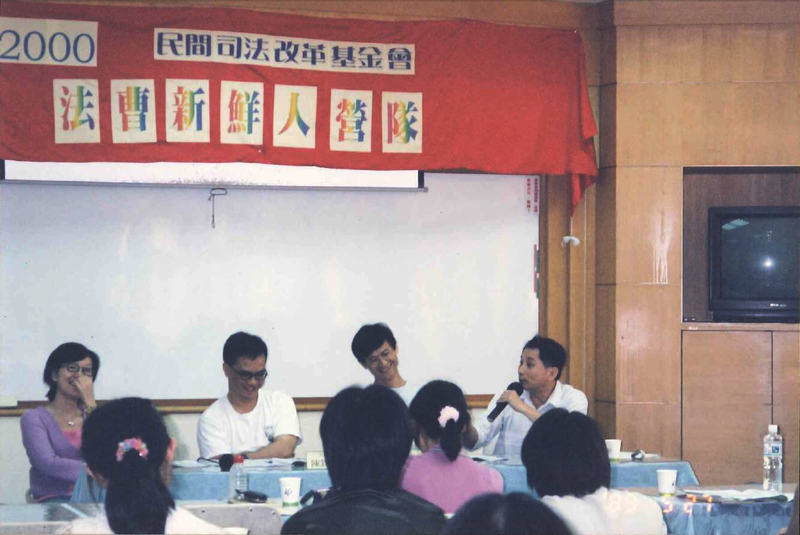
An Idealist Ahead of His Time
In the struggle against the prosecutorial system, aside from Li Tzu-Chun, no one compared to Lai Ching-Hsiang in terms of thoroughness and scope. In the early days, district prosecutors offices had funds for investigating vote-buying during election periods. Prosecutors at the Pingtung District Prosecutors Office had already agreed to report actual expenses for reimbursement. However, a chief prosecutor wanted to follow past practice and divide the funds up as anti-vote-buying propaganda expenses. Lai Ching-Hsiang was furious and gave the chief prosecutor two choices: 1. Return the money drawn; 2. Lai Ching-Hsiang would open an investigative file and close the case under the pretext of a false report. If the Control Yuan came to investigate, Lai Ching-Hsiang was willing to take full responsibility. But this chief prosecutor did not take the matter seriously at all. Consequently, Lai Ching-Hsiang initiated an investigation himself. However, the chief prosecutor immediately transferred the case to Kaohsiung, and there was no further word until Lai Ching-Hsiang was transferred to Taitung, when he received a letter stating the case had been closed. After the September 21 earthquake, the Kaohsiung District Prosecutors Office still held a Mid-Autumn Festival party with wining and dining, and door prizes of a VCD player for everyone. Lai Ching-Hsiang did not attend the party, but another prosecutor informed him of the situation. Outraged, Lai Ching-Hsiang submitted a signed complaint to the Control Yuan website against the chief prosecutor.
Ultimately, Lai Ching-Hsiang never achieved the goal he set when he first arrived at the district prosecutors office: to return to Taipei and be promoted to chief prosecutor within six years. Not only was he never promoted to chief prosecutor, he never even made it to a district prosecutors office in northern Taiwan. Throughout his entire career as a prosecutor, he remained a rank-and-file prosecutor at a district prosecutors office. Perhaps, as he himself said, this was a failed professional career.
************
Lai-Tzu, you said, "I feel I am a failure, with nothing to show for ten years, and I am deeply disappointed." You were wrong. The Hualien vote-rigging case can serve as a model for many subsequent electoral dispute cases. The collaborative investigation experience you developed at the Pingtung District Prosecutors Office remains unmatched to this day. Your selflessness and participation in judicial reform, transcending sectarianism, are precisely what current judicial reforms urgently need.
Lai-Tzu, you said, "I can only influence one or two people." You were wrong. You once lamented, "Where have the shoulders of people who study law gone? They grow old before their time. It is the entire prosecutorial system that grinds people down into this shape. Many people's goal is to spend ten years as a prosecutor just to become a chief prosecutor without having to handle cases. Why does a person change so quickly upon entering this system?" But what you did not know is that you are the shoulders of many prosecutors.
Lai-Tzu, you said, "I am very lonely, and I don't have many friends." You were wrong. Prosecutor Hung Cheng-Ho, who fought alongside you in the Hualien vote-rigging case, has not forgotten you. Your brothers at the Pingtung District Prosecutors Office and the Prosecutors Reform Association have not forgotten you. Your friends in the courts have not forgotten you. Your friends at the Judicial Reform Foundation have not forgotten you. The sisters at Tu-an-chu in Yilan have not forgotten you.
************
I was wrong. What Prosecutor Lai Ching-Hsiang needed was not vindication from the prosecutorial system, but the realization of the ideals he had long practiced with his own actions.
This article is an AI-generated translation of the original Chinese text. In the event of any discrepancy, the Chinese version shall prevail.