
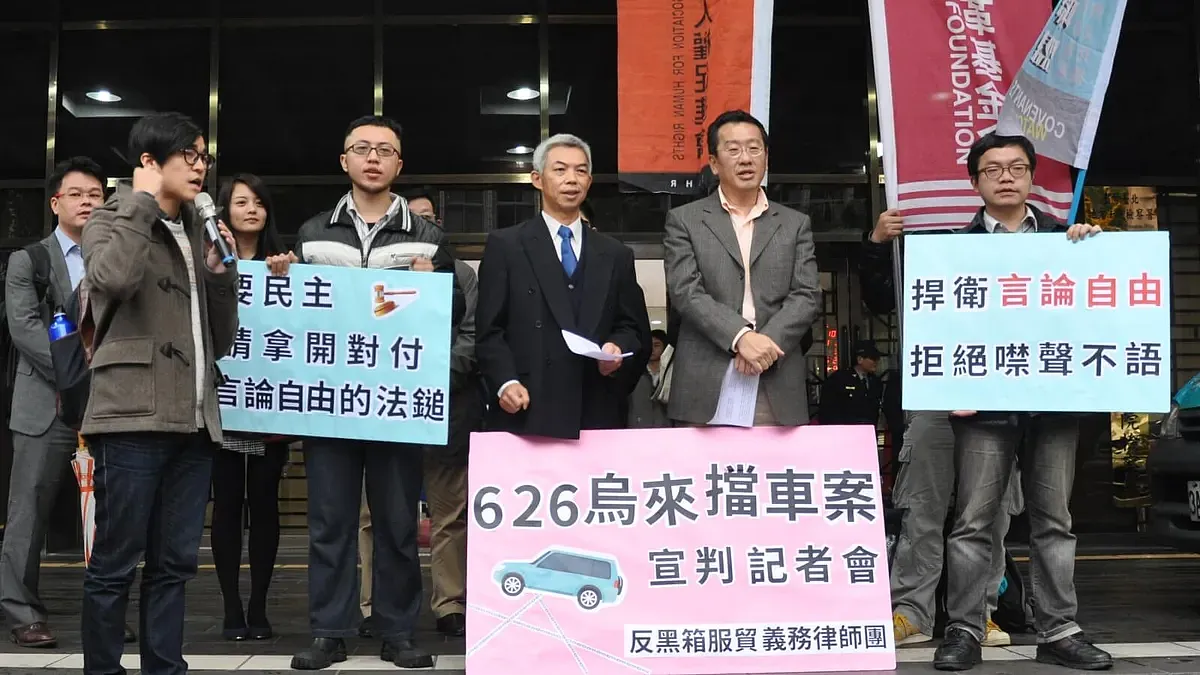
Press Conference on the Judgment in the June 26 Wulai Road Blockade Case
Last edited: 2026-11-08
Today (January 15), the Taipei District Court convicted the eight defendants in this case who, on June 26, 2014, chained themselves together with their bodies to block Zhang Zhijun, Director of China's Taiwan Affairs Office, from traveling to Wulai. The pro bono legal team deeply regrets this judgment!
The year 2014 was a critical moment for the rise of civic consciousness in Taiwanese society. Major actions that captured widespread public attention—including the March 18 Occupy Legislative Yuan, the March 23 Occupy Executive Yuan, the April 28 Zhongxiao West Road Anti-Nuclear Protest, and the June 26 Wulai Road Blockade—all aimed to awaken society's concern for major national policies, demanding that the government respond to public opinion, carefully evaluate, and reformulate policy directions. The expression of freedom of speech is a fundamental human right guaranteed by the Constitution, and "symbolic speech (including action)" directed at political opinions is the core embodiment of freedom of speech. Within socially tolerable limits, it should not be punished by criminal law.
Out of deep concern over the impact of the Cross-Strait Service Trade Agreement on Taiwan, and following the "Novotel Hotel break-in incident" the previous day, the eight protesters took action to block the road using their bodies to impede the motorcade. They hoped to draw the government's attention to public demands and prompt a reconsideration of issues such as the Cross-Strait Service Trade Agreement. Furthermore, the protest was conducted through peaceful means, lasting only a little over ten minutes with police directing traffic at the scene. Even if it caused brief inconvenience, it should reasonably fall within the tolerance of the general public. The collegial panel failed to examine the facts of this case or clarify the chain of cause and effect, and went straight to a conviction, which truly violates the constitutional guarantee of freedom of speech.
Since the March 18 occupation of the Legislative Yuan, the 318 Anti-Black Box Service Trade Agreement Pro Bono Lawyer Platform has taken on 7 defense cases, covering a total of 168 people indicted by prosecutors. Only one of these cases has reached a final judgment (the April 22 Qingdao East Road Protest Case). Meanwhile, apart from teacher Lin Ming-hui's successful State compensation claim, every complaint the pro bono legal team has brought over the state's excessive use of force has vanished without a trace, and no one has been held accountable. Throughout these protest actions, the state has used judicial prosecution to infringe upon the people's right to express opinions, attempting to induce a chilling effect. Today, the court convicted the defendants but exempted them from punishment, holding that chaining themselves together to block the road constituted "violence or threats." This will criminalize future passive protest and petition activities such as sit-ins and road blockades, which not only violates the principle of legality but also severely restricts the right to express civic will. Upon receiving the judgment, the legal team will deliberate on appeal strategies to uphold the fundamental constitutional spirit of protecting human rights.
Attendees
Clients of the June 26 Wulai Blockade Case
Ku Li-hsiung, Attorney / Convener of the Wulai Blockade Case Pro Bono Legal Team
Yu Po-hsiang, Attorney / Pro Bono Lawyer for the Wulai Blockade Case
Wang Chan-hsing, Attorney / Pro Bono Lawyer for the Wulai Blockade Case
Huang Kuo-cheng, Attorney / Pro Bono Lawyer for the Wulai Blockade Case
Lo Wan-ting, Attorney / Pro Bono Lawyer for the Wulai Blockade Case
Lin Chun-hung, Attorney / Pro Bono Lawyer for the Wulai Blockade Case
Supporting Organizations
Taiwan Association for Human Rights
Covenant Watch
Alliance to Reform the Bad Assembly and Parade Law
Taiwan Forever
Judicial Reform Foundation
Press Contact
Ho Yu-lun / Researcher, Judicial Reform Foundation
This article is an AI-generated translation of the original Chinese text. In the event of any discrepancy, the Chinese version shall prevail.
