
Tender Memories of Prosecutor Lai Ching-hsiang
Last edited: 2026-08-30
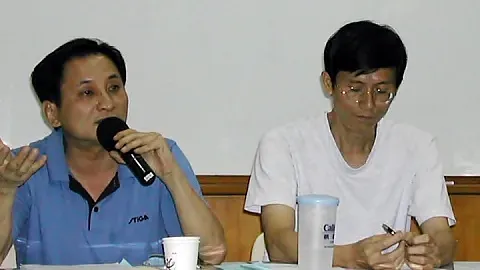
Photo / 2003 JRF Legal Professionals Freshmen Camp; Prosecutor Lai Ching-hsiang is on the left.
To be frank, I hesitated quite a bit before writing this memorial piece. I could hardly claim to know Prosecutor Lai; perhaps he didn't remember me at all. Our only actual meeting and time spent together was just that once. The impression was small, yet profound. Back then, I was a young, newly admitted lawyer with absolutely no clue about my career path. For some reason, I signed up on my own for the Judicial Reform Foundation's 2002 Freshmen Camp. Strangely enough, aside from remembering the sisters Lu Ching and Lu P'ing—who shed heartbreaking tears while speaking about the wrongful execution of their younger brother Lu Cheng—for over a decade, the one thing that has stayed with me is an image of Prosecutor Lai during the camp. He was sharing the feeling of "leading a large group of police officers to ambush a port in order to crack down on drug smuggling, with everyone holding their breath, waiting for his single command to charge." I don't know why, but that image has always stayed in my mind.
Uncompromising Tenderness
I hadn't really thought deeply about why this particular image and feeling stuck with me. Perhaps, in my early twenties, I felt a deep sense of admiration for an impressive prosecutor acting like an urban hero fighting crime. However, the other judicial officers who came with him—Prosecutor Ch'en, Prosecutor Ho, and Brother Shu—were each formidable in their own right.
Sitting in the audience and acting very much like an elementary school student during the lectures, looking at the already well-known Prosecutor Ch'en felt like gazing up at the sky, so brilliantly unsurpassable. Prosecutor Lai had a different style; as soon as class ended, he would freely gather friends to go smoke. As I recall, Prosecutor Ho was a gentle person who spoke less, and Brother Shu was still very young and shy. It was Prosecutor Lai who was lively and generous, chatting casually with everyone while smoking, and even pulling young participants over to talk.
At times, I would doubt whether these memories were merely my own "wishful thinking." It wasn't until last month, when I suddenly learned of his passing and read Professor Wang Chin-shou's memorial article, that I became even more certain his brilliant life deeds coincided with my small yet profound memory.
His life was uncompromising. From cracking the Kuomintang's vote-rigging case during Huang Hsin-chieh's election in Hualien, to joining forces with prosecutors from the Pingtung District Prosecutors Office to root out severe black-gold politics in Pingtung, these accomplishments were unprecedented. He could even step beyond his institutional boundaries to participate in judicial reform. Although none of this endeared him much to his superiors, history has undoubtedly secured his rightful place.
Yet, beyond his unyielding nature, as I carefully recall the feeling of that day in my heart now, it was rather the tenderness he displayed while recounting the moments before the raid. A large group of police officers deeply ambushed, everyone holding their breath, waiting solely for his single command. In my youthful, hot-blooded imagination, it should have been majestic, cinematic, full of murderous aura, and overflowing with dominance, waiting simply for the "boss" to give an order for gunfire to erupt everywhere.
To my surprise, his expression and attitude while speaking were hesitant, worried, and uneasy. He hesitated because the timing wasn't right; he worried about potential casualties among his brothers-in-arms. His unease stemmed from realizing that at that exact moment, he wielded immense power—a matter of life and death in a split second—which demanded the utmost alertness and caution.
Deliberating repeatedly over the timing of exercising power and its possible consequences is a form of uncompromising tenderness. For someone holding power, being unyielding is already no small feat, but pairing it with a cautious, fearful tenderness—walking as though on thin ice—is subtle yet enduring. It is precisely this fleeting moment that can inspire the younger generation, leaving an image in people's hearts that becomes eternal in an instant.
A Group of Prosecutors with Backbone
One imagines that in the post-1990 era when social reform forces began to erupt, it was precisely because of ordinary yet great figures like Prosecutor Lai that Taiwan was fortunate enough to become what it is today. During this period, reading materials commemorating Prosecutor Lai often brought tears to my eyes for reasons unknown. Perhaps it was because I suddenly understood many things—why the prosecutorial system of today is the way it is.
It becomes understandable that the efforts of a group of prosecutors with backbone are perhaps precisely why Taiwan's prosecutorial system did not turn into the nightmare of an emerging democracy: arrogant, overbearing, and uncontrollable. It is also why a few concerted, selfless prosecutors could fight against massive, entangling black-gold networks that no one else dared to touch. Prosecutors can choose not to act, rather than being incapable of acting.
This is why civil society supported grassroots prosecutors back then and was willing to unite against a Ministry of Justice and prosecutorial higher-ups that served the regime. It is also why, based on confidence in reform-minded prosecutors, the public and legislators were willing to expand the powers of the Task Force for the Investigation of Black-Gold Crimes, transforming it into the Special Investigation Division. Only then can one understand why the subsequent downfalls of Chen Tsung-ming and Huang Shih-ming, which successively ruined the reputation of the Special Investigation Division, effectively dashed the lifelong hard work and unblemished reputations of a group of reform-minded prosecutors.
Taiwan is always fortunate to have remarkable individuals who silently shun fame, making it possible to have even the slightest bit of democratic achievement and rule-of-law pride to boast about today. I was too young when these things happened to grasp the context in real-time, but gradually coming to understand these threads makes me all the more grateful and thankful. Prosecutor Lai, many people still remember you, just like the tenderness in my memory from my youth.

This article is an AI-generated translation of the original Chinese text. In the event of any discrepancy, the Chinese version shall prevail.
