
How I Wish the Judges in the Ting Hsin Case Had Taken Bribes
Last edited: 2026-11-04
How I wish the first-instance judges in the "Ting Hsin case" had taken bribes. If so, society's anger would have a justified outlet.
This would be a clear and simple outlet: doubts about the judiciary would be confirmed, and the Ting Hsin Group's wickedness would be compounded. The public successfully "destroying Ting Hsin" would be just around the corner. This would also be an easy and effortless outlet. There would be no need to carefully clarify the prosecutor's scope of indictment, no need to cautiously exclude evidence that should not enter the court, no need to discuss how different procedures should apply to different statuses of witnesses and expert witnesses, no need to waste breath explaining the applicable standards of the Act Governing Food Safety, and no need to painstakingly weigh the probative value of the evidence. Of course, there would also be no need to bother checking whether the judges actually addressed the controversies in their judgments before easily making comments and joining in the dog-piling. One could also shake off those annoying legal terms and useless legal concepts—such as the presumption of innocence, judicial independence, the prosecutor's burden of proof, the principle of conviction based on evidence, strict evidentiary procedures, and criminal versus administrative illegality. If the judges had taken bribes, the difficult problems brought by Ting Hsin's acquittal would be instantly resolved. However, "unfortunately," as of now, there seems to be not a trace of "judges taking bribes." So, shouldn't we first seriously look at and think about what "ghostly nonsense" this judgment is actually insisting on?
Several Controversies
First is the definition of "adulteration or counterfeiting." This is probably the point where the judges have received the harshest criticism from insiders. Because this legislative provision—traditionally interpreted as an "abstract endangerment offense"—usually allows punishment as long as there is an "act," regardless of whether there is a "result." However, the general public interpretation is that the judges seemed to "arbitrarily" add the requirement of a "result"—namely, "likely to be hazardous to human health"—to narrow the scope of application for "adulteration or counterfeiting." Is this correct?
Some object, criticizing this as adjudication that "surpasses the legislator," which is tantamount to altering the statutory "abstract endangerment offense" into a "concrete endangerment offense." Even more severely, some criticize this as "illegal adjudication" because the judges have distorted the law and are not adjudicating in accordance with the law. However, the judges emphasize that such "teleological reduction" did not "alter" the statutory provisions, did not secretly tamper with the law, and did not turn an "abstract" endangerment offense into a "concrete" endangerment offense.
In other words, the judges still consider the statutory provision to be an "abstract endangerment offense." Adding this requirement is actually the judges demanding of themselves that, even when determining "abstract endangerment," they must still make a "substantial" determination and evaluation of "where the danger lies" in each individual case. In plain words, whether an act constitutes "adulteration or counterfeiting" under the "Criminal Code" still requires first determining "what substance" was mixed in, and whether it could possibly be hazardous to the human body? The court's conclusion was that, based on the evidence presented by the prosecutor, it was impossible to prove "what substance" was mixed in. The judges did not say something like "the finished product is harmless, so raw materials can be mixed indiscriminately (the refined feces theory)"; that statement may simply be the imagination of media pundits.
Secondly, the judges were criticized for not treating "raw material oil" as "food" (also accusing the judges of believing that "raw materials can be mixed indiscriminately"). Judging from the judgment, this seems to be a misunderstanding. The judges acknowledged that "raw materials" are also "food" (and therefore naturally cannot be mixed indiscriminately) and must comply with regulations requiring them to be "edible and harmless to the human body." However, the judges emphasized that what constitutes "edible raw materials" lacks a specific and clear definition, requiring the prosecutor to produce evidence proving that the raw materials were inedible (if the prosecutor could prove that feces were indeed added to the raw materials, the judges might have convicted). The reason the judges acquitted was also because they believed the prosecutor was unable to prove this.
Thirdly, the judges explicitly determined that the raw material oil in this case could be ruled out as being "swill oil or recycled oil." Therefore, naturally, there is no issue of whether collecting "swill oil or recycled oil" violates the Act Governing Food Safety. Of course, the judges have their own arguments and evaluation of evidence. Frankly speaking, interpreting the results of food testing is a highly specialized food science judgment, and I believe there will still be plenty of arguing when the case is appealed to the second instance.
Fourth, regarding the heavy metals contained in the raw material oil, the judges believed that the prosecutor's sampling might be problematic, and even if heavy metals existed, the prosecutor was unable to explain how they entered the raw material oil—whether they were "artificially adulterated" or "naturally generated" during the lard extraction process. If it is the latter, and it is proven that they can be removed through a refining process and the finished product stage meets the standards, it seems impossible to incriminate someone.
Fifth, the judges believe that whether it is "edible oil" or "feed oil," it should come from healthy, disease-free pig carcasses. However, the prosecutor was still unable to prove whether the source of the raw material oil was indeed dead-on-arrival pigs or unhealthy pigs. Since the prosecutor made such an accusation, they must be able to provide such proof. Finally, the judges do not deny the importance of "raw material traceability management," meaning that manufacturers should have the responsibility to provide a description of the source of raw materials and guarantee that the source is legitimate, healthy, and meets food safety standards. However, the judges believe that if manufacturers cannot explain or prove the source of raw materials, they may be subject to severe "administrative penalties," but cannot be subjected to "criminal punishment" under the Act Governing Food Safety.
Can Such Standards Be Considered Harsh?
Undeniably, the judges' series of interpretations of the law, choices regarding evidence, and determinations of facts were all very favorable to Ting Hsin. They also excluded several key pieces of evidence obtained by the prosecutor in Vietnam, rejected the prosecution's appraisal report, imposed a quite high burden of proof on the prosecution, and narrowly interpreted the law.
However, upon careful reflection, had the Ting Hsin enterprise not previously erupted in other scandals and almost triggered a comprehensive social and public siege, and even become entangled in political wrestling, the court's judgment probably would not have provoked such public outrage. This reminds me of the sentiments of many drug offense defendants. Sometimes they feel resentful and unjust toward the judiciary because the police, prosecutors, and judges sentencing them do not care at all about their procedural safeguards and the strength of the evidence, simply because they have prior drug convictions. They often say: "Lawyer, to be honest with you, I sold drugs last week, and I might sell them next week, but on the exact days the prosecutor indicted me, I really didn't sell any. When we get to court, the judges still don't pay attention to us, don't care whether there is evidence, and still hand down heavy sentences. No one cares about our procedural safeguards just because we have criminal records."
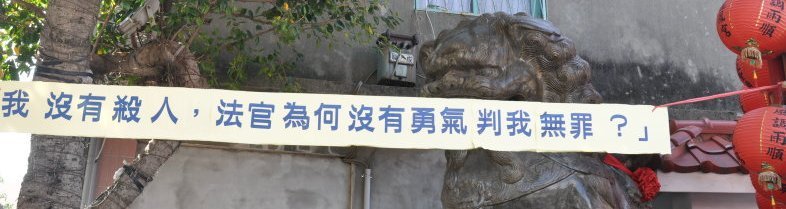 Caption: A banner hung in front of the Lungfung Temple in Chunan, Miaoli, in support of the Chiou Ho-shun case
This is the bad impression our judiciary gives people, a cumulative "collective karma" that we may all have to bear. In other words, we cannot ask the first-instance judges to "return to a low bar" where evaluating evidence and operating procedures are casual and sloppy; rather, we hope that the cases of all ordinary citizens can be "handled by raising them to the same high standard." In all fairness, judging from the context of the entire judgment, the first-instance judges' extraction of evidence, determination of facts, and application of law strictly guarded their stance and offered earnest advice. They provided detailed explanations for areas that might be questioned. A case of such high public interest is not easily acquitted and will surely be subject to strict scrutiny; the judges must have known this in their hearts. To be besieged like this—regardless of whether the prosecutor had sufficiently met the burden of proof—is driven in no small part by the general public reflex of wanting to let people with "criminal records" "escape."
Regardless of Ting Hsin's corporate image, let's discuss the matter on its merits. Even following the logic of the Changhua District Court's first-instance judgment, the standards adopted by the judges are actually not too harsh on the prosecutor. Determining "abstract endangerment" inherently requires "substantial operation," right? Can it really be done just by conjuring up a "feeling of danger" out of thin air? The judges also treated "raw material oil" as "food"; as long as the prosecutor could prove that the raw material oil was any of "swill oil, recycled oil, diseased pigs, or contained heavy metals," they could still have delivered a "fatal blow" to Ting Hsin.
Amidst public fury, what requires the utmost caution is the legal effect of "raw material traceability management." Food safety experts mostly seem to believe that as long as raw material suppliers cannot produce certificates or certification methods, they should be "punished," while overlooking the fact that so-called "punishment" must be further subdivided into two categories. In fact, no one opposes that there should be "punishment"; it's just that the judges believe administrative penalties should be used, rather than "criminal punishment," which should be used with restraint as a last resort. It is as simple as that.
It is just a question of whether the executive branch and honorable legislators—who have always advocated "severe punishment" for the control of high-risk modern society and prefer using "criminal punishment" to deal with all problems—can actually listen to such voices.
※ Original publication source: PNN PTS News Issues Center
This article is an AI-generated translation of the original Chinese text. In the event of any discrepancy, the Chinese version shall prevail.