
Discussing Judicial Reform Based on the Merits
Last edited: 2026-08-30
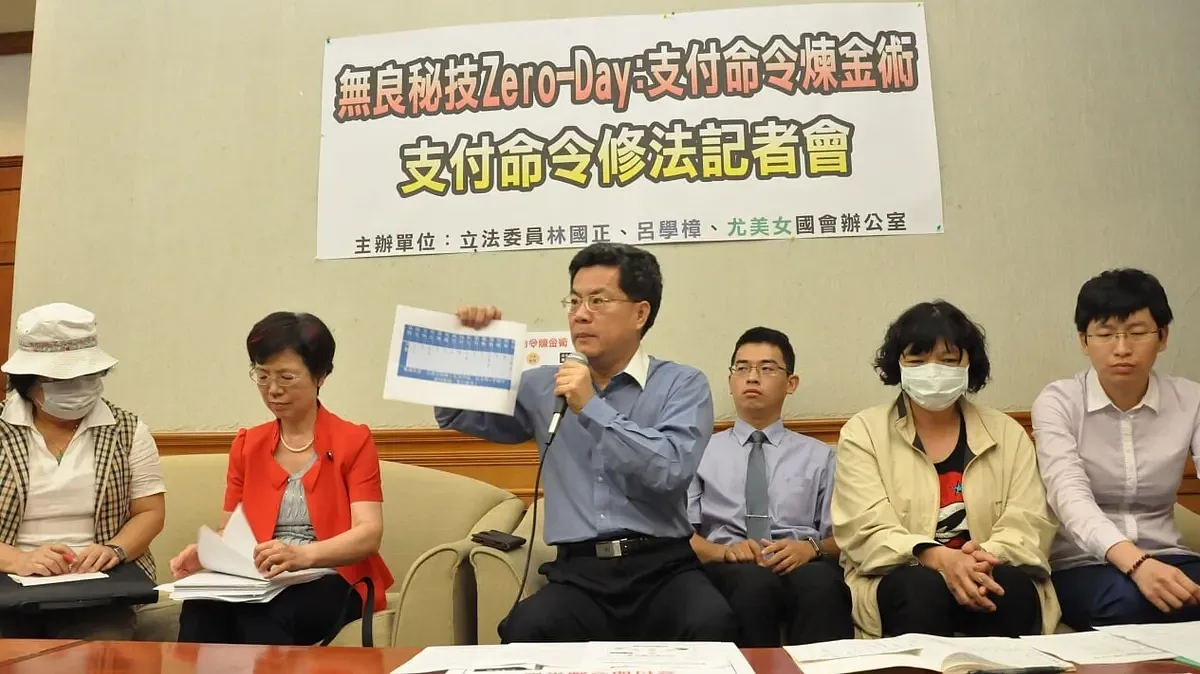
Photo / Joint press conference held with KMT, DPP, and other legislators on June 4, 2015, regarding the amendment of the order for payment
Over the past week, the Judicial Reform Foundation's "Judicial Sunshine Net" has faced heavy criticism, most notably from Prosecutor Chen Jui-jen and Professor Lin Yu-hsiung in their op-eds published on Monday. Unfortunately, the ensuing discussion became increasingly scattered and allowed political rhetoric to overshadow the real focus.
The JRF's stance on the Sunshine Net has been very clear: we apologize for any inaccuracies in the content and ask for your understanding given how difficult it is to gather data, especially regarding prosecutors who have long been largely free from oversight.
Whether unfair reward and penalty records should be displayed in their entirety is open to debate. The Judicial Yuan and the Ministry of Justice's historically unreasonable backlogged-case evaluation methods are the true culprits behind the one-sided distortion of judges' and prosecutors' actual performance. As for the extent to which basic profiles should be established, this too warrants dialogue and discussion; whether gender, judicial training cohort, and birth year should be included remains a matter of opinion. However, if even names and professional backgrounds are to be removed, it signals an unwillingness to accept even the most basic level of information transparency. Aside from these, we have not posted any other personal information, and we have even listened to the suggestions of judges and prosecutors willing to engage in dialogue with us by removing news media reports.
Although we have never met, I hold Prosecutor Chen Jui-jen in the highest regard. The group of reform-minded prosecutors led by Prosecutor Chen has been selfless, externally sweeping away corruption and black gold while internally resisting interference from higher-ups. Sometimes, when hearing friends talk about South Korea—where political and economic development is similar to Taiwan's, yet prosecutors hold overwhelming power and often collude with political forces to strike at political enemies with outrageous conduct—I realize that Taiwan has avoided such a path largely thanks to these selfless prosecutor predecessors who did not seek official promotion, and their contributions must not be erased. Professor Lin Yu-hsiung has long been a master of the Code of Criminal Procedure, and we have often collaborated on advancing legislation; his scholarship and insight are unquestionable.
However, their criticisms may be built on erroneous information or misunderstandings lacking dialogue, and the legislative amendment process mentioned by the two predecessors is worth discussing.
For Prosecutor Chen to speak of "backroom negotiations" is an exaggeration. At least to the knowledge of the author over the past four years, the Judiciary and Organic Laws Committee has been highly professional, and the Legislative Yuan consistently invites the Judicial Yuan and the Ministry of Justice to participate in negotiations. Even for bills proposed at the behest of civil society lobbying, legislators overwhelmingly insist on waiting for official counter-proposals to be released. As for which scholars the authorities or legislators choose to invite for consultation or assistance, that is truly beyond our control.
The Code of Criminal Procedure was jointly proposed by the Judicial Yuan and the Ministry of Justice. In response to President Ma's passage of the two Covenants, the bill was discussed for a full four years and more, spanning at least two Department Directors at the Judicial Yuan and four Department Directors at the Ministry of Justice—particularly the Ministry of Justice, where every time a new official took office, they would disavow the commitments of their predecessors. The bill's discussions repeatedly stopped and started, and the proceedings were severely delayed. With the end of the legislative session imminent, endless waiting was labeled as a "black box," and I truly feel that the legislators exercised remarkable patience and restraint.
Recently, bills initiated proactively by civil society mostly belong to the amendments concerning recording audio discs and orders for payment. Regarding recording audio discs, the Judicial Yuan first unilaterally amended its regulations, banning them on a whim, which prompted lawyers and parties to object and catalyzed the legislative amendments—a process in which Professor Lin was deeply involved. We indeed vigorously promoted the order for payment, but we do not believe it "created more problems"; rather, it truly helps resolve the helpless plight of ordinary people. Dragging the pan-Blue and pan-Green political rivalry into this is even more absurd. Taking the order for payment as an example, it is precisely a model of cooperation between pan-Blue and pan-Green legislators. What is wrong with legislators solving problems for the people?
Following the Sunflower Student Movement, I believe more people are willing to get involved and care about public affairs; remaining indifferent and ignoring issues is equivalent to renouncing one's own civic rights. Legislative amendments inevitably involve political maneuvering, but we are not afraid to cooperate with both pan-Blue and pan-Green legislators. As long as matters are discussed on their merits and for the selfless benefit of the people, they are our partners. Smearing us as pan-Blue or pan-Green—save yourselves the trouble.
※ This article was published in the Apple Daily Forum on November 30, 2015
This article is an AI-generated translation of the original Chinese text. In the event of any discrepancy, the Chinese version shall prevail.
