
Legal Musings on the Ma-Xi Meeting
Last edited: 2026-08-30
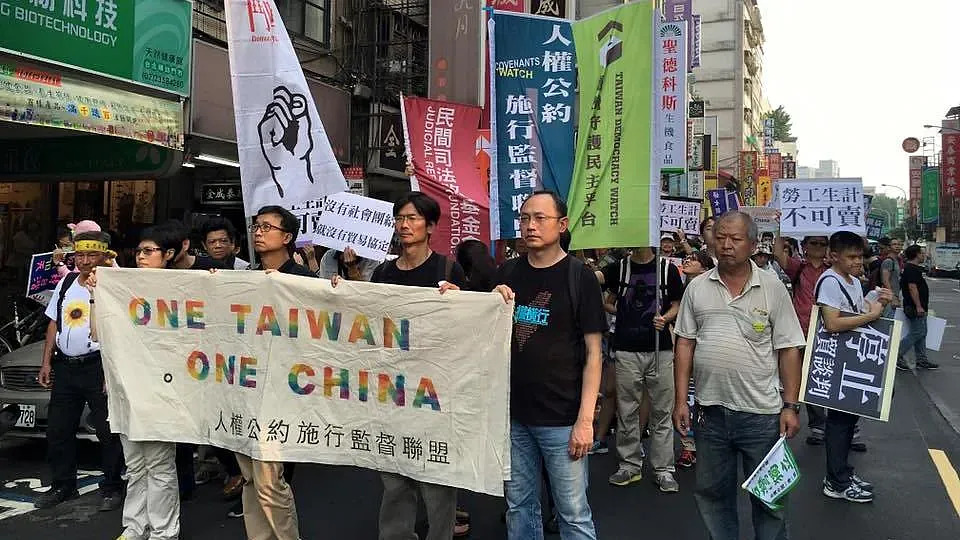
Photo/November 7, 2015: Ma Ying-jeou and Xi Jinping meet in Singapore. On the same afternoon, civil society groups protest in a march in Taipei.
During a freshman constitutional law class, Professor Lin Tzu-yi asked: If you were a national leader and completely certain that taking a specific direction was the right thing to do, failing which the nation would perish, yet the entire populace opposed you, what would you do? This is naturally a tricky question. Normal people that we are, it is difficult to be certain that we are absolutely right, let alone opposing everyone, which borders on the arrogance of 'everyone is drunk while I alone am sober.' Moreover, in the real world, there should also be room for compromise and maneuvering, rather than being inevitably reduced to sharp confrontation.
However, becoming a leader usually requires extraordinary willpower, and people who firmly believe in the correctness of their convictions are everywhere. The professor asked this question to have us self-assess our degree of faith in democracy and whether we would become arbitrary and dictatorial. Furthermore, even if you hold supreme power, are supremely intelligent, and are entirely correct, based on your faith in democracy, would you be willing to walk the path to ruin together with your people? This is truly not easy to answer. I remember struggling deeply inside when I heard this as a freshman, feeling bewildered and half-comprehending—seemingly understanding something about democracy, yet not quite sure.
An Abnormal Country, an Abnormal President
President Ma went to see Xi Jinping. If interpreted solely from the perspective of 'leaders of the two sides meeting, probably no one would object. The real problem is that this 'game' is not that small in scale; it looks much more like a political layout involving China, Japan, the United States, and Taiwan. Small-state diplomacy is not easy and requires treading carefully with the overarching situation in mind. Mr. Ma clearly cares most about himself; such a president lacks vision and stature.
Besides, even if cross-strait issues are to be addressed, President Ma's term is about to end and his public approval is low, meaning his representativeness is already diminished, and the preparatory procedures were completely opaque. Touching upon the sensitive issue of unification versus independence, after listening to the old clichés of the Taiwan Affairs Office, Taiwanese people likely experience a comprehensive sense of 'repulsion.'
I used to hear Professor Lin Shan-tien say that the root of all Taiwan's problems is that it is 'not a normal' country. He was a person of action, so he later went on to found the Taiwan Independence Party. At the time, I always wondered why someone who studied law would want to engage in politics. Moreover, to do so with a high-profile stance on independent nation-building—wasn't that too dangerous? Later, I realized that I had simply been too deeply brainwashed by the Kuomintang, so much so that hearing 'Taiwan independence' triggered a 'built-in' electric-shock reaction.
On the eve of the Ma-Xi meeting, it felt as though President Ma was acting entirely 'sreptitiously' in going to Singapore, and only made a public explanation after being exposed by the media. If the Chinese Communist Party has consistently been the hypothetical enemy that Taiwanese people worry about most—one that might 'destroy the national polity, alter the national constitution, and cause the Republic of China to lose its territory'—Ma Ying-jeou's less-than-open actions truly leave people both suspicious and anxious: will he simply hand Taiwan over to them after the meeting?
The absurdity is that we find ourselves in a situation where legal professionals might argue for half a day over whether to charge him with the crime of internal rebellion or external aggression. Professor Lin Shan-tien was right; Taiwan is indeed not a very normal country. Of course, what is 'proudly' worth noting is that Taiwan has always had its own 'special chapter' in hefty international law textbooks.
Taiwan is truly too special; it meets the definition of a state, yet the government is unwilling to call itself 'China' or the 'State of Taiwan.' The government lacks the willingness to call its own country by its name, a point that foreign scholars find extremely difficult to understand. Instead, we have all sorts of 'status designations' and 'appellations': one moment we are the 'Separate Customs Territory of Taiwan, Penghu, Kinmen and Matsu,' and the next we are a 'fishing entity.' We take a certain smug comfort in this, but in the 'simple' minds of foreigners, it makes us look 'schizophrenic.'
Creating 'International Reality'
Being constrained by 'international reality' is usually an excuse we give ourselves. However, 'international reality' may well be something we create ourselves. Pursuing independence, we dare not and cannot do so thoroughly; seeking unification, we are entirely devoid of imagination. Taiwan is an important economic entity in the world, with a grassroots vitality that continually renews itself; what is frail is the government, which lacks the capacity for comprehensive policy layout and planning.
Think of Scotland, which forced England to go to great lengths just to barely pacify the forces of 'Scottish independence.' Scotland had to be granted its own parliament, its own laws, and complete self-governance. Furthermore, Scotland not only gets to elect its own First Minister, but also has the chance to become the Prime Minister of the United Kingdom. It has its own independent tax revenue and still receives subsidies from the national tax pool. If the Chinese Communists want to talk about unification, they can—if made conditional upon opening up party politics and elections, it remains to be seen who fears whom. All of these can be bargaining chips for Taiwan in negotiations.
Britain's political maneuvering is exceptionally brilliant; in order to maintain unity, it also places great importance on sentiment and emotional comfort. Part of the British flag is a fusion of the Scottish flag, and the royal family even sent a potential successor, Prince William, far away to study at Scotland's oldest university, St Andrews, deliberately fostering greater 'local connections' between the royalty and Scotland—bearing a strong resemblance to the ancient practice of 'Wang Zhaojun sent off to the Huns for a peace alliance.' Does China want to talk idly about 'unification' without paying any price? Resorting only to high-handed coercion will naturally find no market.
Of course, both England and Scotland are democracies, consistent in their institutional framework and territorially connected; changing the status quo is naturally more difficult. Even if President Ma takes 'ultimate unification' as his vocation, he remains an utterly incompetent caller at the negotiating table—overly submissive, failing to defend national interests or uphold democratic institutions, and completely unaware of what he is fighting for.
Perhaps we should have abandoned long ago the illusion of ascribing 'good morality' to rulers, and instead started focusing on the overall institutional design of the state. Professor Chiu Lien-kung has remarked that many high-ranking judicial officials cannot even raise their heads in front of him. The reason is simple: he comes from the judicial circle and has peach-and-plum disciples everywhere; he knows precisely which individuals compromised their principles and committed unseemly acts just to secure official positions, and with his upright and unyielding character, he knows it all.
Rulers often lack good morality; they only ever think of themselves. Only ambition can counter ambition, and only systems can protect the people. Every single Taiwanese person must seriously and solemnly ponder the question of unification or independence with China. They must also recognize that sound institutions alone are our true sanctuary and reliance.

Postscript/In the early morning of November 7, 2015, protesting crowds at Songshan Airport were arrested and taken to the Special Police Corps headquarters. The volunteer lawyer platform accompanied them for questioning until late into the evening.
This article is an AI-generated translation of the original Chinese text. In the event of any discrepancy, the Chinese version shall prevail.
