
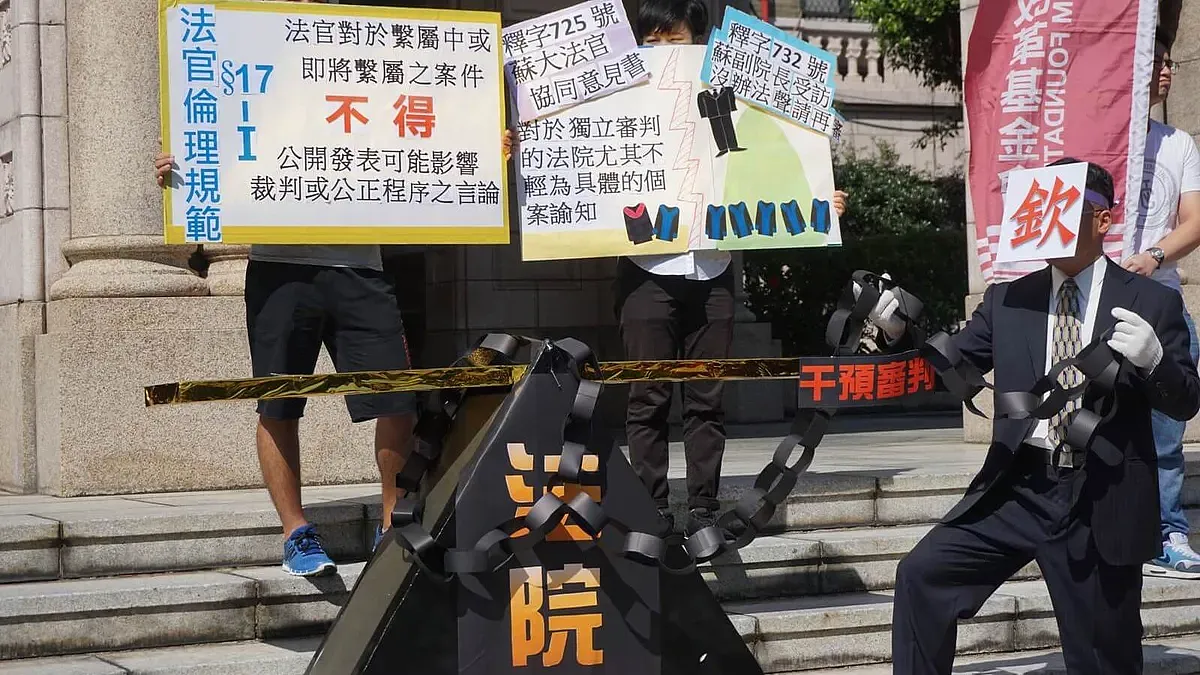
The Grand Justice Who Made His Aides Take the Blam
Last edited: 2026-08-30
Taking the fall for a crime boss is a fast track to rising through the underworld ranks. Grateful for the loyalty, the boss rewards and reuses the subordinate upon release, quickly turning a lackey into a leader. Grand Justice Su Yung-chin was embroiled in a scandal after it was exposed that he secretly modified his opinion after it was published online. Last Friday (10/30) before the weekend, the Judicial Yuan issued a press release "reprimanding the Grand Justices' Secretariat." The implication was that the Grand Justice bore zero responsibility for modifying the opinion post-publication, and if there was any mistake, it was entirely the fault of the administrative staff. How magnificent is our judiciary!
The rhetoric of the press release was intended to make the "aides and assistants" take the blame, and also smacked of a deliberate attempt to fish in troubled waters. The controversy triggered by Grand Justice Su involves three levels. First, can Grand Justices modify their opinions after the fact? Some commentators point out that even the U.S. Supreme Court frequently alters holdings or arguments post-facto. Since individual opinions carry even less legal force, it should logically be permissible. Although other commentators point out that this is inconsistent with our current system, theoretical views remain divided.
I believe that as long as the procedures for publication, correction, and notification are improved, rendered fully transparent and public, and governed by clear rules, the public will not be overly harsh. This is precisely the focus of the Judicial Yuan's press release, yet it "stops right there," concealing other issues it "neither wants nor dares" to address.
Second, if modifications are permitted, what is their permissible scope? The press release dragged in three other Grand Justices to endorse Vice President Su. A detailed comparison reveals that the others either made minor corrections for "clerical errors" or, at most, further supplemented their "original opinions." None of them, like Grand Justice Su, conjured entire paragraphs "out of thin air."
This part conjured out of nothing leads to the third and most important issue: Did the modified portion cross the "unspeakable" red line for Grand Justices? The additional content later written by Grand Justice Su is entirely a judgment concerning the specific case of "Mei Ho City." Setting aside whether one can "discuss individual cases," let us simply apply the words that Mr. Su himself once "coolly" stated in Interpretation No. 725: "(Grand Justices) shall not make any description or response regarding the applicant's claims, nor shall they provide any explanation regarding the underlying case that triggered the initiation of proceedings." Mr. Su owes the public an apology for violating the principle of estoppel.
The Judicial Yuan's press release answered only the first question while evading the second. Furthermore, the third question crossed a red line, which is the primary reason Grand Justice Su should resign and step down. Even more pathetically, after damaging the environment for fair trials in ordinary courts, he treated the "judges" detailed to the Judicial Yuan like lackey subordinates, subjecting the judiciary to yet another round of humiliation.
This article is an AI-generated translation of the original Chinese text. In the event of any discrepancy, the Chinese version shall prevail.
