
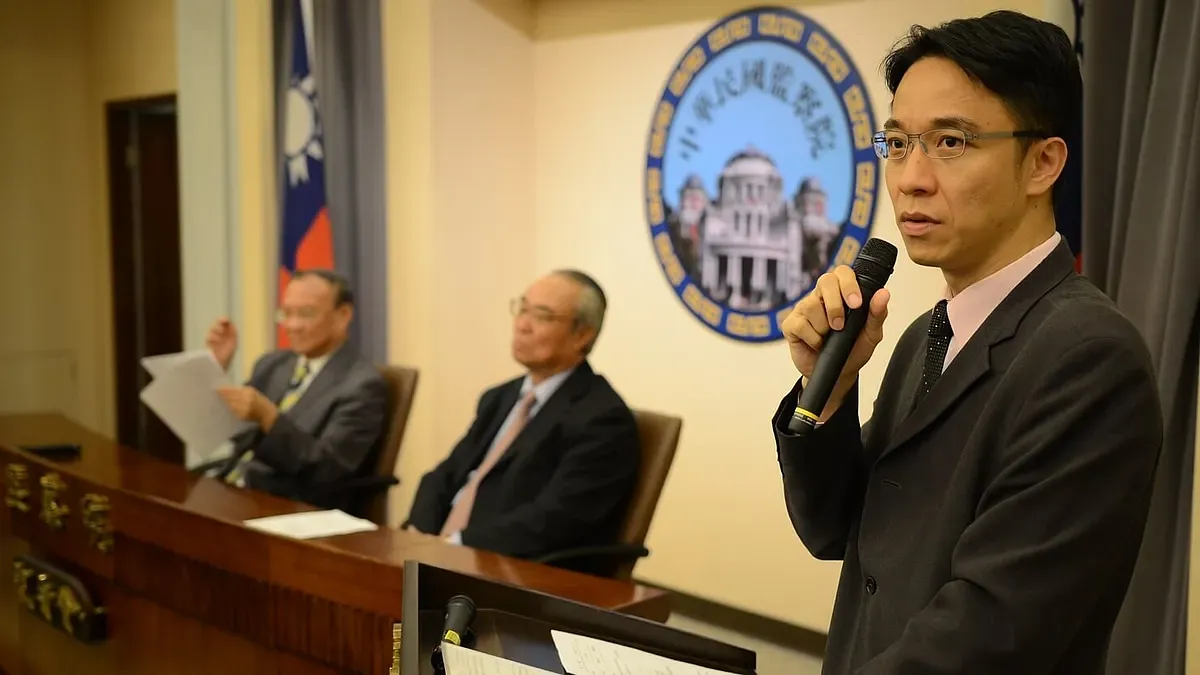
When the Ministry of Justice Squares Off Against the Control Yuan
Last edited: 2026-07-27
The escape of "big fish" criminals has always been a pain point for Taiwan's justice system. The public always expects that if the government makes a mistake or if there are loopholes in the system, it is fine as long as they correct it or take remedial action. However, high-profile figures keep fleeing one after another—Wu Tse-yuan, Lo Fu-chu, Ho Chih-hui—each leaving a deep, unforgettable, and infuriating impression on the public. One must ask, how can the image of the judiciary ever improve?
Recently, the Control Yuan issued a corrective measure against the Ministry of Justice (MOJ), holding the MOJ responsible for the flight of former Tainan County Council Speaker Wu Chien-pao and former Ruifang Mayor Liao Hsiu-hsiung after their convictions, and even demanding disciplinary action against three prosecutors. Unexpectedly, the MOJ launched a massive counterattack, issuing two press releases in a single day filled with sarcastic and aggrieved tones, even invoking the "Excellencies" of the Control Yuan members—how ironic! Reading through it all, one truly feels a sense of sorrow. The public, witnessing the prosecutorial system's self-protective and hypocritical reactions, must be the ones truly feeling pained and aggrieved.
The Public Cares Not for Black Cats or White Cats
We can agree that some of the MOJ's defense arguments are reasonable. Under the current system, a window indeed exists between the finalization of a judgment and its execution, giving criminals an opportunity to flee, which is not entirely the fault of the MOJ. However, we truly cannot condone the attitude of the MOJ, which projects an image of "the fault lies entirely outside of me," evoking a profound sense of sorrow.
Black cats or white cats do not matter; the public only cares about where to find a "good cat" that catches mice. The MOJ clearly does not believe this is a role it should play. By implication, the MOJ believes this should be "entirely" the responsibility of the Judicial Yuan. If that is the case, the press release should have just stated it clearly and directly replied that the Control Yuan targeted the wrong entity, since it has nothing to do with the MOJ anyway! Any faults would simply be the Judicial Yuan's faults.
Yet, on the one hand, the press release argues that prosecutors determined Wu Chien-pao would not run, and thus did not initiate anti-escape measures against him—doesn't this admit that they bear responsibility as well? Are they merely arguing that even if they messed up this time, it cannot be considered a fault? Furthermore, the MOJ even dragged in the excuse that it oversees 130 agencies and over 16,000 colleagues, making it an "impossible mission" for the MOJ to manage individual cases.
Such shrugging-off of responsibility leads the public to conclude that the MOJ might as well be disbanded, since it neither wants to do anything nor can do anything right. Can a majestic Ministry of Justice really respond in this manner? The public's expectation is that even if it is not entirely within the MOJ's scope to handle, it is an old problem after all, and they should at least be proactive, talk to the Judicial Yuan, and brainstorm a proper solution.
Moreover, to be completely honest, if the issue is about amending the Code of Criminal Procedure, the main reason it gets blocked in the Legislative Yuan and fails to pass through cross-party negotiation is largely due to the MOJ itself! Besides, as the Control Yuan members also noted, the Judicial Yuan should likewise face this issue and devise feasible improvement measures. To put it bluntly, in the eyes of the public, it does not matter whether the problem lies with the MOJ or the Judicial Yuan; they just want them to coordinate quickly and catch the mice, and only then will the public applaud. If the black cat passes the buck to the white cat, and the white cat shifts the blame to the black cat, neither is a good cat.
The Control Yuan's Spinelessness Reaffirms Defective Constitutional Design
If there had been genuine and proactive efforts toward anti-escape measures, the public would not be overly harsh even if a criminal actually managed to escape. But the public's most visceral feeling is precisely this institutional-centric attitude of the MOJ: passing the buck, dodging twice, and three times shirking responsibility. While the initiative over finalized judgments certainly rests with the courts and the MOJ can only passively cooperate, this does not mean it cannot actively coordinate. Demonstrating to the public the MOJ's minimum sincerity in attempting to solve the problem should not be very difficult.
The fundamental problem behind the Control Yuan getting battered back by the MOJ this time is perhaps its misguided belief that "initiating anti-escape mechanisms" can solve all problems, leading it to demand that the MOJ strengthen measures related to anti-escape mechanisms—when in reality, police manpower is simply unable to bear the load. Because the press releases offered no substantive response, we have no way of knowing whether the MOJ shares the same misconception.
In truth, whether someone will run is primarily determined by whether they "have the capability to run." Ordinary criminals lack the capability even if they want to run, whereas what the public cares about most is when powerful and influential individuals commit crimes and are still able to escape judicial sanction. The MOJ and the Judicial Yuan should be able to "categorize" certain "high-risk" types so that resources can be concentrated for monitoring.
Of course, to some extent, the courts must also begin to contemplate how to improve the bad habit of pronouncing only the main text of a judgment during sentencing, thereby shortening the window between the finalization of a judgment and its execution. Furthermore, if the Supreme Court is not strictly limited to a retroactive review of questions of law, it might need to hold hearings for sentencing. The MOJ and the Judicial Yuan truly have far too many areas for discussion, coordination, and improvement.
Regardless, the Control Yuan has once again proven to be a defective constitutional design, possessing no other weapons to cope with the MOJ's nearly humiliating rebuttal. It seems it might as well be abolished, reverting afterward to the Legislative Yuan so that legislators simultaneously exercise the powers of hearing, investigation, impeachment, and budget, sparing it from always being mocked as a "steamed-tea" [a pun on the Chinese characters for Control Yuan, sounding like 'tea-straining'] yuan that can neither strike tigers nor swat flies.
Further Reading
- 2015/10/14 Control Yuan Press Release Major political and business criminals Wu Chien-pao, Liao Hsiu-hsiung, and others fled after being convicted and sentenced by the court; numerous derelictions of duty found on the part of the MOJ, Taiwan High Prosecutors Office, and Keelung District Prosecutors Office; Control Yuan passes investigation report and corrective measure
- 2015/10/16 Ministry of Justice Press Release Earnestly Requesting the Control Yuan to Judge Fairly
- 2015/10/16 Ministry of Justice Press Release Earnestly Requesting Control Yuan Members Not to Act as Vanguards for Populism
This article is an AI-generated translation of the original Chinese text. In the event of any discrepancy, the Chinese version shall prevail.
