
Protecting Prosecutors or Harming Them?
Last edited: 2026-07-27
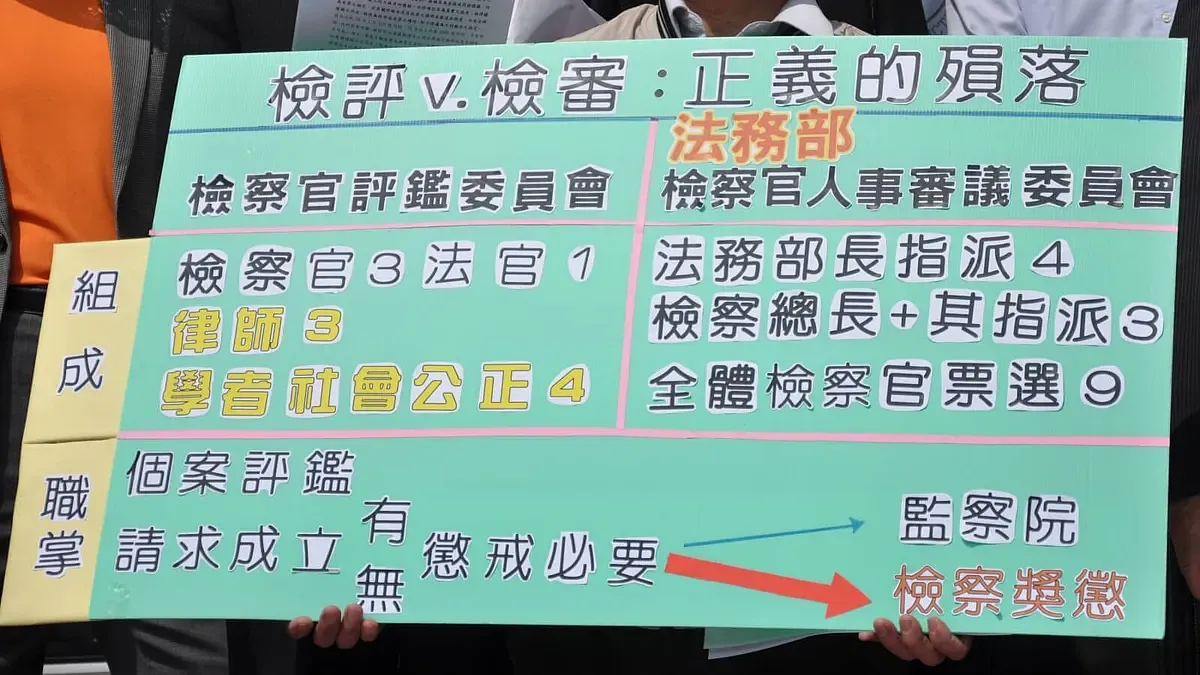
Recently, citizens filed complaints with the JRF against two prosecutors. In one case, the Prosecutor Evaluation Commission (established after the passage of the Judges Act, primarily responsible for the removal of incompetent prosecutors) directly dismissed our claim, holding that our arguments lacked merit. In the other case, the commission found merit in the complaint, but deemed the circumstances not severe enough to warrant referral to the Control Yuan, choosing instead to hand the matter over to the Ministry of Justice for disciplinary action. Unexpectedly, the Prosecutor Review Committee within the Ministry of Justice (traditionally housed within the Ministry to review personnel matters such as promotions and disciplinary actions for prosecutors) rejected the commission's decision, resolving not to impose any disciplinary action.
To be clear, the author has no intention of continuing to 'hunt down' these two prosecutors; their actions may have been flawed, and perhaps there were extenuating circumstances. In fact, when our internal review panel discussed these two cases, we also felt that the circumstances were not particularly severe. Even if the final outcome had been the mildest form of discipline, everyone would have found it acceptable. However, the attitudes and methods with which the Prosecutor Evaluation Commission and the Ministry of Justice's Review Committee responded were deeply frustrating, forcing us to ponder when a system and culture where prosecutors' powers match their responsibilities will finally be established.
We are uncertain whether prosecutors, emboldened by the successive endorsements from the Prosecutor Evaluation Commission and the Ministry of Justice Review Committee, will turn around and eloquently defend their own or their colleagues' actions, or even continue to attack the JRF's 'substandard' evaluation criteria. What we can be sure of, however, is that if this attitude persists, it will inevitably provoke even greater public anger toward the prosecutorial system. If this vicious cycle continues, is this ultimately an act of protecting prosecutors or of harming them?
Public Anger Will Find Its Own Outlet
When the public is dissatisfied with prosecutors, they seek out avenues to complain everywhere. Effective channels are scarce, and while evaluating prosecutors has a low success rate, it remains one of the few viable methods. If the Prosecutor Evaluation Commission eventually becomes as useless as a chicken rib due to insufficient budgets, inadequate staffing, and the passive resistance of the Ministry of Justice, it will lose its meaning over time.
When paths within the system fail, people turn outside the system. Public anger toward the judiciary may turn into exposing scandals to the media and talk show pundits, or shift into political complaints and street protests. Taiwan is already an open society, and public discourse will inevitably find an outlet. The most feared scenario is the accumulation of pressure bursting all at once, leading to unpredictable consequences. Hasty or impulsive legislation and institutional reforms tend to inflict collateral damage without benefiting anyone.
 The Prosecutor Evaluation Commission, which began operations on January 6, 2012, is 'parasitic' within the Ministry of Justice, sharing its power. It has the authority to prevent individuals from serving as prosecutors and even strip them of their civil servant status. It was originally imbued with high hopes from all sectors for supervising and reining in prosecutorial power.
We have long and repeatedly criticized that, due to the intentional or unintentional marginalization by the Ministry of Justice, the Prosecutor Evaluation Commission is forced to operate at a minimal level. Tied down by rigid regulations, lacking both personnel and funds, devoid of proactive investigative powers, and strictly bound by the rule of 'no petition, no action,' it is simply asking too much to expect the part-time commissioners to draft resolution documents entirely on their own from start to finish and still perform efficiently.
All these systemic dilemmas persist simply because high-ranking prosecutors refuse to take them seriously, ensuring that no one feels accountable. The underlying logic is perhaps not hard to understand: if the Prosecutor Evaluation Commission might cause trouble for prosecutors or even high-ranking Ministry of Justice officials (such as the past precedents of Huang Shih-ming and Chen Shou-huang), the Ministry of Justice naturally would not want this 'trouble' to grow and 'thrive.' This is the primary reason we have consistently argued that the Prosecutor Evaluation Commission should be independent of the Ministry of Justice. (Naturally, even the better-functioning Judges Evaluation Commission should be independent of the Judicial Yuan.)
At the same time, the operations of the Prosecutor Evaluation Commission suffer from numerous problems. In addition to self-limiting the scope of its investigations and reviewing evidence behind closed doors, it sometimes adopts standards that outsiders find difficult to comprehend, denying petitioners any opportunity to express their views during the process. The result of a complete lack of proper dialogue dooms all parties to live in 'parallel universes,' often leading to a situation where everyone simply talks past one another.
We must ask: if even a reasonably professional petitioning organization for evaluations finds it difficult to understand the commission's standards and is utterly unable to offer any further input during the investigation, does the Prosecutor Evaluation Commission truly care about the feelings of ordinary citizens? Does it possess the capacity to fully respond? Can it empathize with the anguish of ordinary citizens who muster the courage (as not everyone dares to offend officials) to file complaints against prosecutors?
We do not know what other petitioning organizations think, but at least as far as the JRF is concerned—despite being the entity that refers the highest number of cases involving judges and prosecutors—we truly do not wish to 'enjoy' this 'referral right.' Historically, the JRF's vision for the evaluation system, as reflected in the draft of the Judges Act, never included such a design.
The evaluation commission we look forward to is one that can 'face-to-face' with the public, personally listening, observing, feeling, and breathing in the sense of grievance experienced by petitioners who have been unjustly treated by the judiciary, rather than having a 'firewall' standing in between. Perhaps after personal contact with the public, their responses to the people's earnest expectations would no longer feel so ethereal and detached, and they would no longer dare to resort to bureaucratic jargon and empty rhetoric.
Taking one of the cases as an example, a prosecutor summoned a person and, during the interrogation session, dismissed the defense counsel, allowing that person to meet privately with the defendant. This defendant was clearly placed under detention and communication ban by the court, meaning they were explicitly prohibited from having private contact with anyone. Is such an 'investigative' procedure not bizarre? Even if the prosecutor considered this an 'investigative technique,' they should have handled it openly and honestly. Why did they not dare to record in the roll call sheet, case handling sheet, or even the trial transcript that such a person had been summoned and that such an event had occurred?
A lack of transparency fuels public suspicion regarding prosecutors' fairness. Strange procedures are also entirely reasonable grounds for doubt. The Prosecutor Evaluation Commission offered a deeply ambiguous legal opinion, stating that whether a defendant subject to an incommunicado detention order during an investigation can meet with specific individuals 'might' be within the prosecutor's purview. Perhaps so, but the prosecutor should have simply recorded it transparently. In any case, we, in our superficial learning, had never even imagined such an interpretation by the commission. Combined with the lack of an opportunity to respond, how can this possibly be considered a sound procedure?
Had we been mistaken about the facts, we would have withdrawn the request—such precedents do exist. Civil society organizations lack investigative powers, so factual errors are inevitable; however, dismissing a case without proper disclosure of information is something no one can accept. (How am I supposed to know whether you actually investigated, to what extent you investigated, or whether the direction of your investigation aligned with our petition?)
Legal interpretations are precisely what require an exchange of views, especially controversial ones. By denying any opportunity to respond, doesn't the commission make it blatantly obvious that it does not want its legal interpretations to be challenged? After all is said and done, receiving a bizarre and ambiguous rationale leaves one feeling as bitter as swallowing coptis root in silence. Who could possibly swallow such a grievance?
Can the Ministry of Justice Review Committee Overrule the Prosecutor Evaluation Commission?
Aside from the poor efficacy of the Prosecutor Evaluation Commission, the Ministry of Justice's culture of 'leniency toward oneself and turning a deaf ear to the outside world' is also hardly commendable. For instance, in another case where the commission determined that disciplinary action was warranted and referred the matter to the internal Prosecutor Review Committee of the Ministry of Justice, how could the Ministry's committee possibly overturn the commission's decision?
Strictly speaking of reason, if the Prosecutor Evaluation Commission includes external members, it should possess a higher basis of representation and legitimacy compared to the Review Committee, which is composed entirely of prosecutors from within the system. The resolutions of the commission should, in principle, be respected. Unless the facts or evidence resolved by the commission contain obvious and material errors, the Ministry of Justice Review Committee's decision to overturn it holds very little justification.
Otherwise, if the Ministry of Justice can arbitrarily overturn the commission's resolutions, one truly wonders why we went to such great lengths to pass the Judges Act, establish the Prosecutor Evaluation Commission, and have commissioners spend so much time deliberating—what was the point of it all? Are we simply returning to the old ways, where the Ministry of Justice controls everything?
Brushing off the commission and ignoring external skepticism might be one thing, perhaps the Review Committee genuinely held different findings of fact. But if it intends to overturn the commission's findings on that basis, shouldn't it attach specific reasons? Shouldn't it make them public? (Is it right to keep resolutions unpublished while leaking statements through the media?)
Then again, the Ministry of Justice directly 'slapped the face' of the Prosecutor Evaluation Commission, yet the commission simply 'swallowed it'? Did the commission not need to track progress or demand a reply from the Ministry? Did it not need to direct the Ministry to reply to the applicant, or reply to the applicant itself upon receiving the Ministry's response?
All of this is merely muddling through. Even more unacceptable is that the Ministry of Justice Review Committee would rather violate the law by refusing to make public its meeting minutes and resolution process, yet gladly leak an exclusive story to Apple Daily, allowing a reporter to write a 'sponsored article.' The article briefly mentions the outcome of the resolution (is this considered a 'public resolution'?), and then emphasizes how heinous the defendant's behavior is, dragging out the facts of a legally finalized conviction to 'lash out fiercely.'
Between the lines, the message is clear: the media and public opinion 'support' prosecutors, the defendant is the 'bad guy,' and that is all that matters. The division of powers and responsibilities between the commission and the Ministry of Justice Review Committee does not matter! Whether there was any significant inconsistency in their factual determinations of the prosecutor's conduct that needs disclosing does not matter! How to respond to the public's complaints does not matter! None of it matters; only the prosecutor matters, and they cannot be wronged even in the slightest. 'Must we really wrong a diligent prosecutor for the sake of those bad guys?' This is perhaps the true message that report intended to convey.
If this vicious cycle continues, it will only sacrifice the entire evaluation system along with the reputation of the Ministry of Justice. While it may feel like 'protecting' prosecutors in the short term, in the long run, such misguided affection will ultimately harm them. The saying 'the people do not fight with officials' will continue to be passed down. Protect prosecutors, or harm prosecutors.
This article is an AI-generated translation of the original Chinese text. In the event of any discrepancy, the Chinese version shall prevail.
