
The New President's Soft Target—Judicial Reform
Last edited: 2026-07-27
Looking ahead to the 2016 presidential election, the candidates boil down to just a few familiar faces. Regardless of whether it is Hung Hsiu-chu, Tsai Ing-wen, James Soong, or another dark horse, whoever takes office will likely want to forge a new path and enact fresh policies. While everyone knows reform is difficult, a closer look reveals that judicial reform may actually be the easiest "soft target" for the incoming president: it easily garners public support and commands high legitimacy; the judiciary is plagued by problems, making minor fixes great for one's reputation; and as a purely domestic affair, there is little room for Beijing or Washington to meddle.
Reflecting on past presidents, why did failures predominate? In the era of Lee Teng-hui, one could at least say that sweeping strides were made; political systems, democracy, and freedom flourished in tandem with the lifting of martial law. Chen Shui-bian's era marked the first party rotation in power, inheriting the spirit of the 1999 National Judicial Reform Conference, which seemingly held great promise. However, as his personal charisma gradually faded and he became mired in his own lawsuits, his political capital for pursuing judicial reform steadily diminished. By Ma Ying-jeou's era, cross-strait relations and the economy took center stage; judicial reform was almost exclusively equated with government integrity and anti-corruption, lacking a focus on core judicial activities. The emphasis was placed on the honesty of civil servants and the integrity of the public administration system. Consequently, more and more benchmark public officials became implicated in corruption, anti-corruption efforts became worthless, and judicial reform had little to show for itself.
Deep-Seated Judicial Problems
In fact, judicial problems are notoriously difficult to resolve for many reasons. Foremost is their inherent nature of demanding "independence and freedom from interference." Under the principle of judicial independence, tidal waves of public opinion can hardly penetrate the inner workings of judicial organs through elections or mass pressure to forcefully turn things upside down.
Unlike "eternal delegates" of the National Assembly who could be voted out, or administrative heads who lose elections when they fall out of favor with the public, judges and prosecutors hold lifetime tenure, making them difficult to weed out. This also means that transitional justice in the judiciary is inherently more difficult and complex than in other departments. The tension between political accountability and judicial independence is, from the outset, an eternal dilemma.
When politics lacks clarity, higher political accountability only deepens the harm caused by inappropriate political interference in the judiciary. Conversely, when the judiciary lacks justice, higher independence only amplifies the extent to which judicial abuse of power infringes upon people's rights. Beyond these intrinsic dilemmas, there is also the lingering, unresolved legacy of the division of power and turf wars between the Judicial Yuan and the Ministry of Justice that has persisted since the "separation of adjudication and prosecution" in 1980.
Judges and prosecutors inherently serve different functions in litigation. Different positions and roles naturally give rise to different trains of thought over time, leading to divergent behaviors. Between the Executive Yuan—represented by the Ministry of Justice—and the Judicial Yuan, inter-institutional disputes and stalemates frequently arise, stemming either from differing visions of an ideal system or from the necessity of competing for resources and shedding heavy workloads.
Magnifying the entire landscape of judicial reform, judicial personnel matters involve the examination, recruitment, and tenure protection of judges and prosecutors, as well as inequalities regarding high retirement and pension benefits compared to other civil servants. Consequently, the Examination Yuan frequently comes into conflict and opposition with the Judicial Yuan and the Ministry of Justice.
If we factor in the examination system, education within university law departments is bound to undergo reforms. Not to mention issues such as the training and cultivation of criminal investigators, reforms to the forensic autopsy system, and the downsizing or transformation of the Investigation Bureau. The issues are deeply intertwined; pull a single hair and the whole body moves.
A Presidential-Led Judicial Reform Committee
Precisely because these issues are so intricate, despite no shortage of reform-minded administrators over the years, more than a decade since the 1999 National Judicial Reform Conference, people still feel at a loss and incapable of providing strong leadership. The resulting outcomes—if not paralyzed by the departmentalism of various organs—tend to be nothing more than fragmented, piecemeal reforms that treat the head when the head aches and the foot when the foot hurts.
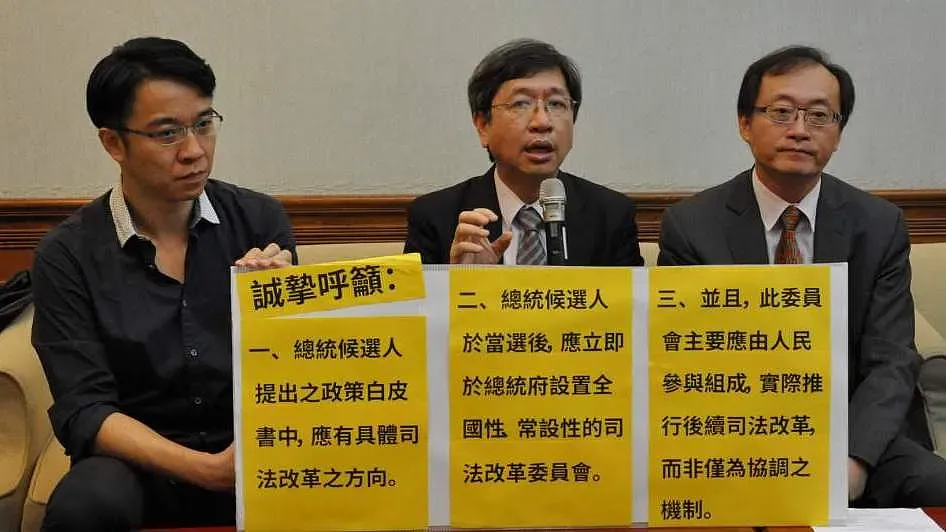
In fact, the most profound lesson taught to us since 1999 is that because the issues of judicial reform are deeply intertwined, mutually influential, and pull-a-hair-and-move-the-whole-body, they can hardly be handled seamlessly or holistically by a single agency like the Judicial Yuan, the Ministry of Justice, or the Examination Yuan alone. If the president could consider establishing a national, continuous Judicial Reform Committee under the Office of the President, widely incorporating broad public participation, gathering opinions from all sectors for discussion and decision-making, and utilizing the president's high standing to coordinate and practically implement subsequent judicial reform initiatives, this might just prove to be a method worth trying.
Of course, whether this committee can become a formal organization, and whether it will once again spark controversies over the separation of powers with the Judicial Yuan and the Ministry of Justice, still require discussion and resolution. However, even if its institutional character is merely an advisory unit under the Office of the President, as long as the president is willing to personally participate or invest considerable political will, there will undoubtedly be significant progress in policy consistency and coherence. Consequently, the thorough implementation and execution of judicial reform will become something we can look forward to with a bit more hope.
This article is an AI-generated translation of the original Chinese text. In the event of any discrepancy, the Chinese version shall prevail.
