
【Legal Life】Ch 1: What to Do in a Car Accident?
Last edited: 2026-08-31
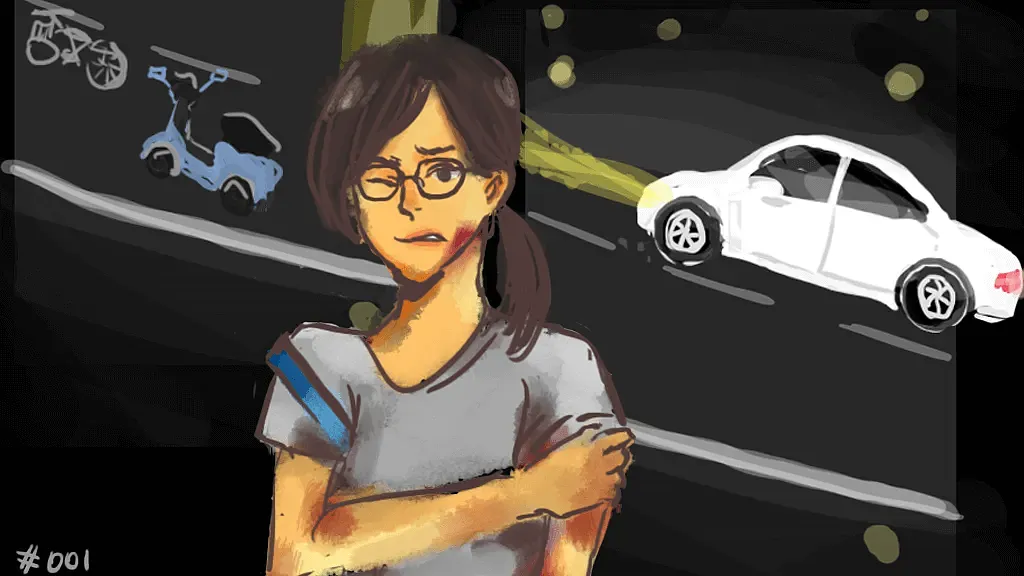
"Ugh..." Chieh-yun gritted her teeth and pushed herself up with both hands, only to feel a stinging sensation reminding her that her hands and feet were caked with dirt from the ground and dark red blood oozing continuously from her wounds. Raising her head, Chieh-yun saw an elderly woman lying unconscious not far ahead, prompting her to push past the pain and hurry over in concern. "Granny! Granny!" Chieh-yun called out, but the elderly woman was already unconscious and unresponsive.
Tonight, as usual, this stretch of road was pitch black. Streetlights were spaced far apart, still insufficient to illuminate the road swallowed by the dark night. Especially on a moonless and windy night like this, the range of visibility projected by vehicle headlights felt utterly meager. Naturally, this was the mandatory route Chieh-yun—a senior law student—had to take when riding her scooter back to the university dormitory after finishing her shift at the beverage shop.
Long accustomed to this road condition, Chieh-yun rode on as usual against the cool breeze, softly humming her favorite song and enjoying the moment of solitude with herself. As she rode, the back of an elderly woman pedaling a bicycle slowly appeared in Chieh-yun's field of vision, causing her to ease up on the throttle and close the distance between them.
Suddenly, the shrill roar of an engine and blinding white headlights rushed toward them from the front. A white sedan sped furiously past Chieh-yun and the elderly woman. Whether due to nervousness and losing balance, or from being grazed by the car, the elderly woman toppled toward Chieh-yun's scooter, causing both of them to crash heavily to the ground. However, the car did not stop; the sound of the engine gradually faded away into the distance, leaving behind only the road's original gloom and silence, alongside the fallen Chieh-yun and the elderly woman...
Issue Formulation: What constitutes a hit-and-run? What should you do when involved in a traffic accident?
Article 185-4 of the Criminal Code: "A driver who flees after causing a traffic accident involving a powered vehicle that results in injury or death shall be sentenced to imprisonment for not less than one year and not more than seven years."
As can be seen from the statutory text, establishing the offense of hit-and-run under the Criminal Code requires meeting the following conditions:
-
Driving a "powered transportation vehicle"
The perpetrator must be driving a vehicle propelled by electricity or engine power. Regardless of whether it is a diesel, gasoline, or electric car, scooter, or bicycle, they all fall under the "powered transportation vehicle" referred to in the provision. Conversely, if the vehicle is a non-electric pedal bicycle, oxcart, or horse-drawn carriage, it naturally falls outside the scope of application of this Article.
-
"Causing injury or death in a traffic accident"
This refers to the driver of a vehicle causing another person to suffer injury or death (regardless of whether the driver was at fault).
-
"Fleeing"
This means the driver, after a traffic accident occurs, fails to remain at the scene to handle the situation and instead leaves.
In short, objectively speaking, as long as a traffic accident occurs while driving or riding a vehicle, resulting in someone's injury or death with a causal link between the two, one must remain at the scene and not simply leave—regardless of whether one is at fault—otherwise, a crime is committed. Furthermore, this offense belongs to the category of crimes subject to prosecution without a formal complaint (non-complaint-based offense), meaning even if the other party does not wish to press charges, the police may still come knocking. Naturally, the legislative purpose of this provision is to require drivers to provide assistance to injured parties and ascertain relevant responsibilities following a traffic accident. If a driver immediately drives to transport an injured person to a hospital or leaves the scene to call the police from a nearby public phone upon discovering the accident, they shall not be deemed to have committed a hit-and-run.
Additionally, it is worth noting that the offense of hit-and-run requires as a prerequisite that the driver knows the fact that a traffic accident has occurred resulting in injury or death. If the driver is completely unaware that they have caused an accident resulting in someone's injury or death, it is naturally difficult to expect "immediate handling," thereby lacking the intent to commit a hit-and-run. In practice, however, a strict standard is adopted regarding a driver's claim of "unawareness of the accident." In other words, without concrete, credible reasons and objective evidence, it is difficult to shirk responsibility using "unawareness" as an excuse.
Moreover, if someone flees the scene after causing injury or death, apart from criminal liability, administrative liabilities such as the revocation of one's driver's license will also apply pursuant to Article 62 of the Road Traffic Management Penalty Act. Conversely, if a hit-and-run occurs when the accident causes property damage only without any casualties, although it does not constitute the criminal offense of hit-and-run, the driver's license may still be suspended for one to three months.
From the above explanation, as long as an accident results in someone's injury or death, regardless of who is right or wrong, do not immediately start the engine and drive away. The following scenario frequently occurs in practice: for instance, after a traffic accident, people check the other party and see only vehicle damage with no personal injuries, or only minor scratches as if it were no big deal. Both parties exchange remarks like "it's nothing," and then go their separate ways, only for the police station to notify them shortly after arriving home that they have committed the crime of hit-and-run! That is truly unjust. After all, some bodily injuries caused by traffic accidents do not manifest immediately, and the other party may realize the gravity of the situation only after returning home, or they may simply wish to demand exorbitant compensation. Therefore, when a traffic accident occurs, handling it in accordance with the "Regulations for Handling Road Traffic Accidents" is the most effective way to protect one's rights.
What Should You Do When Involved in a Traffic Accident?
Traffic accidents covered by the Regulations for Handling Road Traffic Accidents are broader than the hit-and-run offense under Article 185-4 of the Criminal Code. Besides vehicles running on roads and causing injury or death, ordinary vehicle or property damage also falls under the application of these Regulations.
Article 3 of these Regulations stipulates how drivers should handle situations after a traffic accident occurs. First, situations can be simply divided into two categories: "with casualties" and "without casualties."
-
When there are casualties
- Promptly provide rescue and medical aid to the injured, and notify the fire authorities.
- Notify police authorities.
- Erect a vehicle breakdown warning triangle or other prominent warning facilities at an appropriate distance until the accident scene is cleared.
- Do not arbitrarily move the vehicles involved in the accident and the physical evidence at the scene; however, if all parties involved agree to move the vehicles, they must first mark the positions of the vehicles and the evidence at the scene before moving the vehicles to a location that does not obstruct traffic.
-
When there are no casualties
- Notify police authorities; however, if there are no deaths or injuries and the parties reach a private settlement on the spot, notification is not required.
- Erect a vehicle breakdown warning triangle or other prominent warning facilities at an appropriate distance until the accident scene is cleared.
- If there are no casualties and the vehicles are still operable, the parties must first mark the positions of the vehicles and the physical evidence at the scene before moving the vehicles to a location that does not obstruct traffic.
How to Handle Subsequent Matters After a Traffic Accident?
If one day you suddenly receive a notice from the police authorities to investigate a hit-and-run case, pursuant to Article 5 of the Regulations for Handling Road Traffic Accidents, the vehicle owner must report to the scene to provide explanations on the specified date and time. If the license plate number recorded on the notice belongs to your vehicle, but the car was not driven by you, you should also provide the police authorities with the relevant information of the vehicle driver. Failing to appear for an explanation or to provide the driver's information may result in the suspension of the vehicle's license plates for one to three months.
Additionally, after a traffic accident occurs, pursuant to Article 13 of the Road Traffic Management Penalty Act, parties or interested persons may apply to police authorities within a specified period to inspect or obtain the following relevant information:
- Road Traffic Accident Registration Form for Parties Involved: Can be requested from the police at the accident scene.
- Scene diagram and scene photographs: Can be applied for inspection or acquisition from the police 7 days after the traffic accident.
- Preliminary Analysis and Judgment Report on Road Traffic Accidents: Can be applied for from the police 30 days after the traffic accident.
How Should the Story Continue?
Chieh-yun hurriedly took her phone out of her bag, dialed 110 to call the police, and informed them of the location of the accident. After proactively asking Chieh-yun and confirming that someone was injured in the accident, the police stated they would dispatch an ambulance. Chieh-yun stayed by the elderly woman's side until the police and ambulance arrived, where she received bandaging and gave a statement to the police.
Related Statutory Provisions
- Article 185-4 of the Criminal Code: "A driver who flees after causing a traffic accident involving a powered vehicle that results in injury or death shall be sentenced to imprisonment for not less than one year and not more than seven years."
- Article 62 of the Road Traffic Management Penalty Act: "Where the driver of a motor vehicle causes a traffic accident resulting in no injury or death and fails to handle the situation in accordance with regulations, a fine of not less than NT$1,000 and not more than NT$3,000 shall be imposed; if the driver flees, their driver's license shall also be suspended for one to three months.
If the motor vehicle referred to in the preceding paragraph is still operable and is not promptly marked and moved to the roadside, thereby obstructing traffic, the driver shall be fined not less than NT$600 and not more than NT$1,800.
Where the driver of a motor vehicle causes a traffic accident resulting in injury or death, they shall immediately take rescue measures and handle the situation in accordance with regulations, notify police authorities to handle the matter, and shall not arbitrarily move the vehicle involved or the physical evidence at the scene; violators shall be fined not less than NT$3,000 and not more than NT$9,000. However, where an accident results in injury and all parties agree, the vehicle involved shall be marked and moved to a location that does not obstruct traffic.
Where the driver in the preceding paragraph flees after causing an accident resulting in injury, their driver's license shall be revoked; if the accident results in severe injury or death and the driver flees, their driver's license shall be revoked and they shall be barred from re-applying for a test.
Where a hit-and-run case under the first paragraph and the preceding paragraph involves the vehicle owner being notified to appear for an explanation and failing to appear without justifiable reason, or failing to provide the relevant information of the vehicle driver, the vehicle's license plates shall be suspended for one to three months.
Parts of the vehicle involved in the accident and physical evidence on the vehicle that still require inspection, appraisal, or verification may be temporarily detained and handled, and the detention period shall not exceed three months; vehicles not subject to detention whose drivers or owners refuse or are unable to move them promptly, thereby obstructing traffic, may be removed directly.
Vehicle parts that are damaged and whose driving safety is in doubt are prohibited from being driven." - Article 3 of the Regulations for Handling Road Traffic Accidents: "When a road traffic accident occurs, the driver or the person causing the accident shall take the following actions first:
1. If the accident location is in a traffic lane or on a shoulder, a vehicle breakdown warning triangle or other prominent warning facilities shall be erected at an appropriate distance, and shall be removed immediately after the accident scene is cleared.
2. If there are injuries, rescue and medical aid shall be provided promptly, and fire authorities shall be notified as soon as possible.
3. If a fire occurs, it shall be extinguished promptly to prevent the disaster from expanding, and fire authorities shall be notified as soon as possible.
4. Do not arbitrarily move the vehicle involved in the accident and the physical evidence at the scene. However, if there are no casualties and the vehicle is still operable, or if there are injuries and all parties agree to move the vehicle, the vehicle positions and scene physical evidence shall be marked first before moving the vehicle to a location that does not obstruct traffic.
5. Notify police authorities. However, this shall not apply if there are no injuries or deaths and the parties reach a private settlement on the spot." - Article 5 of the Regulations for Handling Road Traffic Accidents: "After receiving a notice from police authorities concerning the investigation and handling of a hit-and-run case, the vehicle owner shall report to the scene to provide explanations or supply relevant information regarding the vehicle driver in accordance with the date and time specified in the notice."
- Article 13 of the Regulations for Handling Road Traffic Accidents: "Parties or interested persons in a road traffic accident case may apply to police authorities to inspect or obtain relevant information within the following periods:
1. At the accident scene, apply to obtain the Road Traffic Accident Registration Form for Parties Involved.
2. Seven days after the accident, apply to inspect or obtain the scene diagram and scene photographs.
3. Thirty days after the accident, apply to obtain the Preliminary Analysis and Judgment Report on Road Traffic Accidents.
Inspection of the information in the preceding paragraph shall take place at the office premises of the police authorities and shall not be taken away, altered, added to, or deleted; police authorities may provide scene photographs by means of photocopying or backing up.
The expenses required for applying to obtain information shall be borne by the applicant."
This article is an AI-generated translation of the original Chinese text. In the event of any discrepancy, the Chinese version shall prevail.
