
【Legal Life】Ch3 What do the police want to take from me? Can I say no?
Last edited: 2026-07-27
"Tick, tock..." Time slipped away second by second. Chün-Ming's lawyer finally rushed to the police station. After briefly informing Chün-Ming of his rights, the police began questioning him regarding the case where he crashed into Chieh-Yun and the elderly woman.
"How did you end up hitting an elderly woman riding a bicycle?" the police asked.
"Well... um... I don't know why this happened." Perhaps feeling exhausted from staying at the police station for a while or harboring a guilty conscience, Chün-Ming stammered.
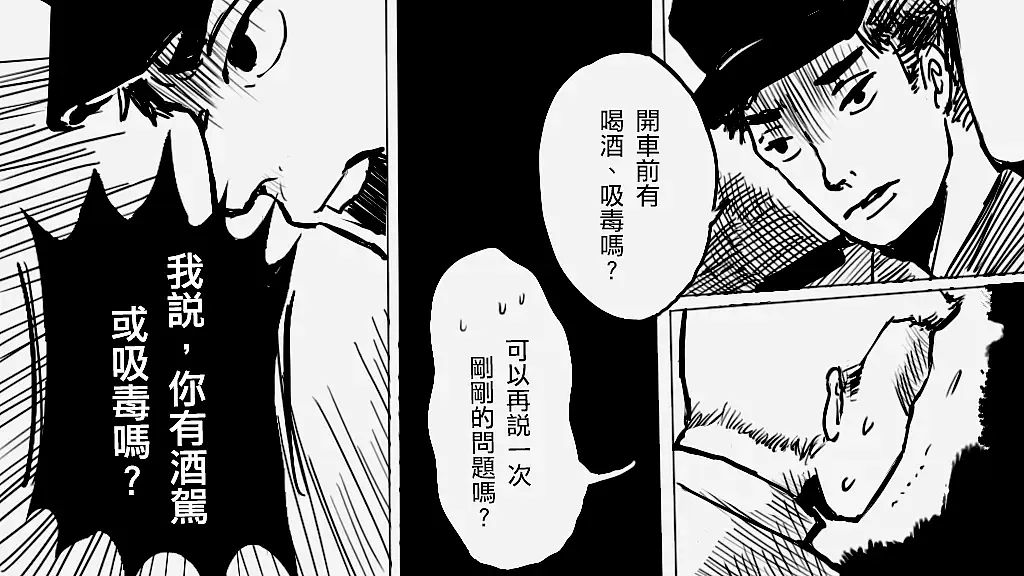
"Did you drink alcohol or take drugs before driving?" the police asked next.
"Could you repeat that last question?" For some reason, Chün-Ming actually zoned out while being questioned by the police.
"I said, were you driving under the influence or on drugs?" The police raised their voice.
"That road had poor lighting, so I didn't notice the elderly woman in the dim visibility..." Chün-Ming gave an irrelevant answer.
"This must be the reaction after taking drugs!" Intermittent zoning out combined with irrelevant answers led the police to suspect that Chün-Ming was dazed because of drug use.
"It probably wasn't poor visibility; you didn't notice the elderly woman because you were out of it from drugs, right?" The police asked another question.
"..." Whether due to fatigue or being guessed correctly by the police and unable to defend himself, Chün-Ming did not answer.
"Pursuant to Article 205-2 of the Code of Criminal Procedure, we will be taking hair and urine samples from you shortly for drug screening, please cooperate!" Seeing Chün-Ming's lack of response to the questioning, the police firmly believed Chün-Ming was using drugs and thus decided to carry out a compulsory taking measure against him.
"Huh? What is a compulsory taking measure? Can I refuse? But the police look so fierce, I have no idea what they might do to me if I refuse..." A helpless Chün-Ming felt even more at a loss before the forceful police, not knowing what to do, and could only cast a pleading look at his lawyer...
What is a Taking Measure?
A taking measure refers to the act by investigative personnel to obtain criminal evidence from the body of a defendant or suspect, also known as a physical examination; the primary legal basis is Article 205-2 of the Code of Criminal Procedure (others include DNA sampling pursuant to the DNA Sampling Act, urine collection pursuant to the Narcotics Hazard Prevention Act, etc.), and taking measures can be broadly divided into:
- Bodily: hair, saliva, urine, vocal tone, or exhaled breath, etc.
- Non-bodily: fingerprints, palm prints, footprints, photographs, and height measurements, etc.
Because "bodily" taking measures are more intrusive to the defendant or suspect, the requirements are stricter; conversely, "non-bodily" measures only gather evidence from the exterior of the human body and are less intrusive to the defendant or suspect, so the requirements are relatively lower. Please refer to the table below for detailed requirements.
Article 205-2 of the Code of Criminal Procedure: "Where necessary for investigating criminal circumstances and gathering evidence, prosecutorial investigators, judicial police officers, or judicial police may, against the will of a criminal suspect or defendant who has been brought in by summons with warrant or arrested, take their fingerprints, palm prints, and footprints, take photographs, measure height, or perform similar acts; where there are reasonable grounds to believe that taking hair, saliva, urine, vocal tone, or exhaled breath may serve as evidence of a crime, the same may be taken."
Under What Circumstances Can Taking Measures Be Carried Out?
| Requirements | Description |
| Brought in by summons with warrant or arrested |
The criminal suspect or defendant must be brought in by lawful summons with warrant or arrest in order for a taking measure to be carried out against their will. The reason is that taking measures are intended to |
| "Necessity" to investigate criminal circumstances and gather evidence |
Even if the criminal suspect or defendant is brought in by summons with warrant or arrest, investigative personnel cannot arbitrarily carry out compulsory taking measures; there must still be For example, if fingerprints are collected at a murder scene, it is necessary to take the suspect's fingerprints in order to confirm whether they were at the scene; in the case of public insult, which has nothing to do with fingerprints, the police are not permitted to take the opportunity to take fingerprints. |
| "Reasonable grounds" to believe...... |
Because bodily measures infringe upon human rights to a greater degree, taking items such as hair or urine must additionally For example, if a criminal suspect is arrested for driving under the influence with a flushed face and reeking of alcohol, there are reasonable grounds at that moment to believe that taking their "exhaled breath" can obtain criminal evidence. |
Can the Police Force Breathalyzer Tests?
The most common taking measure closely related to us is the breath test (breathalyzer). As mentioned above, the police can only compel a criminal suspect or defendant to take a breath test when there are reasonable grounds to believe that taking exhaled breath can serve as criminal evidence.
The two most common situations are as follows:
-
Article 185-3 of the Criminal Code "Crime of Driving Under the Influence"
Drunk driving is a criminal offense, and police may arrest flagrante delicto offenders in accordance with the law. After the arrest, if the police believe there are reasonable grounds and it is necessary to preserve evidence of drunk driving, they may carry out the compulsory taking measure of a "breath test" against the person's will pursuant to the aforementioned Article 205-2 of the Code of Criminal Procedure.
-
Article 35 of the Road Traffic Management and Penalty Act
This can be divided into general alcohol testing or alcohol testing after an accident. The former should be limited to instances where the police reasonably suspect the driver has been driving under the influence of alcohol. Refusing an alcohol test may result in a fine of NT$90,000, immediate towing and impoundment of the vehicle, and revocation of the driver's license. The latter stipulates that when a driver causes a traffic accident, the police may require them to take a breathalyzer test. Refusing the test may lead not only to the aforementioned penalties but also to being forcibly transferred to a hospital or testing institution for compulsory blood drawing.
Can the Police Compel Hair or Urine Sampling?
- The police may only compel the collection of a criminal suspect's or defendant's hair or urine when there are reasonable grounds to believe that taking hair can serve as criminal evidence.
- Additionally, it should be noted that Article 25 of the "Narcotics Hazard Prevention Act" provides that individuals who have previously committed the crime of drug consumption and are placed under protective custody are also subject to compulsory urine testing.
What to Do When Faced with Compulsory Taking Measures? What to Do If Investigative Authorities Act Illegally?
First, everyone should realize that compulsory breathalyzer tests, hair collection, and urine sampling are measures that infringe upon people's fundamental rights. Unless brought in by lawful summons with warrant or arrest, demanding a compulsory breathalyzer test lacks a legal basis, and individuals have the right to refuse compulsory taking measures by prosecutorial investigators, judicial police officers, or judicial police.
Conversely, if someone is brought in by lawful summons with warrant or arrest, even if the criminal suspect or defendant expresses refusal, investigative personnel may in principle still carry out compulsory taking measures, but they must not violate the principle of proportionality. For example: a suspect who is not resisting should not be hogtied for compulsory blood drawing. If you believe the actions of the investigative personnel are excessive, you must find a way to preserve evidence in the interrogation audio (video) recording or the written protocol so that there is an opportunity to have the court exclude such illegally obtained evidence during trial.
In foreign jurisdictions, taking measures mostly require permission from a judge or prosecutor; our legislation permits police officers to make their own determinations, which may offer insufficient safeguards. However, because it has a legal basis, when the police carry out compulsory taking measures that comply with the principle of proportionality, it is recommended to cooperate with investigative personnel to avoid unnecessary and unbeneficial conflicts, which might also result in additional charges of obstructing official duties.
In addition, attention should also be paid to whether the sampling procedure is legal and whether the interrogation protocol is accurate. When collecting urine, attention should be paid to the bottling and sealing process to prevent the specimen from being contaminated. If you took prescription medication before urine collection, you should provide proof as much as possible and immediately request the police to record this in the protocol. Furthermore, since blood and urine collection are invasive taking measures, they should be performed by professional medical personnel.
How the Story Should Continue
Although he was not brought in by summons with warrant or arrest, under the police officer's earnest persuasion and to boost his own confidence, Chün-Ming still agreed to have his hair and urine taken for drug testing. Fortunately, the final test results showed a negative reaction, meaning Chün-Ming had not used drugs. However, regarding the part where Chün-Ming may have killed the elderly woman by crashing into her, the police believed Chün-Ming was strongly suspected of a crime. Therefore, after concluding the police interrogation and having Chün-Ming verify the protocol, they transferred Chün-Ming to the District Prosecutors Office, handing him over to the prosecutor for subsequent questioning and investigation.
Related Provisions
- Article 205-1 of the Code of Criminal Procedure:
(Paragraph 1) If necessary for the purpose of appraisal, an appraiser may, with the permission of the presiding judge, designated judge, or prosecutor, take secretions, excretions, blood, hair, or other substances originating from or attached to the body, and may take fingerprints, footprints, vocal tones, handwriting, photographs, or similar acts.
(Paragraph 2) The measure referred to in the preceding paragraph shall be specified in the permission document under Paragraph 2 of Article 204-1. - Article 205-2 of the Code of Criminal Procedure:
Where necessary for investigating criminal circumstances and gathering evidence, prosecutorial investigators, judicial police officers, or judicial police may, against the will of a criminal suspect or defendant who has been brought in by summons with warrant or arrested, take their fingerprints, palm prints, and footprints, take photographs, measure height, or perform similar acts; where there are reasonable grounds to believe that taking hair, saliva, urine, vocal tone, or exhaled breath may serve as evidence of a crime, the same may be taken. - Article 35 of the Road Traffic Management and Penalty Act:
(Paragraph 1) A motor vehicle driver who drives a motor vehicle and undergoes testing and verification with any of the following circumstances shall be subject to a fine of not less than NT$15,000 and not more than NT$90,000, and the motor vehicle shall be immediately towed and impounded and their driver's license suspended for one year; if carrying a child under the age of 12 or causing injury due to an accident, their driver's license shall be suspended for two years; if causing serious injury or death, their driver's license shall be revoked, and they shall be disqualified from retaking the test:
1. Alcohol concentration exceeds the prescribed standard.
2. Consuming drugs, hallucinogens, narcotics, and similar regulated drugs.
(Paragraph 4) A motor vehicle driver who, while driving a motor vehicle, passes a location set up by police agencies to execute the testing and verification under Paragraph 1, fails to stop and accept inspection as instructed, or refuses to accept the testing under Paragraph 1, shall be fined NT$90,000, and the motor vehicle shall be immediately towed and impounded, their driver's license revoked, and they shall be required to attend road traffic safety lectures; if an accident causing serious injury or death occurs, their driver's license shall be revoked, and they shall be disqualified from retaking the test.)
(Paragraph 5) A motor vehicle driver who causes an accident and refuses to accept or cannot undergo the testing and verification under Paragraph 1 shall have traffic enforcement police or personnel executing traffic inspections pursuant to laws and regulations forcibly transfer them to a commissioned medical or testing institution to have their blood and other specimens sampled and tested and verified.) - Article 25 of the Narcotics Hazard Prevention Act: "(Paragraph 1) Persons who commit an offense under Article 10 and are placed under protective custody, or juveniles ruled to be placed under protective custody due to the consumption of Category 1 or Category 2 narcotics, shall, during the period of protective custody, be notified by police agencies or those executing protective custody to appear at a designated time for urine sampling and testing on a regular basis or when there are factual grounds to suspect them of drug consumption. Those who fail to appear without justifiable reason may have an application filed for permission from a prosecutor or juvenile court (juvenile division of a district court) for compulsory sampling. Those who appear but refuse sampling may be subjected to compulsory sampling against their will. After sampling, an application shall be immediately filed with the prosecutor or juvenile court (juvenile division of a district court) for a retroactive permit."
This article is an AI-generated translation of the original Chinese text. In the event of any discrepancy, the Chinese version shall prevail.
