
The Most Literary Afternoon at JRF: An Interview with Artist Shih Ping-hsi
Last edited: 2026-07-27
Don't think that JRF only talks about serious and rigid laws; in fact, we also have an artistic philosophical and emotionally rich side. Absolutely literary and ultra-delicate, guaranteed sincere and unpretentious. Artist Shih Ping-hsi has served as JRF's "point man" in the literary and artistic circles for more than ten years. His love and concern for Taiwan are not only splashed across canvas, but also embodied in his support for judicial reform.
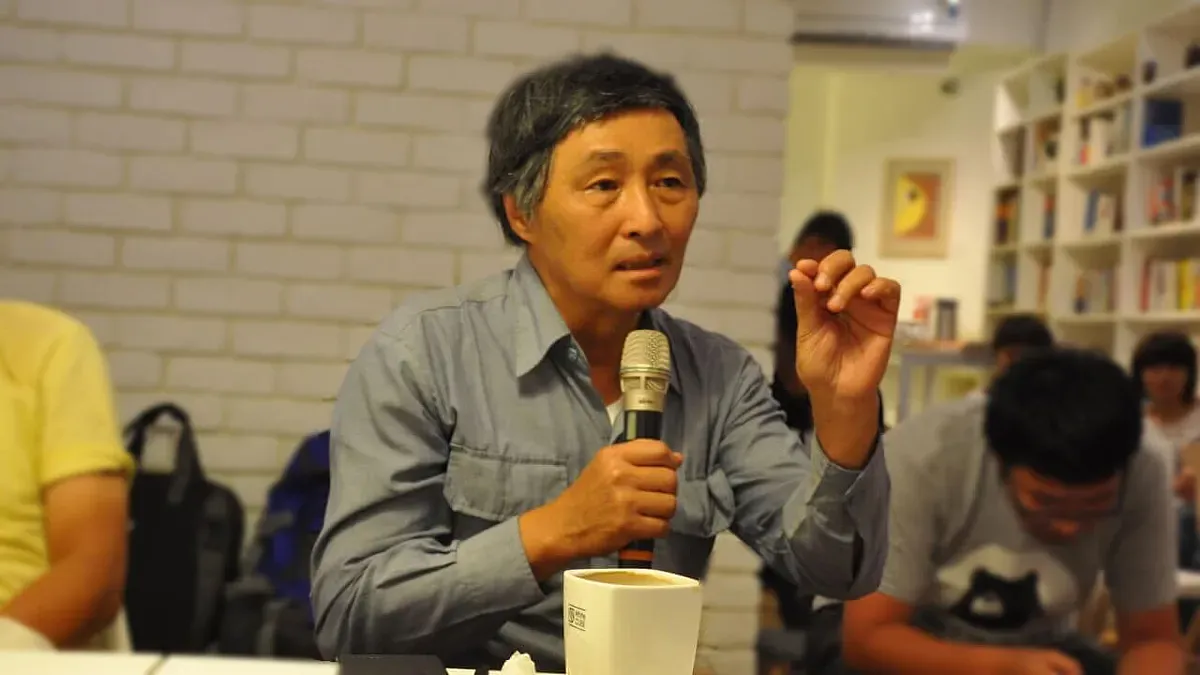
We scheduled to meet with Professor Shih Ping-hsi on a certain May afternoon. When he pushed open the door to JRF and walked in, a wave of fragrance filled the air, bringing with it the most romantic and dashing artist aura (the moment we met, I thought the professor must have been extremely handsome in his youth). That day, Professor Shih talked with us at length about the social responsibilities of artists and Taiwan's subject consciousness, while also sharing his reflections on judicial and public issues.
Long-Term Support for Judicial Reform
You might wonder what a creator holding a paintbrush has to do with legal work? Yes, make no mistake. Artists also participate in judicial reform! Moreover, this connection was established more than a decade ago when Attorney Kao Jui-cheng served as Chairperson of JRF. Until 2016, Professor Shih continuously provided paintings to generously assist JRF in fundraising charity sales.
Creations Deeply Rooted in Taiwan
"A dark-skinned person is worthless; a fair complexion illuminates nine beauties." Although the Taiwanese proverb sounds refined, its original meaning referred to how farmers with dark skin were prone to being looked down upon, which Professor Shih used to describe the discrimination suffered from a rural background. Fortunately, this does not detract in the least from the moving charm within Professor Shih's realistic paintings.
Shih Ping-hsi graduated from the Department of Fine Arts at National Taiwan Normal University, studying under Liao Chi-chun and Li Shih-chiao, among others. After pursuing advanced studies in New York, he taught at NTNU and retired a few years ago, returning to his hometown of Yuanlin, Changhua, where he paints without cease. Professor Shih's creations possess a deeply Taiwanese perspective closely tied to local life, yet this does not mean he is set in his ways. On the contrary, his thinking is open-minded and unrestrained, while remaining tethered to universal human emotional values. A series of his works reproduce the tragic scenes of the February 28 Massacre, and he has also depicted many scenes of his hometown, even using the title Portraying the Legend of Powerless Island to satirize Taiwan's political problems.
 Image / Shih Ping-hsi's 2007 painting, <String-Bound Grievous Souls>, 194x130cm oil painting
During the February 28 Massacre, military troops in Keelung used iron wire to pierce through wrists and ankles, stringing people together before opening fire. Even if the captured victims were not killed outright by bullets, they would be dragged down by the weight of those before them and drown.
"Where are you from—your language, behavior, and thinking carry local codes." When asked why he insists on presenting social reality, Professor Shih answered this way: "Italian New Wave director Federico Fellini also spoke of a similar concept." Professor Shih firmly believes that artists and any individuals with a channel to speak publicly are surrounded by crowds and cannot escape history and community contexts. Only by reflecting true life and emotional experiences can these public-facing utterances have meaning; otherwise, they are merely generating noise.
Citizen Participation and Self-Determination
Speaking of his observations on Taiwan, Professor Shih bluntly stated: "We lack core values. People in the past often belittled their own culture, language, and history; we lacked subjectivity."
Professor Shih took the story of Sayun's Bell[1] as an example: A Japanese teacher stationed in Taiwan received a draft notice, and the indigenous girl Sayun carried luggage to see the teacher off. Heavy rain started falling along the way, and swelling river waters swept away her life. Later, Sayun's "patriotic" bravery was praised and exaggerated, and even adapted into a film. Behind what seems like an ordinary story lies a certain historical interpretive perspective. We ought to ask: Did Sayun truly volunteer for the "country"? What did the people actually living on this land at that time really think?
The contradiction demonstrated by this example exists not only at the cultural level, but is also intertwined with judicial reform, politics, and society: Have we considered how we want to live our lives? Under what social rules and laws do we wish to co-exist? Is the right to make these decisions guaranteed? Professor Shih remarked with emotion: "This is the vital sign of a group." We might even have the consciousness to discover these problems blinded. Precisely because of this, citizen participation should be further encouraged to fill these significant and regrettable gaps.
As the interview drew to a close and we parted ways, Professor Shih did not forget to cheer us on: "Constructing texts is very important. My painting and JRF's promotion of issues are both constructing texts." Yes, abstract ideals alone are not enough; we must create visible entities to carry them. Translate beliefs that must be spoken into language and action, then scatter them everywhere and rally companions to respond: artists, legal professionals, each and every one of you in society... whoever comes, we need you.
Notes
- Sayun's Bell allegedly took place around Nanao, Yilan. There are many versions of the story, and its authenticity and interpretive perspectives are subject to much discussion.
- 《Shih Ping-hsi's Charm of Knives and Paintbrushes Chronicle》, Authors / K'ang Yuan, Shih Ping-hsi, Morning Star Publishing Online Reading Sample
This article is an AI-generated translation of the original Chinese text. In the event of any discrepancy, the Chinese version shall prevail.
