
[Legal Life] Ch6 I don't want to be famous. Can I refuse to hold a press conference or participate in an on-site reenactment?
Last edited: 2026-08-31
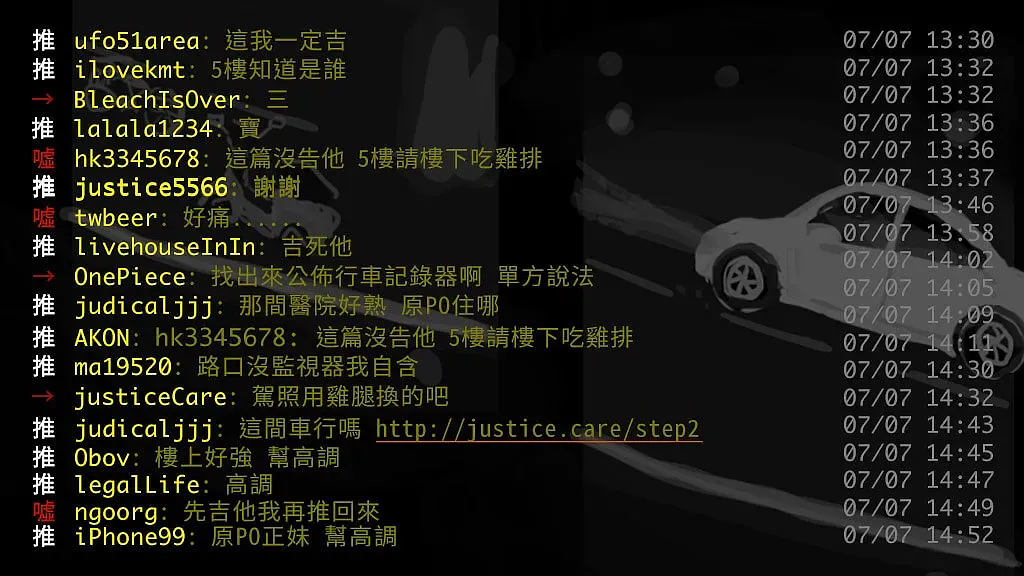
A few days later, Chieh-yun was determined to expose this outrageous hit-and-run so that the perpetrator would not escape justice. Chieh-yun posted a detailed account of what happened that night on PTT's Gossip Board, which sparked widespread discussion. Netizens and internet users were filled with righteous indignation, eager to help Chieh-yun and the elderly woman track down the culprit of that night. Consequently, Chün-ming's personal information began to be doxxed, dug up, and published online. Meanwhile, having identified Chün-ming as the suspect, the police wanted to seize this wave of public opinion to showcase their investigative prowess and explain the ins and outs of the incident to the public. As a result, they demanded that Chün-ming cooperate by holding a press briefing and further requested that he participate in an on-site reenactment to reproduce the night's car accident before the cameras.
You Can Refuse When the Police Ask the Defendant to Join a Press Conference
The purpose of the police holding press conferences is usually to explain the ins and outs of a case to the public. Such press conferences are quite common in cases that cause public uproar (and nowadays, even minor cases often seem to warrant a press conference...). However, if one day you become a defendant, do you necessarily have to comply with the police's wishes to hold a press conference? Not at all. As a defendant, you actually have the right to refuse to accompany the police in holding a press conference. The reason is simple: not only does the defendant have no such obligation, but the defendant's right to reputation must also be protected.
What Is the Right to Reputation?
Simply put, the right to reputation refers to the commentary or respect an individual's character receives while living in society. Even if a defendant's actions may be unlawful and socially unacceptable, they are still entitled to the same protection of the right to reputation—especially since they have not yet been convicted. If the right to reputation is infringed, it may give rise to civil liability for damages, and in severe cases, criminal liability as well. Therefore, under such circumstances, the defendant can still refuse to hold or attend a press conference.
What You Should Know About What the Police Cannot Do During a Press Conference
According to the administrative rule "Key Points for Handling News Regarding Criminal Cases Investigated by Prosecutors, Police, and Investigation Agencies," there are relevant regulations governing police press conferences. First and foremost, these personnel must keep the relevant case details and documents confidential and must not disclose them to reporters or anyone other than the parties involved. These materials and documents include:
- The defendant's confession and related information
- The investigative process and methods of conducting the investigation
- Information that would allow the defendant to alter evidence or flee
- Investigative progress and related insights
- The current status of the victim
- Documentary materials related to the case
- Other information that would affect the defendant's relatives
- The victim's privacy documents
- Documents related to juvenile offenders, whistleblowers, and witnesses
All of the above documents are stipulated to be withheld from disclosure or publication.
Furthermore, apart from keeping these documents and information confidential and undisclosed, prosecutorial, police, and investigative personnel are also prohibited from allowing defendants to be casually photographed by the media, directly interviewed, or filmed via security monitors. In other words, defendants must be protected from direct contact with the media.
As a Defendant, You Can Still Refuse an On-Site Reenactment
Faced with public skepticism and public opinion, the police, being in the position closest to the public during the investigation of a case, sometimes feel compelled to step forward and explain the case due to societal pressure. They may also need to better understand the course of events through an on-site reenactment. However, once the police make such a request, does the defendant have no choice but to accept it, with no right to refuse? Actually, that is not the case.
An on-site reenactment refers to requiring the defendant to reperform the sequence of the illegal act at the crime scene. Therefore, legally speaking, an on-site reenactment is also categorized as a form of the defendant's "confession." Consequently, the procedures related to on-site reenactments are still protected by our Code of Criminal Procedure. The police cannot disregard the defendant's rights merely for the sake of gathering evidence or collecting information, otherwise they may violate the provisions of the Code of Criminal Procedure.
What Is a Confession?
A "confession" refers to making affirmative statements regarding all or a major part of one's own criminal facts. Simply put, a confession is admitting to oneself what wrongdoing one has committed. Because a confession can serve as a form of evidence under the Code of Criminal Procedure, the procedures for obtaining a confession and the methods of acquisition are strictly regulated by the Code of Criminal Procedure. Police must comply with the provisions of the Code of Criminal Procedure when obtaining a confession. Since an on-site reenactment is considered a form of confession, it is likewise subject to the regulations of the Code of Criminal Procedure.
What You Should Know About What the Police Cannot Do
Therefore, pursuant to the provisions of the Code of Criminal Procedure, a defendant can actually refuse to participate in an on-site reenactment. Article 95, Paragraph 2 of the Code of Criminal Procedure stipulates that a defendant shall be notified to remain silent and is not required to make statements against their own will. Consequently, the defendant can remain silent and cannot be forced to express their opinion. The old tactic used by Judge Pao of using finger-pinching torture to force a confession is no longer permissible nowadays (Apologies, Judge Pao...). Therefore, if a defendant does not wish to carry out an on-site reenactment, the police cannot force them to do so.
In addition, Article 98 of the Code of Criminal Procedure also stipulates that "The interrogation of a defendant shall be conducted with an earnest attitude, and no violence, threats, inducement, fraud, fatigue interrogation, or other improper methods shall be used." Therefore, the police cannot use these improper methods to demand that a defendant conduct an on-site reenactment. The old tactic of Judge Pao dressing up as the King of Hell to scare people is no longer allowed either (Apologies, Judge Pao...). The defendant's wishes should be respected, and if the defendant is unwilling to perform an on-site reenactment, the police should not proceed with it.
How the Story Continues
After this incident was posted on PTT, it sparked a huge controversy due to the public's disapproval of Chün-ming's actions. To appease public anger, the police wanted to explain the ins and outs of the matter to the public and thereby demonstrate the swiftness of their case investigation. However, upon learning of the aforementioned information, Chün-ming could actually refuse to cooperate in holding a press conference and could also refuse the police's request for an on-site reenactment. Chün-ming has no obligation to comply with the police in explaining things to the public, because criminal procedural procedures will still protect his relevant rights, and the police also have a duty to comply with the relevant provisions of the Code of Criminal Procedure, rather than ruining Chün-ming's reputation merely for the glory of solving a case.
Relevant Provisions
- Key Points for Handling News Regarding Criminal Cases Investigated by Prosecutors, Police, and Investigation Agencies, Point 3
Before the conclusion of the investigation of a case, prosecutorial, police, and investigative personnel shall keep the following matters confidential, and shall not leak them or release news thereof; nor shall they allow the defendant, criminal suspect, or juvenile offender to be photographed by the media, directly interviewed, or filmed via security camera footage:
(1) Whether the defendant or criminal suspect has surrendered or confessed, and the contents thereof.
(2) Investigative methods that have not yet been implemented or should continue to be implemented, including regarding summons, communications surveillance, apprehension, detention, search, seizure, inspection, on-site reenactment, appraisal, restriction on leaving the country, and asset tracing.
(3) The direction, progress, techniques, specific contents, and formed mental convictions of the investigation.
(4) Matters sufficient to cause the defendant or criminal suspect to flee, or to entail the risk of destroying, falsifying, altering evidence, or colluding with accomplices or witnesses.
(5) Where the victim is being held hostage and has not yet escaped to safety, and their safety is in jeopardy.
(6) Case files, transcripts, audiotapes, videotapes, photographs, electromagnetic records, or other important documents during the investigation.
(7) Criminal details pertaining to the privacy and reputation of the defendant, criminal suspect, their relatives, or spouse.
(8) Information concerning the privacy or reputation of the victim, as well as photographs, names, or other information sufficient to identify the victims of sexual assault cases.
(9) Photographs, names, residential addresses, schools attended, names of family members, and case details concerning juvenile offenders.
(10) Names, identifying information, residential addresses, telephone numbers, contents of statements, or evidence submitted by whistleblowers and witnesses.
(11) Any visitor information, meeting records, and other contents from discussions with various agencies during the period when prosecutorial, police, and investigative agencies investigate a case.
(12) Other matters sufficient to affect the investigation.
Prosecutorial, police, and investigative personnel shall not lead the media in handling cases, nor shall they release video or audio recordings of evidence gathering. - Supreme Court 103-Tai-Shang-3091 Judgment: "The term 'confession' referred to herein means making affirmative statements regarding all or a major part of one's own criminal facts."
- Article 95, Paragraph 2 of the Code of Criminal Procedure: "The interrogation of a defendant shall first inform them of the following matters: ... that they may remain silent and are not required to make statements against their own will."
- Article 98 of the Code of Criminal Procedure: "The interrogation of a defendant shall be conducted with an earnest attitude, and no violence, threats, inducement, fraud, fatigue interrogation, or other improper methods shall be used."
This article is an AI-generated translation of the original Chinese text. In the event of any discrepancy, the Chinese version shall prevail.
