Judicial Collective Karma: Bearing It Together in 2015
Last edited: 2026-08-31
As the New Year approaches, one wants to offer encouraging words and do constructive deeds. Back in the countryside, my mother's very first words were: You're finally back! Meaning she had no idea what her son was "actually busy with" all day in Taipei, other than seeing him "scolding people" every time she looked at the news. Is the government really that bad? she asked me. With all the major and minor events unfolding on the judicial front, it was hardly possible to sum it up in a few words for someone who basically never watches the news. Did we really have to constantly criticize like this? I evasively replied, "No, not really!" and explained to her that sometimes the media frames things from a more "hostile, adversarial" angle, and sometimes government officials really are just that terrible. But she is a peaceful, mild-mannered rural teacher who never wants to offend anyone and believes the government has treated them well. "Think back to how hard it was for us when we were young; we had to farm while studying—planting rice, dealing with floods, harvesting. Life is already very blessed now." She always cherishes her blessings, talks about them constantly, dislikes making things difficult for others, and feels that her child is too "rebellious," seemingly running counter to the spirit of humility and politeness she taught him since childhood.
Looking Back at 2014
In her simple and kind-hearted world, the state is the "adult" and the people are the "common folk," existing only in a binary, top-down relationship. Even with the tumultuous 318 Sunflower Movement, she still could not imagine what a "civil society" looks like. On the one hand, she vaguely felt that young people today have a hard time, and that generational injustice makes a certain amount of sense.
On the other hand, she also felt that young people today are already very fortunate; she does not understand transitional justice and feels it is unnecessary, since it seems like a "settling of accounts" with the previous generation. Especially for Taiwanese who grew up after the February 28 Incident, they are gentle, dislike conflict, and avoid disputes and politics. Moreover, reckoning with one's own generation seems to be a denial of the era in which one survived.
If we are unwilling to call it generational injustice, let us at least call it a "historical collective karma" that we should bear together! As more and more people come to understand and are willing to shoulder this, let us hope that in 2015, every field will take on a completely new atmosphere.
Looking back at 2014, quite a few major events took place in the judicial sphere.
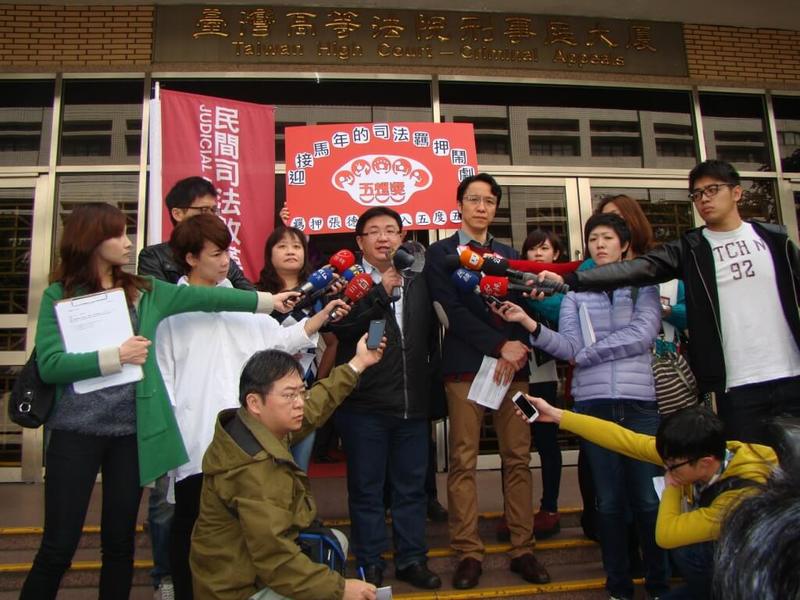
The Year of 甲午 (Chia-wu) opened with Chang Te-cheng's ramming of the Presidential Office, and also staged the absurd drama of a "five-time, five-round" back-and-forth detention battle that spanned from the Year of the Horse to the Year of the Sheep, concluding with Wei Ying-chung's "three-time, three-round" finale. The cases themselves were absurd enough, but what is even more absurd is that judicial higher-ups seem to think that as long as they hide behind "judicial independence," they can avoid thinking about any institutional reforms? In fact, designing a system to prevent these "detention tug-of-wars" is not difficult, and many scholars and experts have put forward ideas. Turning one's back on such an immediate and tangible "small blessing of judicial reform" baffles the mind.
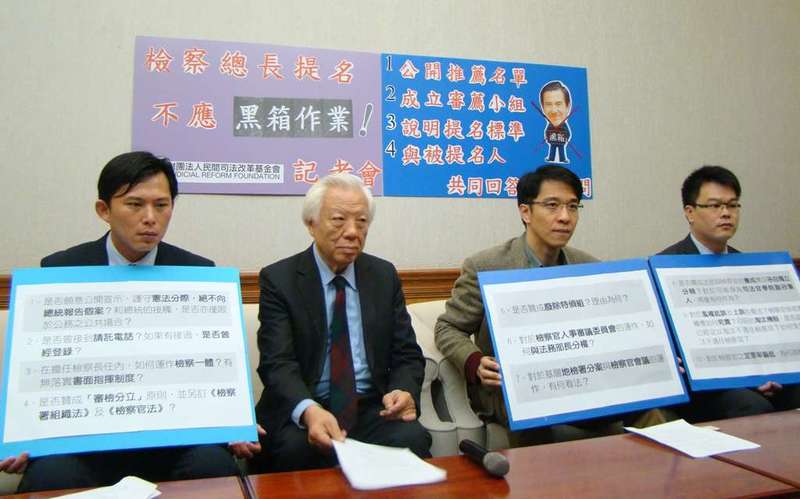
Furthermore, former Prosecutor-General Huang Shih-ming was indicted, convicted, resigned, retired, and ultimately had his guilty verdict finalized. A prison sentence of one year and three months commutable to a fine, without the need to serve time in prison, was the court's way of preserving a last shred of dignity for the Prosecutor-General and the prosecutorial system. Whether Huang Shih-ming goes to prison is not the main point; his personal honor and disgrace are one thing, but the deep-seated judicial problems he exposed are what truly deserve our attention.
The biggest lesson from Huang Shih-ming is that he completely betrayed the core role of the Prosecutor-General. Granting him tenure protection and bestowing upon him the high democratic legitimacy of parliamentary consent was done in the hope that he would conduct investigations independently, remain loyal to the country, and keep a distance from high-level politics. Huang Shih-ming directly reported classified information to President Ma, completely violating the core mission of the Prosecutor-General. Huang Shih-ming also exposed the severe abuse of wiretapping in our country. Although the Communication Security and Surveillance Act was amended, under a mindset that devalues the right to privacy, the wiretapping problem has not improved much. Minister of Justice Lo Ying-shay's blind shielding of Huang Shih-ming further demonstrated how official protection of one's peers can be pushed to its absolute limits. Coupled with Lo's own continuous comments on individual cases, she crossed the red line that the Minister of Justice has historically strictly guarded: "do not interfere in individual cases." Throughout the entire year, morale in the prosecutorial system had long been low, continuously tortured by the exaggerated and absurd actions of these high-ranking officials.
March saw the outbreak of the Sunflower Movement, which was actually the ultimate explosion of various large and small social protests: closed-down factory workers, the Hung Chung-chiu case, and a series of land protests marked by forced demolitions such as Wenlin-yuan and Dapu. In their wake came all sorts of legal battles and skirmishes—individual lawsuits and assemblies and processions—in full swing. It is especially worth mentioning that a government that spared no effort in safeguarding the privileged elite cultivated a group of citizens who opposed exploitation. An arrogant government that incessantly used the judiciary to hunt down citizens also forged a batch of courageous young lawyers. These people are galvanizing more individuals to save their own country themselves.
The judicial actions following the 318 Sunflower Movement demonstrated the gradual divergence between the prosecutorial system and the judges.
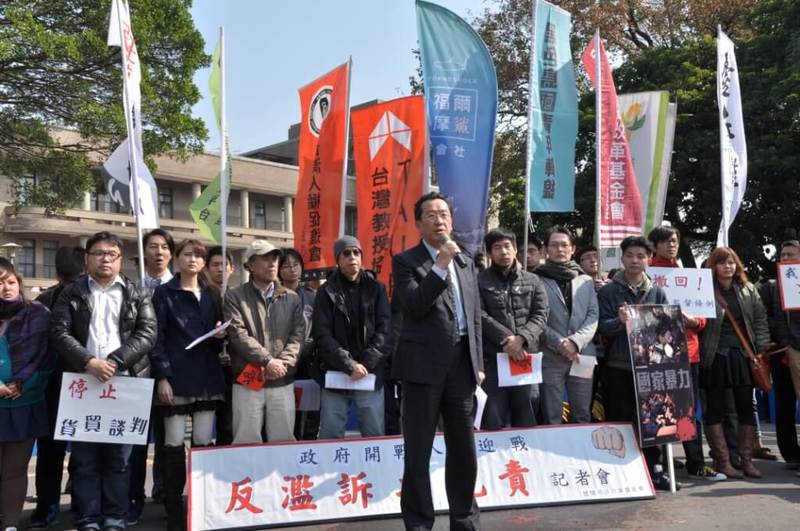
The Taipei District Prosecutors Office massively indicted participants in the 318 movement. Even though the majority of Taiwanese society affirmed the movement's contribution, prosecutors displayed a servility showing that "challenging political power is challenging the law," and showed no mercy in their indictments. In contrast, regarding the bloody clashes on the night of March 24, not a single police officer was subjected even to preliminary questioning or investigation by prosecutors. Either prosecutors were entirely whitewashing the police officers who committed the beatings, or frontline personnel remained tightly reined in by higher-ups, leaving no room to handle cases independently. Conversely, when citizens who were beaten filed private prosecutions, at least some judges were able to investigate evidence and conduct substantive reviews, showing that judges have gradually recognized and are willing to shoulder their role of checks and balances within the separation of powers. However, the Supreme Court still lives in the "prehistoric era" of "case identity" and is eager to manipulate district court judges through "legal interpretations," once again revealing the same problem seen in the prosecutorial system: the biggest problems usually stem from the judicial leadership.
Consequently, after the November 29 elections, Ko Wen-je rode a high-popularity political whirlwind to begin investigating official-business collusion scandals such as the MeiHAS Cityproject. Hau Lung-bin continuously brandished the fact that he had "already been investigated by prosecutors and proven innocent" to endorse himself, making it increasingly clear to the public how chief prosecutors can direct cases toward the direction desired by higher-ups—seamlessly and without restraint. Against the splitting of indictments, non-prosecutions, or suspended prosecutions, the current system is virtually helpless; the people can only be at the mercy of others, lacking oversight and checks and balances, while the prosecution has no intention of being subjected to them.
Finally, a succession of food safety storms spurred legislative amendments regarding food safety. The Ministry of Justice and the Judicial Yuan remained deadlocked on what constitutes effective punitive measures against unscrupulous manufacturers. When the law lacks clarity, it either undermines the confidence of law enforcement officers or creates room for under-the-table maneuvering and "acting in accordance with the law." Coupled with Chen Shui-bian's medical parole, this once again triggered a war between the elites and the common folk, which manifested in the Kaohsiung Prison hostage-taking incident. Prison problems have many causes; blaming the prisoners merely proves one's own incompetence, and pointing fingers at frontline correctional personnel is nothing more than a superficial, buck-passing excuse.
All problems ultimately point back to judicial policy decisions and institutional reforms, which are precisely the jobs of the Ministry of Justice and the Judicial Yuan. If we refuse to confront drug offenses and the criminal policy of severe sentencing, prison problems will remain insoluble. If we are unwilling to handle Chen Shui-bian's political problem through a presidential pardon rather than medical parole, we will destroy the legal system and lose even the most basic fairness. If we dare not offend the elite or reform food safety investigations, we are destined to lose the hearts of the people. If we are unwilling to thoroughly implement popular sovereignty and practice judicial democratization, we will only ever engage in superficial lay participation systems.
The eyes of the people are always sharp; it is the Ministry of Justice, the Prosecutor-General, the Judicial Yuan, and the Supreme Court that have failed to realize they are the true "Chou Chu" [monsters of the land].
Looking Forward to 2015
Looking ahead to 2015, there are still many intractable judicial issues awaiting us to bear together. How we view the scale of a problem depends on the scale of our own perspective. Legal systems and rule-of-law education are foundational undertakings spanning a century; we must maintain a long-term vision so as not to be caught up in anxiety over short-term gains and losses. Although Taiwan is merely a tiny island nation, compared to the most advanced nations in East Asia like Japan, it is not necessarily inferior in its legal system. More importantly, as we unavoidably engage in close exchanges with China, we can exert an even greater influence for freedom and human rights.
Let us make our New Year's resolutions together: that prosecutors match their powers with responsibilities, that judges show more backbone, that everyone attaches greater importance to rigorous procedures and the rule of law regarding human rights, and that the massively admitted lawyers can shed the unfavorable systemic causes and contribute their efforts to Taiwan's society in terms of the rule of law and human rights. Furthermore, let us unite with citizens to forge the future, making Taiwan a nation that is more democratic and free while possessing substantive influence in the rule of law.
Wishing everyone strength at your respective posts for Formosa.
This article is an AI-generated translation of the original Chinese text. In the event of any discrepancy, the Chinese version shall prevail.