
Where is the "Freedom" of Legislative Formation?
Last edited: 2026-07-27
This week is the final week of the Legislative Yuan's session, which traditionally means a "bill clearance" rush.
Grand Justices are quite fond of invoking the concept of "legislative formation freedom," reflecting the separation of powers where certain matters are better decided by legislators rather than the judiciary. Sometimes this is judicial self-restraint, and other times it is judicial buck-passing.
It is the freedom of legislators to decide what kind of laws to form. For example, in Judicial Yuan Interpretation No. 718, the Grand Justices wished to avoid the hot potato of whether "assemblies and processions require prior government approval." Yet, as "bad luck" would have it, this coincided with the March 18 Sunflower Student Movement, making it unwise to directly oppose public sentiment. Consequently, they offered only a "half-hearted service," ruling that spontaneous and sudden assemblies and processions do not need to be reported to the government.
As for the rest—whether government approval is required—they hesitated and ultimately passed the buck to the legislators, labeling it as "legislative formation freedom / legislative discretionary space." They washed their hands of the matter, implying that it is up to the lawmakers, and whether the law is written to be round or square has nothing to do with the judiciary.
Of course, Grand Justices are well-read scholars; they know when to take a stand and when to let go. Amidst this fluidity, they can still present a rational argument without causing any damage to the legislators. After all, it is the legislators' freedom to legislate or amend laws as they please. What the Grand Justices are unwilling to mention is that until the law is amended, the original law remains in effect, and bad laws continue to exist and inflict harm.
Perhaps what the Grand Justices care little about is that the legislative freedom of formation, under our country's current conditions, is sometimes treated too casually—almost "treating freedom as a matter of convenience"—and at other times is not truly "freedom" at all, but merely echoing the executive branch.
The Clearance Sale
Formally speaking, the current situation in the Legislative Yuan is that the Kuomintang holds the majority. If they disregard appearances and lack checks and balances, they can pass any law they desire. Conversely, blocking any law they wish to stop is equally effortless. Of course, if the Democratic Progressive Party were to become the majority without establishing a reasonable model of discussion and operation, their methods in the Legislative Yuan would likely be much the same.
Anyone trained in law often experiences a sense of absurdity. Countless youth spent studying, deeply dissecting, and applying legal theories, only to arrive at the Legislative Yuan and find that none of it is of any use. Whether it is the subjective intent interpretation of the legislator, the objective interpretation matching the current time and space, the systematic interpretation of the law as a whole, or theoretical interpretations aligned with other academic disciplines in legal methodology—during the legislative process, one discovers that what is more realistic is the "wet-market bargaining interpretation" or the "chi-mo-tzu (feeling) theory."
Law, which ought to be the most rational subject for discussion and possess a rational image, is instead turned into something thoroughly imbued with "Taiwanese characteristics": devoid of reason yet overflowing with emotion, too agonizing to watch. This is, of course, the result of a defective system. Furthermore, legislators must naturally possess legislative expertise; if they already have a background in law and politics, it is all the better, as it facilitates communication and discussion with all parties. However, legislators need not all hail from legal or political backgrounds. Diversity from other backgrounds is also a good thing, as it allows for the accommodation and integration of various perspectives, pros, and cons.
However, bills are as numerous as the hairs on an ox. With the current relatively small number of lawmakers, a well-resourced team of assistants becomes all the more crucial. Otherwise, given that an individual lawmaker only has 24 hours in a day, coupled with a miserably small office team, it is simply impossible to cope. They must handle constituent services, participate in bill negotiations, and—for the more diligent ones—attend or host various public hearings and coordination meetings, while traditional lawmakers are busy running from event to event and juggling schedules. This makes life miserable for legislators, and it is hardly a blessing for the citizens.
In particular, the Judiciary and Organic Laws and Statutes Committee has traditionally been a "cold department" that "attracts less attention," often failing even to meet due to a lack of quorum. On the one hand, as rumors go, it is because there are "fewer perks to be made," rendering it unimportant; on the other hand, it is because judicial and legal matters are "non-urgent" affairs.
We must remind ourselves that modern society often defines "important" as "urgent." Consequently, judiciary and legal matters seem unimportant. Yet, they are matters that will profoundly impact the future of Taiwan's rule of law. They may not be urgent, but they are vital. If important bills are constantly being cleared out at a fire sale, the people will sooner or later jump off a building.
Even Simple Court Recordings Become Complicated
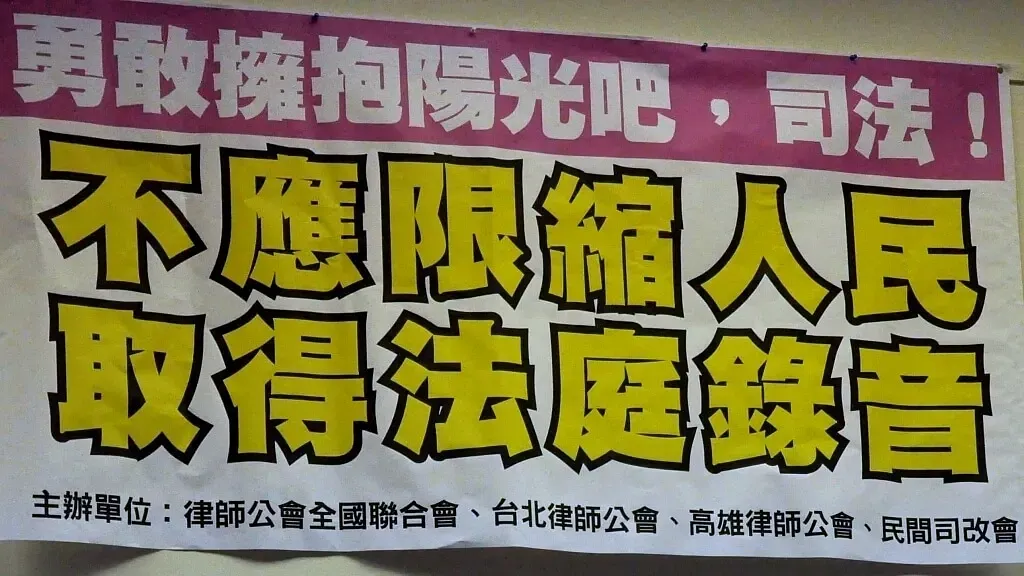
Take, for example, the Judicial Yuan's amendment of administrative orders to prohibit citizens from obtaining copies of court recording discs. The Judicial Yuan "acted first to secure an advantage," proactively amending the rules to alter the legal status and strictly limit access to court recordings. When the official side unilaterally exercises judicial administrative power and civil society's dissuasion proves ineffective, people can only hope for a legislative remedy.
Obtaining a court recording disc is merely a very straightforward choice of legal system, requiring no profound erudition. Yet, when tangled up in institutional interests, poor communication, and the straitjacket of legislative negotiations, a simple matter appears infinitely complex. In countries around the world, there are those that release court recordings and those that do not; there is no absolute rule, depending entirely on the objectives sought to be achieved.
To prevent the abuses of secret trials (think of how Chiang Kuo-ch'ing was taken by the military to an air-raid shelter in the middle of the night to watch the interrogation technique of the "autopsy video"), court proceedings are public by principle and private by exception. Therefore, activities inside the courtroom generally do not pose issues of "infringement of privacy" or "violation of secrecy." Parties inside the courtroom should, in principle, be able to obtain audio and video discs.
Consequently, "being able to review case files means being able to obtain audio and video" should be the most appropriate equilibrium point. However, allowing parties to obtain court audio and video discs does not mean they can be publicly broadcast—these are two different matters. Obtaining audio and video discs is a consideration centered around courtroom activities. If other considerations apply, whether there are other equilibrium points requires more sophisticated discussion and balancing. The point here is not to discuss "how" the details should be pursued, but rather "how the pursuit of details should be conducted."
This article is an AI-generated translation of the original Chinese text. In the event of any discrepancy, the Chinese version shall prevail.
