
Commemorating Professor Ts'ai Tun-ming by Rescuing Wrongful Convictions
Last edited: 2026-07-27
Over twenty years ago, following a seminar, I received a question: Is criminal law seemingly closely related to political power? At the time, I answered thus: A nation's sovereign power is manifested through military force in times of war, and through the power to punish during peacetime. I then added a remark I often tell my students in class: Therefore, those who teach criminal law courses often risk their necks, especially when lecturing on the offenses of internal and external rebellion.
In an era when martial law had not yet receded far into the past, listeners could easily grasp the underlying meaning.
Thirty-six years ago, Professor Ts'ai Tun-ming once suggested that I write my master's thesis on the offense of internal rebellion. This proposal was vetoed by Shih Chih-mou, the then-director of the Graduate Institute of Law at National Chengchi University. I do not know whether the two of us, as teacher and student, thereby avoided falling into political peril, for two years later the military tribunal for the Kaohsiung Incident (Formosa Magazine incident) took place, and the thesis would inevitably have contained critiques. If critique was necessary, then the consequences would have been unpredictable.
In an era of thought control, what was a teacher thinking when he wanted to guide a student to write about the crime of internal rebellion? After the Kaohsiung Incident, most people came to understand.
Doubts about the Kaohsiung Incident and the military trial made the professor a target for various consultations. Usually a man of few words, he began to express his views on democracy, the rule of law, and human rights in various media outlets, thereby joining the vast ranks of those pushing for the lifting of martial law. The professor, who often walked alone on campus, gradually began to appear in social organizations promoting the ideals of freedom and democracy; his presence could be found in the Chinese Comparative Law Society—the predecessor of the Taiwan Law Society—and the Awakening Society (Hsueh-she). Professor Ts'ai was one of the twenty-one founding members of the Awakening Society and even served two terms as the president of the Chinese Comparative Law Society.
Continuing his conviction to promote social reform, pursue democracy and the rule of law, and implement fair justice, Professor Ts'ai readily accepted the commission at the end of 1995 to lead the evaluation project for the death penalty judgment of Su Chien-ho, Liu Bing-lang, and Chuang Lin-xun. That judgment evaluation project was the first such project planned after the establishment of the Judicial Reform Foundation, and it was also an unprecedented initiative in Taiwan's judicial reform. At the time, the criminal justice practice sector, ranging from the Supreme Court downward, often sparked a media uproar in their backlash against the rescue of this case, while the criminal law academia and legal circles largely remained silent. Yet Professor Ts'ai, who had always been deeply respected by the criminal justice practice sector, unexpectedly took the lead in accepting the commission for the judgment evaluation—was this not making an enemy of the criminal justice practice sector? Professor Ts'ai, who never spoke in a loud voice, hesitated not at all and took brave action.
Through the persistent efforts of Su's defense lawyers and numerous supporters, Su's case was finally concluded with a not-guilty verdict in 2012. That year coincided with the professor's celebration of his eightieth birthday.
No matter how credible a judicial system may be, wrongful convictions are practically inevitable. But whatever the case, turning one's face away cannot possibly be the appropriate attitude to take when facing a suspected wrongful conviction. In the year of the professor's passing, on March 12, the Control Yuan released an investigation report pointing out that in the "Thirteen AUNTIE KTV" shooting case, which occurred in 2002 within the jurisdiction of the Fongyuan Precinct of the Taichung County Police Bureau, there were obvious grounds for a retrial due to a failure to exercise due care during the investigation and adjudication processes. On August 25, the newly appointed Prosecutor-General, Yen Ta-ho, questioned the ballistic identification and potential procedural flaws in obtaining the defendant's confession, and filed an extraordinary appeal with the Supreme Court.
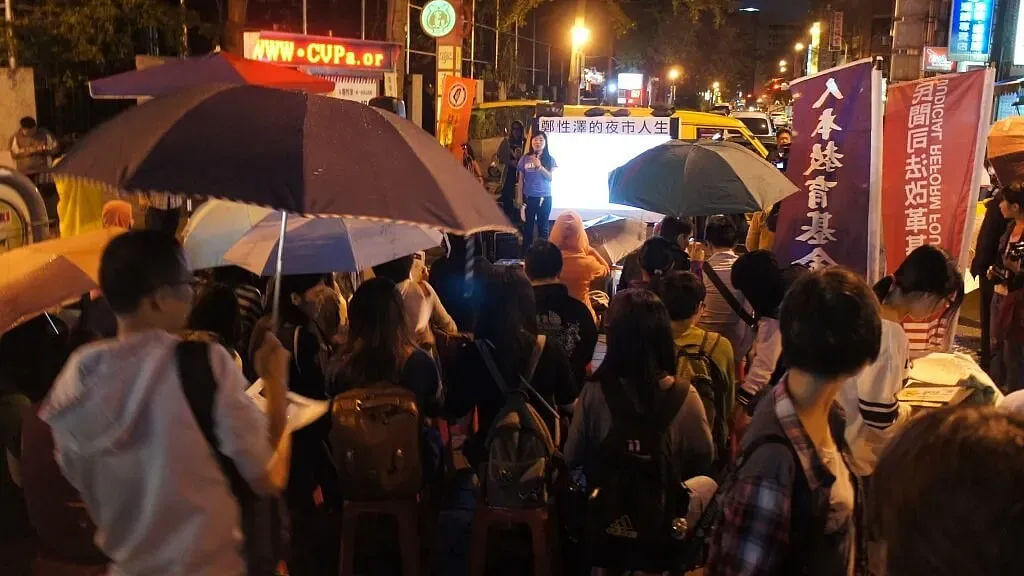
This is yet another polarized case of death penalty or acquittal. The defendant in this case, Cheng Hsing-tse, has lost his freedom for twelve years. Since his death sentence was finalized in 2006, he has lived under the shadow of execution for the past eight years, and due to the state's death penalty policy, his life has been hanging by a thread at any given moment.
Professor Ts'ai's memorial service will be held at 9:00 a.m. on November 9 in the Ching-Yang Hall of the Second Funeral Parlor. All those willing to go and bid Professor Ts'ai a final farewell, or those who cannot attend the send-off on that day but hold deep remembrance for the professor in their hearts, if they are also willing to do something memorable for Professor Ts'ai, can consider the suggestion made in this article: continue to pay attention to and support the retrial of Cheng Hsing-tse's case.
Do Not Look Away
Professor Ts'ai never uttered grand rhetoric, nor did he appear to be a particularly brave person, but when faced with a suspected wrongful conviction in the judiciary, he did not look away. To his disciples, old friends, and new acquaintances who hold him in deep respect, let us also not look away, shall we?
This article is an AI-generated translation of the original Chinese text. In the event of any discrepancy, the Chinese version shall prevail.
