
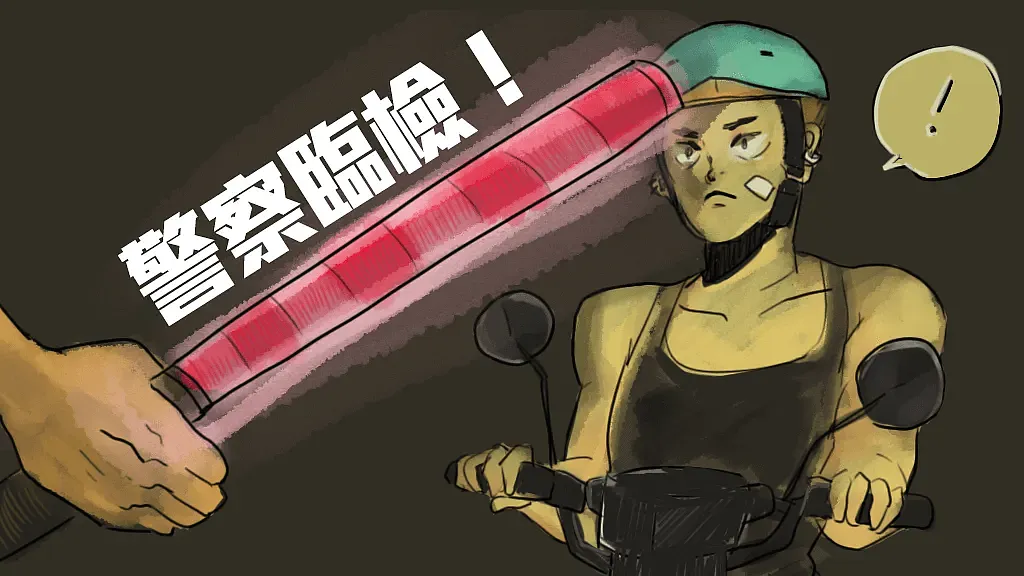
[Legal Life] Ch13 If You Haven't Done Anything Wrong, Why Can't You Be Subjected to a Police Inspection?
Last edited: 2026-07-27
Chun-ming's vehicular misfortune saga reaches Episode 13. With his inner frustration reaching its absolute limit, he stands on his home balcony smoking a cigarette and dials childhood playmate T'ai-sheng (anyone named this seems like trouble...), arranging to meet at a stir-fry restaurant for food and drinks. On the day of the meetup, T'ai-sheng brings along Tu-p'ing, a follower he met before going to prison on a public-security special assignment; the three of them enjoy themselves over drinks, temporarily allowing Chun-ming to put aside the turmoil of his lawsuit. Amidst the lively drinking, Chun-ming complains about Chieh-yun's previous attitude of wanting money while also filing a lawsuit. Upon hearing this, T'ai-sheng gets fired up and, without a second word, orders his follower Tu-p'ing to "bring some hardware" and "say hello" to Chieh-yun's house. As luck would have it, Tu-p'ing finally gets his gear ready in the back seat and, while driving late at night to "pay a visit" as ordered, runs into a police road closure and stop-and-search...
What is a Stop-and-Search (Lin-chien)?
Article 11, Subparagraph 3 of the Police Duty Regulations provides a definitive rule:
"Stop-and-search (Lin-chien): Duties assigned to on-duty personnel in public places or designated locations and road sections to conduct on-site inspections or roadside checks, enforce crackdowns, conduct interrogations, and execute duties conferred by relevant laws and regulations."
In other words, a stop-and-search is a duty method whereby the police intercept and question people in public places or designated locations to maintain public order when they have a reasonable suspicion that a specific person or place is engaging in illegal behavior.
Although a stop-and-search, much like a search under the Code of Criminal Procedure, is an intrusion upon a person or place, its purpose lies in crime prevention and the maintenance of social safety, and it can be carried out without a court-issued warrant. A search, on the other hand, focuses on criminal investigation to discover defendants, criminal evidence, and objects subject to confiscation, and in principle requires a search warrant issued by a court. Therefore, a stop-and-search cannot go too far, and especially cannot exceed a search under the Code of Criminal Procedure. In principle, it is limited to a visual search of a person, place, vehicle, or public place—meaning it is restricted to observing the appearance of persons, objects, or places (limited to what is plainly visible). If further inspection is desired, such as opening sealed items or the trunk, aside from other provisions of law, the consent of the person being inspected is required; one cannot simply open things at will.
More importantly, although a stop-and-search is a necessary action to maintain public order and prevent harm, police officers still cannot be given free rein to exercise it arbitrarily, using "If you haven't done anything wrong, why can't you be subjected to a stop-and-search?" as an excuse for abuse of power. Therefore, the implementation requirements and procedures for various stops-and-search must naturally be accompanied by clear legal norms to conform to the spirit of the Constitution in protecting the freedom and rights of the people. This point has been extremely clear ever since the Council of Grand Justices rendered Interpretation No. 535 in 2001.
Statutory Procedures and Requirements for Stop-and-Search
-
Identity Must Be Stated
Article 4 of the Police Powers Exercising Act stipulates: "When exercising powers, police officers shall wear uniforms or present identification documents to state their identity, and shall inform [the person] of the reasons. If a police officer exercises powers without complying with the provisions of the preceding paragraph, the people may refuse [such exercise]."
-
Locations Must Be Carefully Chosen
-
Public Places
Public places refer to "places where an unspecified majority of people may freely linger, gather, or utilize," such as meeting venues, parks, plazas, stations, aviation stations, and roads. Aside from raising fewer issues regarding the infringement of privacy, when stopping people, cars, boats, and other vehicles to conduct stops-and-search in these places, police must also comply with the provisions of Article 6, Paragraph 1 of the Police Powers Exercising Act—that is, they must have a reasonable suspicion of a criminal offense before initiating it.
Regarding roadside checks commonly seen at crucial road junctions in the story, they must also comply with the provisions of Article 6, Paragraph 1, Subparagraph 6 and the requirements of Paragraph 2 of the same Article. Only when the chief official of the police agency determines, upon judgment, that it is necessary to prevent crimes or handle major public safety or social order events, may they designate public places, road sections, and control checkpoints and order police officers to execute stops-and-search.
Although the aforementioned designation falls under the authority of the chief official of the police agency, it must still be prudently evaluated based on a comprehensive judgment of the local security conditions and past criminal occurrence records; it cannot be decided by casting divination blocks or throwing darts inside a police precinct.
In addition, to block dangerous driving behaviors such as drunk driving, Article 8 of the Police Powers Exercising Act further stipulates that police may also stop and adopt relevant measures regarding vehicles that "have caused hazards or, based on objective and reasonable judgment, are prone to causing hazards," such as practicing S-turns on the road or driving with one's eyes closed.
-
Places Accessible to the Public
There are also "places accessible to the public," which refer to places where unspecified persons may enter and exit at any time, such as acupressure massage centers, drinking establishments, bars, saunas, hotels, KTVs, tourist hotels, coffee and tea houses, and movie theaters. Practice largely holds that because people naturally come and go in places like KTVs during business hours, and if the police enter for the purpose of hazard prevention without forcibly breaking down doors, there seems to be no reason to deny their entry. However, it should be noted that when a "hotel room" is rented to a guest, since the guest has already acquired the right of use over that room, it is akin to a private living space and should enjoy the same protection as a residence; it should not be considered a "place accessible to the public." Therefore, police should not, in principle, drop by a motel to "check the water meter" whether one goes there to take a dump, provide constituent services, or hold a fan meeting.
When the police lawfully enter the aforementioned places accessible to the public and discover persons with suspicious conduct, they should still follow the spirit of Article 6, Paragraph 1 of the Police Powers Exercising Act and initiate a stop-and-search against such person only when they have a reasonable suspicion that the person is suspected of a crime or is likely to commit a crime.
-
-
Conduct Must Be Prudent
-
Public Security Interception and Stopping
According to Article 7 of the Police Powers Exercising Act, in order to prevent the public security hazards referred to in Article 6 of the same Act, identity may be verified, and the following necessary measures may be adopted:
- Intercepting people, cars, boats, and other vehicles.
- Ordering the presentation of identity documents, or inquiring about name, date of birth, place of birth, nationality, residence or domicile, and national ID card serial number, etc. (When identity obviously cannot be verified, the police may take the person to a duty station for verification; when taking them there, physical force shall not be used unless encountering resistance, and starting from the time of interception, [the duration] shall not exceed three hours, and the competent police duty command center shall be reported to immediately, and their designated relatives, friends, or lawyer shall be notified).
- If there are obvious facts sufficient to show that [a person] is carrying items sufficient to commit suicide, self-harm, or injure the life or body of others, their body and carried items may be checked. Since the check here is to prevent the actor from immediately picking up items and causing injury to people nearby, it is limited to patting down from the outside of clothing with both hands from top to bottom, and does not extend to further carefully rummaging through pockets or sealed items.
-
Traffic Interception and Stopping
As mentioned above, to block dangerous driving behaviors such as drunk driving, regarding vehicles that have caused hazards or, based on objective and reasonable judgment, are prone to causing hazards, pursuant to Article 8 of the Police Powers Exercising Act, they may be intercepted and stopped, and the following measures may be adopted:
- Requiring the driver or passengers to present relevant documents or verify their identity.
- Checking the engine, chassis number, or other features sufficient for identification.
- Requiring the driver to submit to an alcohol concentration testing verification.
If the police reasonably suspect that the driver or passengers of the aforementioned vehicle will engage in harmful behavior due to abnormal actions—such as bullets ("ging-ki") dropping out of a pocket—they may also compel them to exit the vehicle; if there are facts sufficient to show that they are likely to commit a crime, the vehicle may also be searched.
-
How to Seek Relief Against an Illegal Stop-and-Search?
Article 29 of the Police Powers Exercising Act points out that an obligor or interested party may, when the police exercise powers under this Act, state reasons on the spot and express defiance objections regarding the methods, procedures to be observed, or other matters infringing upon their interests. If the police deem the objection justified, they shall immediately suspend or correct the enforcement act; if they deem it unjustified, they may continue enforcement. Upon the request of the obligor or interested party, the police shall prepare a record of the reasons for the objection and deliver it to the people.
Furthermore, the written document detailing the stop-and-search process and the reasons for objection constitutes an administrative disposition. If the obligor or interested party considers that the police's exercise of powers involved illegal or improper circumstances that damaged their rights and interests, they may initiate administrative litigation in accordance with the law. In addition, because this administrative disposition of the stop-and-search has already been executed on the spot, the person subjected to the stop-and-search should, pursuant to the latter part of Article 6, Paragraph 1 of the Code of Administrative Procedure, file a lawsuit for "confirmation of the illegality of an administrative disposition," and may concurrently claim damages pursuant to Article 7 of the same Act.
How Should the Story Continue?
At the exact moment Tu-p'ing is subjected to the late-night stop-and-search, because there are too many unusual clubs, paint and Taiwanese salt-crispy chicken in the back seat of his car, the police reasonably suspect him of being suspected of causing injury and trouble, and ask him to step out of the car to check the items he is carrying. Unexpectedly, upon a pat-down search, a controlled weapon known as "brass knuckles" is discovered in his pants pocket. Although Tu-p'ing expresses that having brass knuckles is perfectly natural for a delinquent punk, he is nevertheless invited by the police back to the police precinct to drink tea and make a record; thus, the plan to "bring some hardware" to Chieh-yun's house to "say hello" goes down the drain.
Relevant Legal Provisions
- Article 11, Subparagraph 3 of the Police Duty Regulations: "Stop-and-search (Lin-chien): Duties assigned to on-duty personnel in public places or designated locations and road sections to conduct on-site inspections or roadside checks, enforce crackdowns, conduct interrogations, and execute duties conferred by relevant laws and regulations."
- Article 6 of the Police Powers Exercising Act: "Police may, in public places or places lawfully entered, verify the identity of persons under any of the following circumstances: 1. Having reasonable suspicion that they are suspected of a crime or are likely to commit a crime. 2. Having facts sufficient to show that they have knowledge of a crime that has already occurred or is about to occur. 3. Having facts sufficient to believe that, in order to prevent concrete harm to the life or body of themselves or others, it is necessary to verify their identity. 4. Lingering in a place where there are facts sufficient to show a conspiracy, preparation, or commencement of the execution of a major crime, or where a criminal is hiding. 5. Lingering in a place where a stop (residence) permit should be held, without such permit. 6. Passing through designated public places, road sections, and control checkpoints (Paragraph 1). The designation under Subparagraph 6 of the preceding paragraph shall be limited to what is necessary to prevent crime or handle major public safety or social order events. Such designation shall be made by the chief official of the police agency (Paragraph 2). Police entering places accessible to the public shall do so during business hours and shall not arbitrarily interfere with their business (Paragraph 3)."
- Article 7 of the Police Powers Exercising Act: "Police may, in accordance with the preceding article, take the following necessary measures to verify a person's identity: 1. Intercepting people, cars, boats, and other vehicles. 2. Inquiring about name, date of birth, place of birth, nationality, residence or domicile, and national ID card serial number, etc. 3. Ordering the presentation of identity documents. 4. If there are obvious facts sufficient to show that they are carrying items sufficient to commit suicide, self-harm, or injure the life or body of others, their body and carried items may be checked (Paragraph 1). When identity obviously cannot be verified by the methods in Subparagraphs 2 and 3 of the preceding paragraph, the police may take such person to a duty station for verification; when taking them there, physical force shall not be used unless encountering resistance, and the time thereof shall not exceed three hours from the interception, and the competent police duty command center shall be reported to immediately and their designated relatives, friends, or lawyer shall be notified (Paragraph 2)."
- Article 8 of the Police Powers Exercising Act: "Police may intercept and stop vehicles that have caused hazards or, based on objective and reasonable judgment, are prone to causing hazards, and adopt the following measures: 1. Requiring the driver or passengers to present relevant documents or verify their identity. 2. Checking the engine, chassis number, or other features sufficient for identification. 3. Requiring the driver to submit to an alcohol concentration testing verification (Paragraph 1). If the police reasonably suspect that the driver or passengers of the aforementioned vehicle will engage in harmful behavior due to abnormal actions, they may compel them to exit the vehicle; if there are facts sufficient to show that they are likely to commit a crime, the vehicle may also be searched (Paragraph 2)."
- Article 29 of the Police Powers Exercising Act: "An obligor or interested party may, when the police exercise powers under this Act, state reasons on the spot and express objections regarding the methods, procedures to be observed, or other matters infringing upon their interests (Paragraph 1). If the police deem the objection in the preceding paragraph justified, they shall immediately suspend or correct the enforcement act; if they deem it unjustified, they may continue enforcement, and upon the request of the obligor or interested party, shall prepare a record of the reasons for the objection and deliver it (Paragraph 2). If an obligor or interested party suffers damage to their rights and interests due to illegal or improper circumstances in the police's exercise of powers, they may initiate petition and administrative litigation in accordance with the law (Paragraph 3)."
This article is an AI-generated translation of the original Chinese text. In the event of any discrepancy, the Chinese version shall prevail.
