
【Legal Life】Ch19 What to do when injured due to defective public facilities: Seeking justice
Last edited: 2026-07-27
That car accident had happened several months ago, and late at night in the quiet of her bed, Chieh-Yun still could not help but recall the scene back then—the screech of the brakes, the terror, the very moment of impact—all of which left her tossing and turning, unable to sleep. On yet another distressing night, Chieh-Yun sighed, curling up and hugging herself, when she suddenly remembered: before the accident, she had passed a 90-degree sharp turn, and after the turn, the width of the road sharply decreased, suddenly allowing only one car to pass, before she saw Chün-Ming's car speeding directly toward her and her grandmother.... Thinking of this, a flash of inspiration hit Chieh-Yun's mind, and she decided to immediately roll over and look up information to see if the road was poorly designed and what kind of justice she could seek from the government management agency.
Issue Awareness: If public facilities (such as roads) are defective in their establishment or management, resulting in damage to rights, how does one claim state compensation?
Where is the basis for the claim?
At this point, please look directly at Article 3, Paragraph 1 of the Compensation Act: "The State shall be liable for damages if any public facility, established or managed by the State, is defective and thereby causes damage to the life, body, or property of any person." The relevant elements of this article are explained below.
-
What is a public facility?
So-called public facilities refer to places that everyone can access, such as stadiums, parks, bridges, airports, and parking lots. Taking the road in this case as another example, it also includes subordinate hardware equipment such as manhole covers, guardrails, signs, or signal lights. It must be specially emphasized that the public facilities referred to here must have already been "established and made available for public use." Therefore, a site that is not yet completed is merely a construction site and is not a public facility as referred to in this article. Moreover, if someone violates access control regulations, sneaks into a military camp, and takes photos thinking it is their own home alongside an Apache helicopter, but is accidentally injured by a loose propeller, for the same reason—since it was not provided for public use—they cannot claim state compensation (whether the provisions of the Civil Code on damage compensation apply is another matter).
Furthermore, "public" as referred to in this article is not limited to being "owned" by the State or other public legal persons; as long as the facility is indeed under the "management status" of such organizations, that is sufficient.
-
How is establishment or management defective?
"Establishment" refers to the "design, construction, or installation" of public facilities; management refers to the "management and maintenance" after the public facilities have been established. The defect referred to here carries the implication of a threshold; that is, during the process of establishing or managing a public facility, it fails to meet the "required state or function." For example, failing to provide sufficient lighting in accordance with the law in a specially dangerous road section, or failing to reasonably set up warning signs and guardrails to reduce the driving risks of that section and ensure the driving safety of road users, or leaving a large hole on the road unrepaired for a long time, etc.
-
How does facility defect cause infringement of rights?
There must still be a "causal relationship" between the defective facility and the personal injury of rights. That is to say, even if a sightseeing cable car has super poor design, if an individual's injury stems from their own desire to challenge extreme sports by jumping off the cable car down a hillside and breaking their leg, this situation has nothing to do with the poor design and does not constitute a causal relationship.
-
What is the statute of limitations for claims?
This part often leads victims to inadvertently exceed the time limit, making them unable to continue vindicating their rights, and therefore deserves close attention. Article 8 of the State Compensation Act stipulates: "The right to claim compensation shall be extinguished if not exercised within two years from the time the claimant knows of the damage; the same shall apply if five years have elapsed from the time the damage occurred."
For more detailed explanations of examples with additional elements and related evidentiary issues, please further refer to another article by the same author, "Disaster Prevention and Relief and State Compensation."
How does the claim process work?
-
Agency negotiation comes first
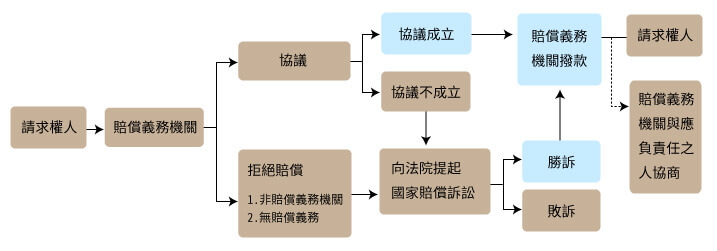
At this point, let us flip through the legal provisions again. Article 10 of the State Compensation Act stipulates: "When claiming damages pursuant to this Act, a written claim shall first be submitted to the compensation-obligated agency (Paragraph 1). The compensation-obligated agency shall promptly negotiate with the claimant regarding the aforementioned claim. When an agreement is reached, a written agreement shall be drawn up, and such written agreement may serve as an executive title (Paragraph 2)."
As can be seen from the aforementioned provisions, the first step of the claim process adopts the "principle of prior agency negotiation," meaning one cannot directly file a lawsuit with the court using a complaint! One must first try to negotiate with the agency. The aforementioned written format is detailed in Article 17 of the Enforcement Rules of the State Compensation Act as follows (claimants must strictly abide by the aforementioned format, otherwise the compensation-obligated agency will still notify the claimant to make corrections.):
- The claimant's name, gender, date of birth, place of birth, national ID card number, occupation, and domicile or residence. If the claimant is a legal person or other organization, its name, principal office or principal place of business, and the name, gender, domicile, or residence of its representative.
- If there is an agent, their name, gender, date of birth, place of birth, national ID card number, occupation, and domicile or residence.
- The facts, reasons, and evidence for claiming compensation.
- The amount of damages claimed or the content of restoration to the original state.
- The compensation-obligated agency.
- Year, month, and day.
-
Court lawsuit comes later
What should be handled if the claimant is refused or the agency delays in responding? At this time, pursuant to Article 11 of the State Compensation Act, when (1) the compensation-obligated agency refuses compensation, or (2) fails to start negotiations for more than thirty days from the date the claim is submitted, or (3) negotiations fail to reach an agreement for more than sixty days from the date negotiations begin, the claimant may file a state compensation lawsuit with the competent district court.
For a brief explanation, please refer to the Ministry of Justice State Compensation Flowchart below.
How should the story continue?
Stimulated by her research in the middle of the night, Chieh-Yun accordingly took a day off from her part-time job the next day. As a result of unravelling the details step by step, she discovered that the road at the accident scene made a 90-degree turn with a sudden decrease in width, and although the management unit had set up a "continuous turns" warning sign before the curve, it failed to set up a warning sign for this 90-degree sharp turn at a certain required distance ahead in accordance with regulations. There seemed to be a flaw in the road sign design, which failed to give a reminder before the turn, leaving Chieh-Yun with insufficient reaction time after entering the curve, thereby reducing her reaction time to evade Chün-Ming's vehicle, which jointly caused the car accident. Having figured out the whole story with a determined mood, Chieh-Yun began preparing materials to file a state compensation negotiation with the road competent authority....
(As for whether the insurance company can subrogate and claim state compensation from the agency after indemnifying Chieh-Yun pursuant to the contract, that is another matter.)
Related Legal Provisions
- Article 3, Paragraph 1 of the State Compensation Act: "The State shall be liable for damages if any public facility, established or managed by the State, is defective and thereby causes damage to the life, body, or property of any person."
- Article 8 of the State Compensation Act: "The right to claim compensation shall be extinguished if not exercised within two years from the time the claimant knows of the damage; the same shall apply if five years have elapsed from the time the damage occurred."
- Article 10 of the State Compensation Act: "When claiming damages pursuant to this Act, a written claim shall first be submitted to the compensation-obligated agency (Paragraph 1). The compensation-obligated agency shall promptly negotiate with the claimant regarding the aforementioned claim. When an agreement is reached, a written agreement shall be drawn up, and such written agreement may serve as an executive title (Paragraph 2)."
- Article 11, Paragraph 1 of the State Compensation Act: "When the compensation-obligated agency refuses compensation, or fails to start negotiations for more than thirty days from the date the claim is submitted, or negotiations fail to reach an agreement for more than sixty days from the date negotiations begin, the claimant may file a state compensation lawsuit with the competent district court.
This article is an AI-generated translation of the original Chinese text. In the event of any discrepancy, the Chinese version shall prevail.