[Legal Life] Ch21 BE A GIVER - The Juvenile Justice Act Concerning Assistance and Atonement
Last edited: 2026-07-27
Just as the prosecutor decided to indict Tu P'ing for public insult, assault, and other charges, and was working overtime in the office to draft the indictment (EP18). The prosecutor shockingly discovered that beneath Tu P'ing's mature-looking face lay a tender age—Tu P'ing was actually only 17 years old. Looking at Tu P'ing's date of birth, the prosecutor was reminded of Wu X-chen's voice in the commercial... Knowledge is not merely used for personal gain; knowledge can be used to contribute; knowledge can be used to help others...
Issue Formulation: Because of Tu P'ing's age, his case should be governed by the Juvenile Justice Act. Which cases are actually handled under the Juvenile Justice Act? And how do juvenile proceedings differ from ordinary criminal litigation procedures?
It Is Also a Litigation Procedure
As people grow older, both their ability to handle matters and society's expectations of them change. Just like a three-year-old child lying on the ground demanding to eat KenXXucky Fried Chicken compared to a soldier lying on the ground eating KenXXucky Fried Chicken—everyone would think the former is cute, while the latter is pathetic. In fact, the design of the law is much the same. When people bear different responsibilities and society holds them to different levels of culpability due to differences in "age," the design of criminal liability naturally involves differential treatment in terms of sentencing severity (such as Article 18 of the Criminal Code, where those under 14 are not punished, and those aged 14 to 18 or over 80 may receive reduced sentences). To respond to differences in people's capacities to handle situations corresponding to their "age," the legal treatment applied to them also differs. The Juvenile Justice Act is the law governing how litigation proceedings are conducted for such individuals; much like the Code of Criminal Procedure, it is a procedure outlining how "persons" involved in "certain cases" are to be "handled."
According to Articles 2 and 3 of the Juvenile Justice Act, as long as a juvenile between the ages of 12 and under 18 is involved in a "criminal case" or is in a state of potentially committing a criminal case, they can be brought into the legal realm constructed by the Juvenile Justice Act. The condition of "potentially committing a criminal case" is legally termed an "act of predisposition to delinquency" (虞犯). The statutory types of such predispositions include frequently associating with people from the temple gates of Monga (frequently associating with persons having criminal habits), frequently visiting Hou-pi-tsuo to see Hsiao-ning (frequenting improper venues), frequently truancy or running away from home, joining local gang factions (unruly organizations), carrying a ruler-two or a butterfly knife in one's school bag for no good reason (frequently carrying weapons without justifiable reason), inhaling contact cement (inhaling or administering hallucinogens other than narcotics or psychotropic substances), or bringing a knife before someone and shouting that they must pay with blood (performing preparatory criminal acts or attempted crimes that are not punishable by law).
Basically, doing any of the things in the video makes one a juvenile with a predisposition to delinquency (eating snacks at the temple gate does not count).
Steps for Handling Juveniles
Step 1: Send to Court First
Unlike the steps in criminal litigation, in criminal litigation proceedings, criminal cases are generally concluded through investigation by a prosecutor. Depending on the circumstances of the case, the prosecutor will "indict," "not indict" (decide not to prosecute), or grant "suspension of prosecution." After indictment, the case files and evidence are transferred to the court, and the court begins trial proceedings. However, pursuant to the Juvenile Justice Act, anyone who discovers that a juvenile is involved in a criminal case, any person or institution bearing the obligation to protect the juvenile (including persons with supervisory authority over the juvenile, the juvenile's school, or institutions engaged in juvenile protection work), or judicial personnel (prosecutors, judicial police officers, or courts) who discover in the course of executing their duties that a juvenile is involved in a "criminal case" or is in a state of potentially committing a criminal case, must—following preliminary investigation by prosecutors and police—first transfer the case to the juvenile court.
Step 2: Next, Investigation by a Juvenile Investigator
The judge of the juvenile division of a district court or a juvenile and family court will conduct a brief review of the juvenile's involvement in the case and the circumstances of the offense, and then hand the case over to a juvenile investigator. The juvenile investigator must investigate necessary matters relating to the juvenile's behavior connected with the incident, the juvenile's character, life history, physical and mental condition, family circumstances, social environment, and educational level, submit a report, and provide recommendations to the judge. However, this recommendation cannot serve as the sole evidence for the judge to ascertain the facts in Step Three.
Step 3: Then the Judge Issues a Ruling
Depending on the results of the investigation, the juvenile court may render different rulings. When the criminal offense involving the juvenile carries a minimum statutory penalty of five years or more of imprisonment, or when the juvenile has already reached the age of 20 after the case is pending in court, the matter constitutes a "juvenile criminal case," and the court must transfer the case to the prosecutor for investigation. If the case does not fall into the two aforementioned categories, but the juvenile court, based on the investigation results, deems the gravity of the offense to be significant and considers it appropriate for the juvenile to receive criminal punishment after taking into account the juvenile's conduct, personality, and background, it may likewise transfer the case to the prosecutor for investigation. If the juvenile court, based on the investigation results, deems that the juvenile court itself should directly commence trials, the court shall render a ruling to commence a trial. Once this ruling is rendered, the juvenile case bypasses the prosecutor's investigation and indictment, entering the juvenile case trial proceedings, which constitute a "juvenile protection case."
However, if the court deems the juvenile's circumstances to be quite minor, and that subjecting the juvenile to subsequent juvenile trial proceedings or imposing admonition or other protective measures of an educational nature would merely be a nuisance with no necessity for the juvenile to enter the system—let alone requiring prosecutorial intervention for investigation—it may render a ruling of "non-placement for trial." In such cases, the case will not enter juvenile trial proceedings; nevertheless, when rendering a ruling of non-placement for trial, the court may attach certain measures concerning the juvenile, such as referring them to a child and youth welfare organization for counseling, or entrusting them to the juvenile's statutory agent for strict discipline. In cases involving victims, with the consent of the juvenile, the juvenile's statutory agent, and the victim, the court may also order the juvenile to apologize to the victim, write a statement of repentance, or bear responsibility for compensating the victim's damages.
What Does a Courtroom for Trying Juveniles Look Like? – A Secret and Warm Juvenile Courtroom
As previously mentioned regarding the side effects of "labeling" in criminal litigation procedures, and considering that a juvenile still has a long life ahead, whether it is the investigation by the juvenile investigator, the trial ruling by the judge, or the final adjudication process (including juvenile criminal case handling and protection case trial proceedings), the principle is that these are not open to the public. The court may only permit the juvenile's relatives, school teachers, persons engaged in juvenile protection work, or other persons related to the juvenile case to be present to observe as appropriate, or—upon the request of the juvenile, the juvenile's statutory agent, or the person currently protecting the juvenile for an open trial—the court may conduct an open trial as permitted by law (such as in sexual assault cases, where even if the juvenile or their statutory agent requests it, trials still cannot be conducted publicly pursuant to regulations).
Furthermore, unlike ordinary criminal or civil trial proceedings where both parties participating in litigation are filled with an oppressive atmosphere, and the judge wears judicial robes and holds a gavel while sitting majestically on the bench, in trial proceedings for juvenile protection cases, the judge does not wear judicial robes and does not sit high above on the judicial bench. Instead, they sit at a flat round table together with the juvenile investigator, the juvenile, the juvenile's statutory agent, the protector, and the victim, discussing through collaborative trial proceedings what the juvenile actually did, why they did it, and how everyone can cooperate to counsel the juvenile in the future (though this is not the case in juvenile criminal case courtrooms).
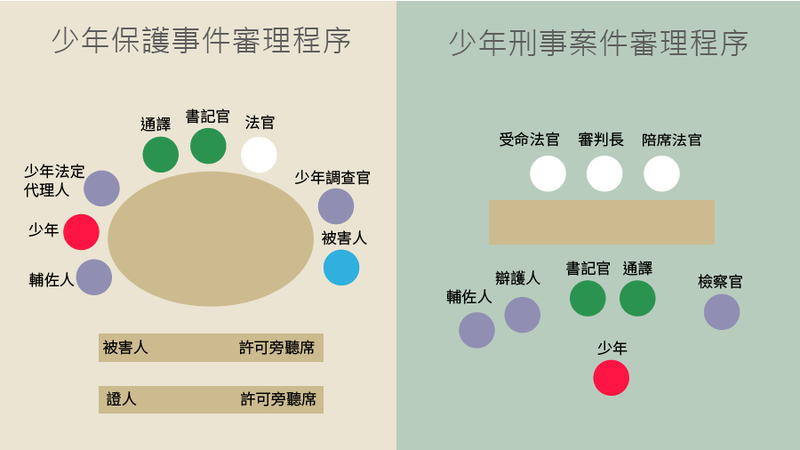
Considering that such institutional differences are designed between "juveniles" and "adults"—taking into account not only that juveniles lack self-control and experience, are easily seduced by external influences, and possess weaker culpability, but also that for juveniles who are currently in a stage of high malleability—compared to a criminal litigation procedure full of labels and high pressure, conducting litigation procedures with a higher degree of privacy protection and lower pressure not only helps juveniles in need of protection alleviate the stress of facing proceedings, but also helps other participants in the proceedings discuss the causes of the juvenile criminal case or predisposition-to-delinquency incident in order to render the best disposition for the juvenile.
How the Story Should Continue
As soon as the prosecutor discovered Tu P'ing's age, he immediately transferred the case to the juvenile court. The juvenile investigator discovered that Tu P'ing's parents were busy with work on weekdays, and that his grandmother—the only person at home who would chat with Tu P'ing and discipline him—had passed away during his third year of junior high school, after which his parents simply treated their ATM as a parent and home as a hotel. He began hanging out with boss T'ai-sheng, dabbling in smoking and drinking, participating in debt collection and fights... For such a juvenile, how on earth should the judge Be a giver? Standing at this crossroads of decision, once the judge decides to let the case enter the trial proceedings of a "juvenile criminal case," is the juvenile destined only to be locked up? And after entering the trial proceedings of a "juvenile protection case," is it likewise impossible to impose criminal punishment on the juvenile? Let us continue to watch and see.
Related Legal Provisions
Article 18 of the Criminal Code
~Juvenile Justice Act~
Article 17: Anyone who knows of an incident under Article 3, Paragraph 1 may report it to the competent juvenile court.
Article 18, Paragraph 1: "Prosecutors, judicial police officers, or courts who, in the execution of their duties, have knowledge of an incident under Article 3 shall transfer it to the competent juvenile court."
Article 19, Paragraph 1: After receiving an incident transferred, requested, or reported pursuant to Article 15, Article 17, and the preceding article, the juvenile court shall first have a juvenile investigator investigate matters relating to the juvenile's behavior connected with the incident, their character, background, physical and mental condition, family circumstances, social environment, educational level, and other necessary matters, submit a report, and attach recommendations.
Article 27, Paragraph 1: If the juvenile court, based on the results of the investigation, finds that a juvenile has committed an offense punishable under criminal law and has any of the following circumstances, it shall render a ruling to transfer the case to the prosecutor of the court prosecutor's office with jurisdiction:
1. Having committed an offense carrying a minimum statutory penalty of five years or more of imprisonment.
2. Having reached the age of twenty after the case is pending.
Article 27, Paragraph 2: Except for the circumstances in the preceding paragraph, if the juvenile court, based on the results of the investigation, deems the gravity of the offense to be significant and considers it appropriate for the juvenile to receive criminal punishment after taking into account their conduct, personality, and background, it may render a ruling to transfer the case to the prosecutor of the court prosecutor's office with jurisdiction.
Article 73, Paragraph 1: Trials may be held not in public.
Article 73, Paragraph 2: The provisions of the proviso of Article 34 shall apply mutatis mutandis when trials are not held in public.
Article 73, Paragraph 3: Where the juvenile, the juvenile's statutory agent, or the person currently protecting the juvenile requests an open trial, the court shall not refuse unless there is a statutory cause for non-disclosure.
This article is an AI-generated translation of the original Chinese text. In the event of any discrepancy, the Chinese version shall prevail.