【Legal Life】Ch23 It is greatest virtue to correct one's mistakes
Last edited: 2026-07-27
After reviewing the report submitted by the juvenile probation officer (EP21), the judge concluded that Tu-p'ing was merely a lonely child. Since fate had given him the opportunity to be a giver, he decided to seize it well...
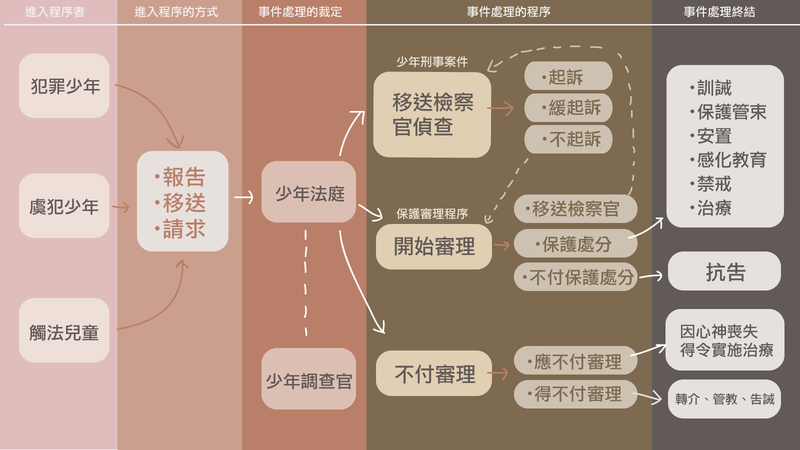
What are the differences between juvenile protection cases and juvenile criminal cases, and how does the subsequent referral procedure take place?
How Should These Juveniles Be Handled?
Every juvenile inevitably encounters setbacks throughout their developmental process; however, not every juvenile is afforded the opportunity to receive assistance and grasp a helping hand when facing such developmental setbacks. The Juvenile Justice Act plays the role of ensuring that juveniles can grasp that helping hand. For juveniles who are in a stage of high malleability, compared to stigmatizing and high-pressure criminal punishments, if they can be granted educational protective measures, or even if penalties are imposed upon them, treated separately from adults, the chances of a juvenile "turning over a new leaf" will be vastly improved.
As the old saying goes, "He who steals a gourd in childhood will steal an ox in manhood." If a juvenile who steals a gourd is directly locked up without being subjected to educational protective measures, or is locked up alongside adults, it is tantamount to pushing the juvenile further down a path of social rejection, significantly increasing the likelihood that they will contract bad habits or "enhance their criminal skills." Conversely, if a well-functioning procedural design can be implemented, both the personal rehabilitation of the juvenile and the costs and risks faced by society as a whole are greatly reduced.
As introduced previously (EP21), when a case is not referred to a prosecutor and is not subject to a hearing, it enters the juvenile protection case procedure. Whether a case is referred to a prosecutor, not subjected to a hearing, or enters the juvenile protection hearing procedure is determined by the judge through a ruling that takes into consideration the juvenile probation officer's report and other evidence. However, when the juvenile court adjudicates a party aged 7 to under 12 who has violated criminal laws, the juvenile court must apply the provisions governing juvenile protection cases under the Juvenile Justice Act (Article 85-1 of the Juvenile Justice Act).
Protection Case Hearing Procedure ≠ Protective Measures
A judge's decision to apply the protection case hearing procedure does not mean that the juvenile entering the procedure will necessarily be granted protective measures. This is because case hearings are dynamic. If, after the hearing commences, the judge discovers circumstances prescribed in Article 27 of the Juvenile Justice Act—including that the crime involved carries a minimum statutory penalty of imprisonment for five years or more, or that the juvenile has reached the age of 20 after the case was docketed—the judge may still, pursuant to Article 40 of the Juvenile Justice Act, transfer the case to the prosecutor, thereby initiating the juvenile criminal case procedure. For example, the court initially believed the delinquent juvenile accidentally stabbed an awl into the victim's eye during a fight, causing the victim to lose one eye (negligent infliction of grievous bodily harm, carrying a sentence of imprisonment of one year or less). However, investigation revealed that the delinquent juvenile acted upon the belief that "if you don't finish them off today, they will finish you off someday," intending from the outset to leave the victim with only one eye (the crime of grievous bodily harm, carrying a sentence of imprisonment from 5 to 12 years). In such a case, the juvenile court may still transfer the case to the prosecutor, who will conduct an investigation and render a decision to prosecute, suspend prosecution, or not prosecute based on the investigative results.
Juvenile Criminal Case Procedure ≠ Sentencing Judgment
The same structural design appears in the juvenile criminal hearing procedure. When a prosecutor, after conducting an investigation pursuant to a court ruling, deems that the crime committed by the juvenile carries a sentence of imprisonment of five years or less, and—taking into consideration the relevant provisions of Article 57 of the Criminal Code—considers it more appropriate to render a non-prosecution disposition coupled with protective measures, the prosecutor may issue a non-prosecution disposition and transfer the case to the juvenile court for a hearing in accordance with juvenile protection cases. Nevertheless, to prevent juvenile cases from spinning endlessly in a loop where the juvenile court transfers the case to the prosecutor, and the prosecutor issues a non-prosecution disposition to transfer it back to the juvenile court, Paragraph 2 of Article 67 also stipulates that once a case has been transferred by a prosecutor via a non-prosecution disposition to the juvenile court for a hearing as a juvenile protection case, if the juvenile court subsequently issues a transfer ruling, the prosecutor may no longer issue a non-prosecution disposition to transfer the case back to the juvenile court for a juvenile protection hearing.
In short, grounded in the concept of giving juveniles a second chance, the handling procedures for juvenile cases involve quite intricate interlocking workflows.
Conclusion of Juvenile Case Proceedings
If a juvenile goes through the criminal case hearing procedure and the conclusion is the imposition of a custodial sentence, taking into account that juvenile offenders have different correction methods and needs compared to adult offenders, they will be sent to juvenile correction schools (currently including Ming-yang Senior High School and Cheng-cheng Senior High School, though Cheng-cheng Senior High School in practical operations mostly houses juveniles subjected to reformatory education under protective measures). If the conclusion of the juvenile court's protection hearing procedure is the imposition of juvenile protective measures, the contents include reprimand, protective supervision, placement and guidance, and reformatory education (Article 42 of the Juvenile Justice Act).
Among the protective measures implemented for juveniles, the one that most severely restricts a juvenile's personal liberty is reformatory education. The execution of reformatory education is carried out by placing the juvenile in a juvenile reformatory school (in practical operations, this also includes Cheng-cheng Senior High School in Kaohsiung, while the reformatory school in Changhua is the sole facility housing female juveniles). It is hoped that through such placement, the juvenile's bad habits can be corrected, allowing them to repent and turn over a new leaf. Within the reformatory school, based on the juvenile's actual needs, they are cultivated with the ability to handle future livelihoods or provided with supplementary education to continue their schooling. The execution period of reformatory education shall not exceed 3 years. When execution has exceeded six months and it is deemed unnecessary to continue, the juvenile probation officer or the executing agency may present relevant evidence and apply to the court for the exemption or suspension of its execution. When the execution of reformatory education is suspended, the remaining execution period shall be ordered by the court to be placed under protective supervision.
The placement and guidance measure is primarily designed with the consideration that placing juveniles into specialized facilities easily raises concerns of stigmatization. Under the consideration of prioritizing the protection of juveniles, by placing them in welfare institutions, those subject to the measure—especially juveniles whose family functions are deficient—are allowed to grow up under better conditions and in an environment free from stigmatization. The period of placement and guidance for a juvenile is between 2 months and 2 years. When the execution period exceeds 2 months, the execution has achieved significant results, and it is deemed unnecessary to continue, or when there are factual reasons making it better for the juvenile to cease further execution, the placement institution, the juvenile, or the juvenile's statutory agent may present evidence and apply to the court for exemption from execution. However, if it is deemed necessary to continue placement and guidance, an application may be made to the court for a ruling to extend the period, provided that such extension shall not exceed 2 years. Similar to protective supervision (see below), if a juvenile violates matters required to be observed during the placement and guidance period, and the circumstances are serious, or if they violate matters required to be observed again after a detention and observation measure, making it difficult to achieve placement results, an application may be made to the court for a ruling to revoke the placement and guidance, upgrading the intensity of the placement and guidance measure to reformatory education, whereupon the remaining period of the juvenile's protective measures must be served in a reformatory institution for reformatory education.
Protective supervision replaces imprisonment measures through long-term guidance, whereby a designated person (usually a juvenile probation officer) or an organization/group supervises whether the juvenile complies with matters specified by the court, guiding the juvenile to re-adapt to social life. During execution, through frequent contact with the juvenile, in addition to monitoring the juvenile's daily activities, guidance can also be provided regarding the juvenile's upbringing, daily life, physical health, employment, and environmental improvement. Put simply, this judicial treatment continuously "nudges" the juvenile to help them distance themselves from a past life of lawbreaking and return to the right track. The execution period of protective supervision shall not exceed 3 years or until the juvenile reaches the age of 21. If execution has already exceeded 6 months with demonstrated results and it is deemed unnecessary to continue, or if subsequent evaluation shows that discontinuing execution is more appropriate, the protective supervision measures may be terminated. The implementation of protective supervision may be combined with community service, with the duration limited to no less than 3 hours and no more than 50 hours. If a juvenile violates matters required to be observed during the protective supervision period and disobeys admonitions twice or more, and the juvenile court deems it necessary to "conduct a close inspection," it may rule to detain the juvenile in a juvenile detention home for a period of up to 5 days. If, after such detention and observation, the juvenile repeatedly violates matters required to be observed, making it clear that protective supervision cannot achieve its intended effect, the juvenile probation officer may apply to the juvenile court to discontinue protective supervision and upgrade the intensity of the protective measure to reformatory education, requiring the juvenile to serve the remainder of their protective measure period in a reformatory institution for reformatory education.
Reprimand refers to the judge notifying the juvenile or their statutory agent to appear on a specified date (usually the day of the court session). The judge explains to the juvenile in open court which specific wrongful act they committed, what legal consequences this wrongdoing will entail, and informs the juvenile of the rules they must observe, while admonishing and encouraging the juvenile not to reoffend, giving the juvenile a reality check through the court system. The implementation of a reprimand against a juvenile may be combined with weekend lifestyle guidance, requiring the juvenile to report to the court for guidance on weekends or holidays, administered by a juvenile probation officer or an appropriate institution or individual. Such guidance may be conducted individually or alongside other juveniles.
In addition, to prevent criminal labeling from affecting a juvenile's future prospects and to grant them an opportunity for a fresh start, records of juveniles entering the juvenile justice procedure will all be expunged after successive time limits. If a case is not subjected to a hearing, the records will be expunged immediately after the ruling. If a case is not subjected to a hearing but is accompanied by a referral, disciplinary education, or admonition measure, it shall be deemed as never having had such referral, disciplinary education, or admonition measure declared two years after the completion of execution. Similarly, three years after the completion of protective measures or the execution of a prison sentence, it shall be deemed as no protective measures or prison sentence having been declared.
If a juvenile subjected to protective measures is addicted to drugs, marijuana, hallucinogens, or has a drinking habit, or if the juvenile exhibits obvious physical or mental defects, the court may add an ancillary measure alongside the protective measures, requiring the juvenile to enter an appropriate facility for treatment. In addition to measures targeting the juvenile themselves, when the court evaluates that a juvenile is involved in a "criminal case" or is in a state of potentially violating criminal laws, and the reason they are subjected to protective measures or imprisonment stems from the neglect of the juvenile's upbringing by their statutory agent or guardian, the juvenile court may also rule to require the juvenile's statutory agent or guardian to undergo parental education guidance ranging from 8 to 50 hours.
How the Story Should Continue
The judge evaluated that Tu-p'ing's violations were merely public insult and bodily injury, coupled with an alienation from his family environment. Believing that the best approach for Tu-p'ing was to continuously provide gentle reminders while retaining a certain degree of freedom and keeping him away from his old environment where he constantly messed around with T'ai-sheng, the judge decided to subject Tu-p'ing to two years of protective supervision. Furthermore, the judge felt that Tu-p'ing's parents had served merely as ATMs and had never attempted any better parenting methods for Tu-p'ing. Consequently, the court also ordered Tu-p'ing's parents to undergo forty hours of parental education guidance.
Relevant Legal Provisions
~Juvenile Justice Act~
Article 17: Anyone who has knowledge of an event referred to in Subparagraph 1, Article 3 may report it to the competent juvenile court.
Article 18, Paragraph 1: "Prosecutors, judicial police officers, or courts who, in the performance of their duties, have knowledge of an event referred to in Article 3 shall transfer the case to the competent juvenile court."
Article 19, Paragraph 1: After receiving a transfer, request, or report of an event pursuant to Article 15, Article 17, and the preceding article, the juvenile court shall first have a juvenile probation officer investigate matters related to the juvenile's behavior concerning the event, their character, background, physical and mental condition, family circumstances, social environment, level of education, and other necessary matters, submit a report, and attach recommendations.
Article 27, Paragraph 1: If, based on the results of the investigation, the juvenile court finds that a juvenile has violated criminal laws and falls under any of the following circumstances, the court shall issue a ruling to transfer the case to the prosecutor of the court prosecutor's office with jurisdiction:
1. The crime committed carries a minimum statutory penalty of imprisonment for five years or more.
2. The juvenile has reached the age of 20 after the case was docketed.
Article 27, Paragraph 2: Except for the circumstances in the preceding paragraph, if the juvenile court, based on the results of the investigation, deems the circumstances of the crime to be serious and—taking into consideration their character, personality, background, and other conditions—considers it appropriate for the juvenile to receive criminal punishment, the court may issue a ruling to transfer the case to the prosecutor of the court prosecutor's office with jurisdiction.
Article 29: If, based on the results of the juvenile probation officer's investigation, the juvenile court deems the circumstances to be minor and considers it appropriate not to hold a hearing, it may render a ruling not to subject the case to a hearing and take the following dispositions:
1. Refer the child or juvenile to a welfare or educational institution for appropriate guidance.
2. Deliver the child or juvenile to their statutory agent or current custodian for strict discipline and guidance.
3. Admonition.
Article 40: If, based on the results of the hearing, the juvenile court deems that the case involves circumstances under Paragraph 1 of Article 27, it shall issue a ruling of transfer; if it involves circumstances under Paragraph 2 of the same article, it may issue a ruling of transfer.
Article 42, Paragraph 1: In adjudicating a case, the juvenile court shall, apart from dispositions under the preceding two articles, rule to notify the juvenile of the following protective measures:
1. Reprimand, and may also be subjected to weekend lifestyle guidance.
2. Placement under protective supervision, and may also be ordered to perform community service.
3. Placement in an appropriate welfare or educational institution for guidance.
4. Commitment to a reformatory education institution for reformatory education.
Article 42, Paragraph 2: A juvenile who falls under any of the following circumstances may be ordered to undergo the following dispositions prior to or simultaneously with the protective measures in the preceding paragraph:
1. A juvenile who is addicted to narcotics or the use of anesthetics or hallucinogens, or who has a drinking habit, shall be ordered into an appropriate place to undergo prohibition treatment.
2. A juvenile who exhibits obvious physical or mental defects shall be ordered into an appropriate place to undergo medical treatment.
Article 55-3: If a juvenile refuses without justifiable reason to accept dispositions under Paragraph 1 of Article 29 or Subparagraphs 1 and 3 of Paragraph 1 of Article 42, the juvenile probation officer, juvenile protection officer, the juvenile's statutory agent or current custodian, or the juvenile welfare or educational institution may apply to the juvenile court for the issuance of a warning notice. If warnings prove ineffective, each of the aforesaid applicants may apply to the juvenile court for a ruling to detain the juvenile in a juvenile detention home for observation for a period of up to 5 days.
Article 73, Paragraph 1: Trials may be held in camera.
Article 73, Paragraph 2: The provisions of the proviso to Article 34 shall apply mutatis mutandis to trials held in camera.
Article 73, Paragraph 3: Where a juvenile, the juvenile's statutory agent, or current custodian requests a public trial, the court shall not refuse unless there are statutory grounds prohibiting public access.
Article 83-1, Paragraph 1: Two years after the completion of execution of a referral disposition under Paragraph 1 of Article 29, or three years after the completion of execution or pardon of protective measures or a criminal sentence, or after a ruling of non-hearing or non-protection measure becomes final, the juvenile shall be deemed as never having received the respective declaration.
Article 83-1, Paragraph 2: In the circumstances of the preceding paragraph, the juvenile court shall notify the agencies maintaining the juvenile's criminal record and related information to have the juvenile's criminal record and related information expunged.
Article 84, Paragraph 1: Where the statutory agent or guardian of a juvenile, due to negligence in upbringing, causes the juvenile to commit an act violating criminal laws, or an act with the risk of violating criminal laws under Item 2, Article 3, and is subjected to protective measures or a criminal sentence, the juvenile court may rule to order them to undergo parental education guidance ranging from 8 to 50 hours.
Article 85-1, Paragraph 1: Persons aged 7 to under 12 who commit an act violating criminal laws shall be handled by the juvenile court in accordance with the provisions governing juvenile protection cases.
This article is an AI-generated translation of the original Chinese text. In the event of any discrepancy, the Chinese version shall prevail.