
The Plant Closure Workers' Feedback to the Judiciary
Last edited: 2026-07-27
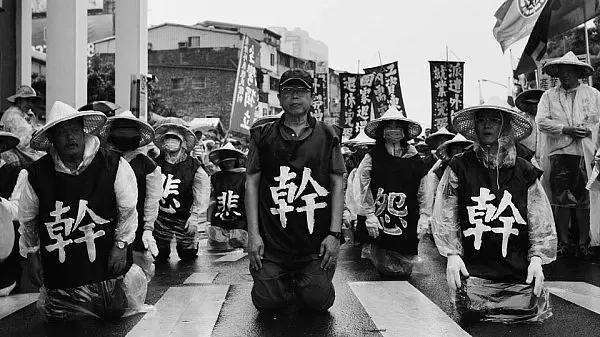
In 1996, companies such as Lien Fu and Tung Ling successively closed down and went out of business. Because they failed to pay wages, severance pay, and pensions, thousands of employees and their families fell into dire financial straits, triggering the first track-lying protest in the history of the labor movement. The incident finally came to a temporary close when the Bureau of Employment and Vocational Training under the Council of Labor Affairs (now reorganized as the Workforce Development Agency of the Ministry of Labor) stepped forward to "lend" money to the workers. Unexpectedly, sixteen years later, the Bureau of Employment and Vocational Training filed civil lawsuits against the workers who had applied for the loans back then, demanding "repayment of the debt." The conflict flared up once again, and elderly plant closure workers staged another track-lying protest, bringing the courts into the controversy as well.
During the court proceedings, the plant closure workers successively expressed their demands through rallies, marches, and other activities, including the track-lying protests. At first, the courts mostly regarded the loan controversy as a civil law relationship, ruling against the workers and ordering them to repay the debts. It was not until late August of last year that the Taoyuan Summary Court of the Taoyuan District Court reclassified it as a public law relationship, transferring the case to the administrative litigation division and opening a new chapter. However, courts across various regions still held divergent views on this matter: some recognized it as a public law relationship and transferred cases to the High Administrative Court, some considered it a civil law relationship and continued the trials, while others applied for an interpretation by the Grand Justices, resulting in a hodgepodge of approaches. Consequently, the workers' protests continued.
However, in early March of this year, the Taipei High Administrative Court rendered a judgment holding that the workers were not required to repay the debts and dismissed the claim of the Bureau of Employment and Vocational Training. Subsequently, in mid-April, the Administrative Litigation Division of the Taoyuan District Court also delivered a judgment recognizing a public law relationship of "social compensation" intended for the state to make up for its failures toward the people, ruling that the Bureau of Employment and Vocational Training could not demand repayment from the workers in the first place. In view of these successive court judgments, the reorganized Ministry of Labor took the opportunity—citing major divergences in judicial views and the inability to achieve a consistent resolution in the short term—to issue guidelines for a comprehensive refund and return of the "loans" to the workers, while proactively withdrawing the lawsuits, finally bringing the plant closure workers' incident to an end.
Looking back at the role played by the courts in the plant closure workers' incident, in theory, the courts should serve the function of "settling disputes and ending controversies," making a final judgment on the loan dispute to draw a definitive period. But clearly, at the beginning of the incident, the courts were hardly able to help; their judgments failed to convince the workers, protests continued throughout the litigation, and judicial authority was completely undermined! Perhaps because the courts initially adopted the view of a civil law relationship, the plant closure workers held no hope for the judgment results, lost the heart to debate in court, and turned instead to street protests.
Yet, through twists and turns, thanks to the efforts of the legal team and scholars who organized numerous seminars to provide legal opinions on the public and private law attributes of the case, the courts' judgments were indirectly influenced. Young judges withstood tremendous pressure, undeterred by strange looks, and departed from past views to recognize a public law relationship, thereby bringing the workers back from the railway tracks and the streets. Judges of the Taipei High Administrative Court also courageously took up their responsibilities, ultimately allowing the dispute to return to the courtroom for a resolution and restoring public trust in the judiciary.
As Professor Lin Ming-chiang (林明鏘) noted, the plant closure workers' incident is one of the rare cases where social controversies were resolved through the law. Associate Professor Hsu Wei-chun (徐偉群) went even further, bluntly stating that this case was "the light of conscience shining through the gaps of the judicial bureaucracy." The judiciary has long given the impression of being conservative, and the culture of seniority ethics has a long history. However, with the injection of fresh blood from young judges in recent years, this has gradually changed. From initial distrust to the final "settlement of disputes and ending of controversies," the process took dramatic turns. Aside from the propelling force of the legal team and scholars, the awakening of the judges themselves was also crucial.
Protest is an expression of the people's right of resistance. Although the plant closure workers' incident caused social unrest, it simultaneously compelled the courts to return to what they ought to be. Recognizing this, judges stopped acting as dinosaur judges; they ceased blindly and callously applying the law, but instead excavated the flaws of the law and sought ways to change them! Re-examining the origins of this incident and the application of the law to shape the values of the courts, rather than thoughtlessly ruling in accordance with old precedents—how is this not feedback from the plant closure workers to the judiciary?
As the plant closure workers' incident draws to a close, the workers will also return to peaceful lives. And what about the courts? A quiet transformation has already begun. Former Grand Justice Hsu Tsung-li (許宗力) once stated: "What is the vocational calling of a legal professional? Simply put, it is to assist and protect those who are in need of protection." Today, the courts have played the role of constitutional protectors well in the plant closure workers' incident, gradually reclaiming the authority of the judiciary. How can we not feel grateful to this group of elderly plant closure workers?
This article is an AI-generated translation of the original Chinese text. In the event of any discrepancy, the Chinese version shall prevail.
