
Plant Closures Case: The CLA's Consistent Shifting of Blame
Last edited: 2026-07-27
The first winning judgment for closed-plant workers in court means that a judge has finally refused to blindly endorse a stubborn administrative agency. It also demonstrates how difficult it is in Taiwan to get the state to correct its own mistakes, requiring incessant extra-institutional protests and insightful arguments from experts and scholars just to secure a winning judgment that rightfully belongs to them.
Reviewing the ins and outs of the incident, a series of policy actions by the Council of Labor Affairs (CLA, now the Ministry of Labor) illustrates that wrong decisions are more terrifying than corruption, and that it has consistently shifted blame all along. The Ma administration must shoulder all of this, and the erroneous decisions made by political appointees promoted and selected by President Ma are precisely the main reason for his low approval ratings and difficult predicament.
The Administration Must First Consider Its "Stance"
The CLA was often ridiculed by laborers as the "Capitalists'" Labor Affairs Council for a reason. Sometimes its institutional role was confused, standing on the side of employers, and other times it was insufficiently proactive in defending workers' rights, both of which disappointed laborers who held expectations.
The raison d'être of the CLA is to "protect labor rights and interests," and its institutional role and positioning must be to "put workers' interests first," while finding ways to resolve, or at least mediate, the difficulties and vulnerabilities workers face regarding state policies or the system. This should be the core ideology of the CLA, and all policies should revolve around this core.
When former CLA Chairperson Wang Ju-hsuan (王如玄) decided to sue workers to "collect debts," it was certainly not legally entirely untenable, but her stance was inappropriate and her administrative actions were clearly insufficiently proactive. As a central administrative ministry, the CLA has too many administrative measures and resources at its disposal. Procedurally, it should not have made workers run back and forth to the courts; substantively, it could have figured out a way to spare workers from the predicament of having to repay the money. Whether to use these means or not depends entirely on whether it values its own institutional role and positioning of safeguarding workers' interests.
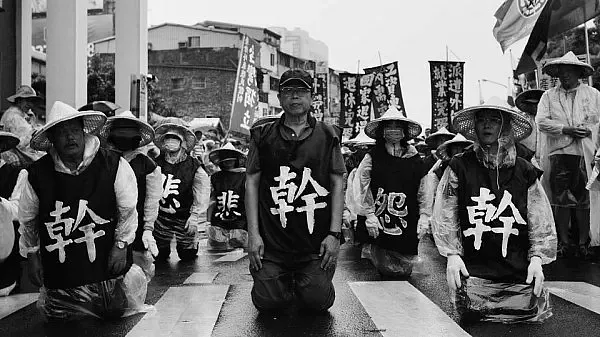
The subsequent protests by the Closed-Plant Workers Alliance proved that the CLA was capable of proposing policy plans that waived "repayment" for over seventy percent or even the entirety of the debt. This was a form of administrative action, indicating that the CLA "did not have to sue." With an administrative agency lacking backbone and closed administrative negotiations, taking to the streets was the workers' only remaining path to fight for their own rights and interests.
Shifting Blame All Along and "Consistent to the End"
The CLA filed lawsuits against more than five hundred cases across the country in one go—a "widespread outbreak." Professionally known as being for "state claims," in reality, it was because the National Audit Office and the Control Yuan began holding people accountable. Civil servants, afraid of being impeached, corrected, or prosecuted for corruption, began a series of "self-preservation actions." Weighing their own responsibility against the suffering of workers, shifting blame came first.
Of course, former Chairperson Wang Ju-hsuan and her successor Pan Shih-wei (潘世偉) probably felt they were "very unlucky." The case had dragged on for sixteen or seventeen years, and they were the "last rats to jump the ship." From the KMT to the DPP and back to KMT rule, no one had dared to touch this "bad account." While encountering it certainly involved an element of luck, no one is forced to be an official. Political appointees who lack backbone are unqualified; those who are insufficiently empowered, unable to advance policies, and yet unwilling to step down are clinging to power. No political party deserves any sympathy here—stop shifting the blame from one party to another, from one person to another. Entering the kitchen means you must cook the food; not fearing the heat is merely a basic condition.
Sixteen or seventeen years ago, why did the CLA disburse this money to workers? Wasn't it precisely because the CLA lacked backbone back then and did not dare to thoroughly investigate whether employers had truly allocated severance pay and retirement funds? Later, when employers maliciously went bankrupt and fled with bundles of cash, the CLA simply threw up its hands. Giving out money was, to a certain extent, merely covering up its own failure to properly investigate. Poor policy implementation results in wasting money and shifting blame.
Furthermore, the legal system was underdeveloped back then, lacking even an administrative procedure law. Raising money to let workers solve their problems was done in a timid, contradictory manner. The Employment Security Fund was clearly a "poll tax" introduced for importing foreign laborers, originally anticipated to impact domestic workers' employment and intended to be used for "stabilizing workers' livelihoods." Distributing it to workers who fell victim to malicious bankruptcies was justified and did not cost taxpayers a single penny. Yet, out of fear of bearing responsibility, they left behind a secretive appendage called a "loan." Fifteen years later, the appendicitis naturally flared up, torturing workers for seventeen years simply out of fear of accountability.
Finally, after the judges of the administrative court issued the first judgment in favor of the workers, the Ministry of Labor expressed its willingness to "withdraw all lawsuits" and issued a press release titled "Promoting Social Harmony and Safeguarding Vulnerable Workers' Rights and Interests." Looking at the text as a whole, it still continued to engage in clever rhetoric, asserting that the lawsuits were withdrawn because "judges from different courts held divergent opinions and respective claims," making the "truth" difficult to clarify—posing entirely as if the Ministry of Labor were the victim. It seemed to have forgotten that the CLA was the root cause of all this turmoil. Shifting blame all along, consistent to the end.
According to "Law" Administration
Legal philosophers often divide law into two parts: "principles" and "rules." The former are more about the weighing of legal principles and legislative spirit, while the latter are more about all-or-nothing statutory applications. Government "policies" are frequently categorized as a type of legal "principle." This is to say, government policies are more a consideration of weighing pros and cons; based on the conflict of two or more different interests, a reconciliation is made. When facing criminal law reviews (such as the crime of profiting) or administrative responsibility audits (such as audits or impeachment corrections), the government actually enjoys greater leeway. When formulating policies, political appointees should enjoy discretionary powers that vary according to the nature of the affairs, which also means they should receive varying degrees of respect from other legal orders.
To speak with hindsight, Chairperson Hsu Chieh-kuei (許介圭), who decided at the time to allocate the Employment Security Fund to stabilize workers facing adversity, is actually worthy of praise. The government spending hundreds of millions of dollars to stabilize over a thousand families—whether based on our Constitution with its strong socialist coloring (protecting workers, stabilizing livelihoods) or policy considerations of weighing pros and cons (avoiding street protests, continued employment, contributing labor productivity in the workplace)—was both a constitutional and legal decision. Subsequent chairpersons could have generously affirmed this policy, insisted on the CLA's stance of taking care of workers, and firmly resisted the questioning from the Control Yuan, the National Audit Office, or even prosecutors. That would have been far more admirable and inspiring than turning their guns on the workers, disrupting their institutional positioning, and picking the softest persimmon to squeeze!
This article is an AI-generated translation of the original Chinese text. In the event of any discrepancy, the Chinese version shall prevail.
