
Grandma Doesn't Need to Worry About Judicial 228
Last edited: 2026-11-04
Ah~ this sort of thing~ ah~ schools never mention it~ ah~ why was it so mysterious back then… sorrowful and dreary, sorrowful and dreary, I heard all about it in childhood la-ji-ox, how could my understanding of you be so scant, the scars of history truly are no trivial matter…
My childhood textbooks contained no mention of the February 28 Incident, nor did the small town where I grew up. One day, on a whim, I pestered my grandma—who is just ten years younger than the Republic of China—asking her about 228. Having never attended school and being illiterate all her life, she had no clear grasp of what was actually happening in Taiwan between her 16th and 26th years; she only knew that during the Japanese era there were "air raids," and the Nationalist government would "make arrests." Her world from a young age consisted of hiding in "air-raid shelters" as a routine matter, after which life would simply go on—securing daily necessities while waiting for the next air-raid siren. After "retrocession," she made sure to remember not to "speak recklessly." When I asked if she knew about 228 and whether many people died, she simply gave a knowing look, placed her forefinger to her lips, and whispered, "Shh."
"Shh~"
That expression and look of "shh" has remained hidden deep within my heart. As I grew older, I gradually came to understand that the Japanese, the American military, and the Kuomintang never had any form of contact with Grandma because she was merely the most ordinary, the most submissive of village women—harmless to any regime, requiring no purging or erasure. That "shh" was the wisdom of her lifetime, her survival strategy, and her amulet. She cherished her grandchildren, and thus she would pass this amulet down to them, generation after generation, praying for their safety.
Grandma felt a profound sense of contentment regarding Taiwan's subsequent economic development. Although she was not quite clear on whether it was the Japanese, the American military, or the Kuomintang that—based on whatever purpose or reason—laid the foundations, provided support, and continued construction, what she understood in her heart was that compared to the hardships she suffered in her youth, we were far, far more fortunate. She possessed a deep sense of contentment, and she constantly used this contentment to instruct each of her grandchildren, hoping that they might thereby find frequent joy. Therefore, she always wanted her grandchildren to be good, study diligently, work earnestly, get married, and have children—generation after generation, living happily.
"Do Not Meddle in Politics"
In this way, Grandma lived out her life removed from worldly disputes. Perhaps this was her choice, or perhaps it was decided for her, but no one else had the qualification to say anything. She was not a perpetrator; her silence was the coercion of an unscrupulous government. Although this may have made it easier for the perpetrators to achieve their aims, it was not her original intention. She was not a victim, yet her silence—even if not necessarily accompanied by a victim's consciousness—nonetheless made her thoroughly a victim. Yet the terms "perpetrator" and "victim" were simply far too heavy for someone who had always lived free from worldly disputes. Grandma simply did not want her grandchildren to carry too much weight, repeatedly admonishing everyone from a young age: "Do not meddle in politics," so that generation after generation could live in peace and happiness.
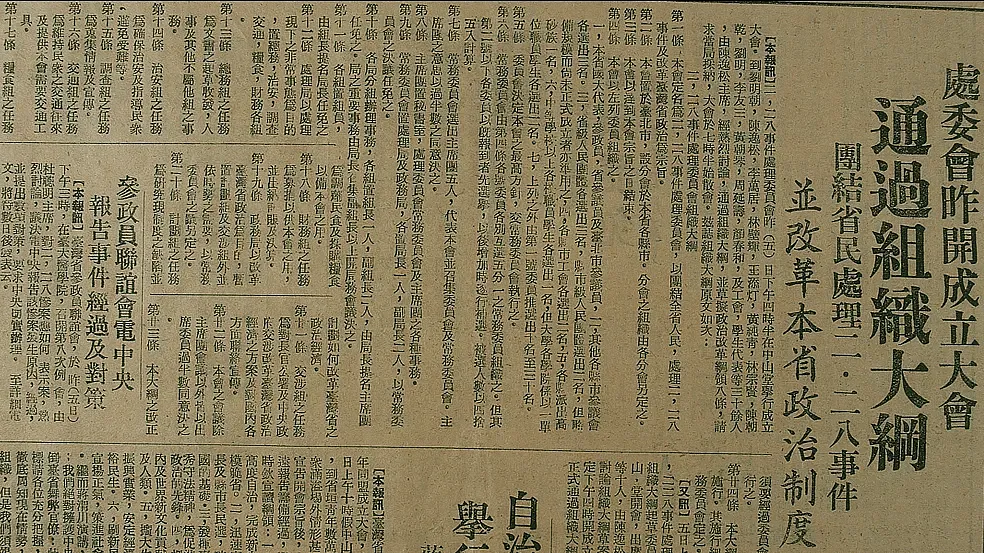
Yet Grandma did not know that politics is public affairs. Unless all her descendants could live lives devoid of worldly disputes just as she did, politics exists in every trade and profession, and 228 exists in every sphere of Taiwan. 228 is difficult to confront because it frequently involves "what was right yesterday being wrong today," but we must still find a way to deal with it, and the judiciary is no exception. During the February 28 Incident of 1947, bullets were what mattered, and the judiciary had no arena to prove its worth; it was not until the Kaohsiung Incident trial that the judiciary took center stage. And what about now?
The Judiciary's "228"
The judiciary has its mass-scale 228: mobilization for the suppression of rebellion, military trials, bandit suppression, assemblies and parades, and offenses against public functionaries are all large-scale 228s. The judiciary also has its boutique-scale 228: the Chiang Kuo-ch'iang case, the Su Chien-he case, the Hsu Tzu-chiang case, and the Chiou Ho-shun case are all small-scale 228s.
The characteristic of 228 is that it is systemic and structural oppression, driven perhaps by a dictator's will or perhaps by an atmosphere of authoritarian mentality. The trouble is that the people of that era, the people caught within it, do not feel that this is a "wrong deed." As for what reasons are used to beautify it, that is merely a matter of rhetoric. Mobilization for suppression, military trials, bandit suppression—many will say these all had the backdrop of a "grand era." That is correct, but the next question is: how should the injustices and harms left behind by these "grand eras" be resolved? And to what extent should they be resolved?
Just as "torture, coerced confessions, and the presumption of guilt" were once "right yesterday" in criminal justice practice, the gradual implementation of the Code of Criminal Procedure has made "the prohibition of torture, the strict ban on coerced confessions, and the principle of the presumption of innocence" turn these cases into "wrong today." Whether the judiciary has the courage to face past mistakes and proceed to correct them is just like whether we are willing to face the 228 of history.
Whenever I look at military officers from Ch'en Chao-min downward stammering and defending themselves by saying they were merely "following orders," and that holding them accountable for criminal and civil damages is "an unbearable weight," many tangled feelings arise in my heart. We are indeed reproaching their "right yesterday"! But should we "sympathize" with them? When they were cracking cases, performing meritorious deeds, and receiving promotions and titles back then, what about Chiang Kuo-ch'iang? He was already a pile of withered bones! How can we achieve balance? What constitutes justice? And to what extent should the accountability of these officers go?
Using the three stages of criminal law, perhaps we can accept that they "lacked the possibility of being expected to act otherwise," or perhaps they lacked "awareness of unlawfulness," but no matter what, their acts still "fulfilled the constituent elements of a crime." In the narrowest definition of criminal law, this is simply "having committed a crime," albeit without imposing penal punishment upon them. What I cannot fathom is how they can be unwilling to bear even the most minimal "characterization" or admit their mistakes. How can this be considered justice? Since Taiwan has structural transitional issues, should we design additional systems to respond to them? If not, are prosecutors and judges aware of this and able to manifest these structural issues in individual cases?
From this stems another important issue: do current judicial personnel have—and can they manifest—the awareness that when the government continuously uses the Assembly and Parade Act, the offense of obstructing a public functionary, or even the offense of compulsion to harass and coerce protesting citizens, it is precisely manufacturing another kind of structural and systemic oppression? And if the police are completely obeying orders, can prosecutors, as guardians of the rule of law, and judges, who self-proclaim to be the last line of defense for justice, perceive this holistic oppression within every "seemingly isolated" case? Furthermore, can they infiltrate varying perspectives of transitional justice into each "ostensibly independent" case?
Legal professionals lacking historical, holistic, and contextual observation and realization are destined to degenerate into legal technicians. And demanding that judges and prosecutors—whose very professional essence is "public affairs"—actively think about and handle the judiciary's 228 should hardly be asking too much. Judges and prosecutors are both elite intellectuals who participate in matters of high public import; they can no longer use a "free from worldly disputes" attitude to passively evade their calling and the demands of the people. To put it more harshly, they have no qualification to make a "shh" gesture.
Legal Professionals Must Face the Judiciary's 228 Themselves
From the buried February 28 Incident to its formal designation as "Peace Memorial Day" alongside various celebrations everywhere, today certainly cannot be compared with the taboo memories of the past. Yet the judiciary remains dead silent amidst these celebrations, as though it has nothing to do with 228. The reality is not so; this is a form of intentional or unintentional silencing.
Grandma doesn't need to worry about the judiciary's 228, but any legal professional dealing with public affairs cannot afford not to care. It is time to take off and properly pack away the amulets of "freedom from worldly disputes" and "self-preservation," return them to the older generation, and instead don the armbands of the "rule of law" and raise the banner of "constitutionalism."
This article is an AI-generated translation of the original Chinese text. In the event of any discrepancy, the Chinese version shall prevail.
