
【Legal Life】Ch27 Breaking Up: Is Parting Without Saying Goodbye the Most Beautiful Way?
Last edited: 2026-07-27
Ming-chieh originally had a blue-collar dream: he wanted to be the top mechanic in both the Philippines and Taiwan. A few years ago, however, Ming-chieh was beaten on the head by a youth named Tu P'ing with a glass bottle (EP18). Because the injury was so deep and painful, Ming-chieh would get a stomachache whenever he saw any long, stick-like object with a handle—yet inevitably, almost all essential tools for a mechanic are long, stick-like objects with handles.
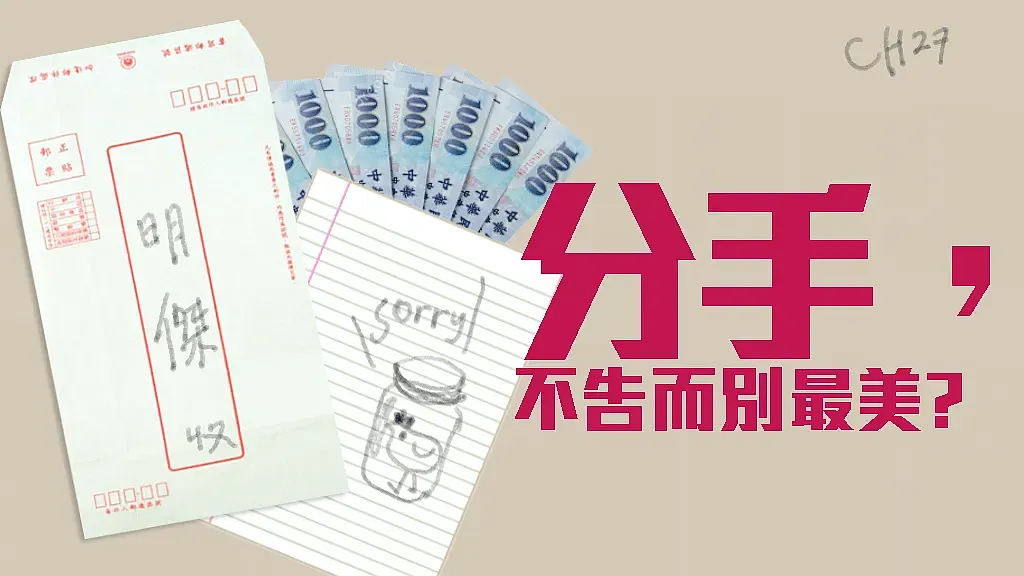
Torn between dreams and financial stability, Ming-chieh compromised with reality and obediently became an operator at a chicken essence bottling plant. After working there for a few years, things were relatively stable, but good times do not last forever. Drinking chicken essence gradually fell out of fashion, and the plant's operations went from bad to worse. One day, Ming-chieh received a letter from his boss. Aside from a cute doodle of a chicken essence jar apologizing, the boss asked Ming-chieh not to come to work anymore, along with one month's wages attached...
Issues for Consideration
- Under current labor laws, what are the grounds for an employer to lay off or dismiss an employee?
- What rights can an employee assert after being laid off by an employer?
- If an employer legally lays off or dismisses an employee, what additional regulations must be observed?
Grounds for Lawful Layoff and Dismissal by Employers Under the Labor Standards Act
In EP17, we already learned that under current law, the grounds for an employer to terminate a contract can be categorized into "layoffs with advance notice" and "dismissals without advance notice (also known as disciplinary dismissal)." Compared to disciplinary dismissal, the grounds for layoffs with advance notice are designed to better reflect the legislator's endeavor to strike a balance between the following two conflicting interests:
- Laid-off workers lose their primary source of income, and finding a new job poses a major shock to their lives; mass unemployment may also trigger social unrest;
- Employers genuinely need to restructure their enterprises and must lay off certain employees, otherwise they will face the crisis of being eliminated.
The restrictions on employers' grounds for lawful layoffs under the Labor Standards Act (Article 11 of the Labor Standards Act) are the product of the aforementioned balancing act; conversely, disciplinary dismissals (Article 12 of the Labor Standards Act) are explicitly stipulated by legislators to grant employers a lawful right of dismissal targeting statutory employee-attributable conduct (meaning it is the employee's fault). Therefore, employers are no longer required to bear severance pay, nor are they obligated to provide an advance notice period.
Article 11 of the Labor Standards Act stipulates that employers may only lay off employees with advance notice if one of the grounds listed in the article is met. As for the calculation of the advance notice period, pursuant to Paragraph 1, Article 16 of the Labor Standards Act, it depends on the length of the employee's service, ranging from 10 to 30 days. Furthermore, according to the competent authority's interpretation, since the Labor Standards Act merely sets the minimum standards for labor conditions, if the employer and employee agree on a longer advance notice period, it is naturally valid. Below, we focus on providing a detailed explanation of each ground for layoffs with advance notice.
Article 11, Subparagraph 1 of the Labor Standards Act stipulates that when an employer ceases business or transfers operations, the employer may lay off employees.
Cessation of business refers to the employer permanently halting its business operations (the boss is closing up shop). (If only a partial business ceases operations, courts mostly still do not permit layoffs.) Moreover, because enterprises in our country often do not prioritize completing business cessation registrations when stopping operations, the competent authority also considers it permissible to determine on a case-by-case factual basis whether a cessation of business has occurred. Transfer of operations includes a business entity changing its organizational form in accordance with provisions of the Company Act, or its ownership (all assets and equipment) being transferred resulting in the extinction of its original legal personality, or a change in the person in charge of a sole proprietorship or partnership business entity (the boss is changing).
Article 11, Subparagraph 2 of the Labor Standards Act stipulates that when an employer suffers losses or experiences business contraction, employees may also be laid off.
Regarding the determination of whether losses have occurred, it should be observed over a long period; one should not cry and determine that losses have occurred simply due to a minor temporary loss. Furthermore, in litigation, the employer bears the burden of proof to submit financial statements from recent years to prove the state of losses, and may only dismiss employees when losses are truly and definitively established. In practice, there are also courts that strictly hold, regarding the ground of losses, that if the department where the employee works is profitable, and the employee is not surplus labor in that department, then the enterprise's overall losses are irrelevant to that department, and employees in the profitable department may not be laid off on the grounds of overall enterprise losses.
Business contraction refers to a situation where an employer experiences poor operations for a considerable period, with production and sales volumes significantly decreasing, requiring the overall business to scale down its scope. It requires the factual existence of business contraction by the employer to the extent that continuing to employ the workers is impossible.
Article 11, Subparagraph 3 of the Labor Standards Act provides that the suspension of work due to force majeure for one month or more is also a ground for dismissal with advance notice.
Force majeure refers to external, extraordinary events that are irresistible by human efforts (such as an attack by the Communists, or an earthquake destroying the factory). According to the competent authority's interpretation, the suspension of work caused by employee strikes does not fall within the scope of this subparagraph.
Article 11, Subparagraph 4 of the Labor Standards Act stipulates that when the nature of the business is changed and there is a necessity to reduce employees, and there are no suitable jobs available for reassignment, the employer may dismiss employees with advance notice.
The change in the nature of the business refers to measures taken by the employer to alter or adjust the management or production organization (the boss is changing industries), focusing on a "qualitative adjustment" by the employer of the original types of business or management production organizational structure for all or specific departments. This differs from the aforementioned business contraction, which is a "quantitative reduction" in the scope of business for all or specific departments. Furthermore, the phrase "no suitable jobs available for reassignment" in the latter part of this subparagraph manifests the principle of last resort in dismissal.
Article 11, Subparagraph 5 of the Labor Standards Act stipulates that when an employee is indeed incapable of performing the duties assigned, the employer may dismiss the employee with advance notice.
Although this looks like the employee's problem, is the employer not responsible for poor judgment in personnel selection or failure to arrange a job suited to the person's abilities? Therefore, advance notice is still required. Regarding the interpretation of this subparagraph, the Supreme Court's consistent view holds that the inability to perform duties referred to in this subparagraph includes not only objective inability due to the employee's capability, but also subjective situations where the employee can do the work but chooses not to, or is able to do it but unwilling. Similarly, under the consistent view of judicial practice, this subparagraph is subject to the principle of the last resort in dismissal—meaning the employer should give the employee a certain period of opportunity to improve, and only when the employee remains incompetent and the employer has no other alternative may the employer lay off the employee.
What Rights Can an Employee Assert After Being Laid Off by an Employer?
Since the statutory grounds for layoffs stipulated in Article 11 of the Labor Standards Act are mostly beyond the employee's control and should not be blamed on the employee, the Labor Standards Act establishes provisions for an advance notice period so that employees can react to and buffer against the adverse impacts of being laid off. However, pursuant to Paragraph 3, Article 16 of the Labor Standards Act, the advance notice period may be converted into wages (exchanging money for time), which is also a common scenario in practice.
In addition, pursuant to Paragraph 2, Article 16 of the Labor Standards Act, employees may take job-seeking leave of no more than two days per week during the advance notice period, and employers must still pay wages during such job-seeking leave. Employees may invoke this to be exempted from work obligations during the statutory job-seeking leave period.
Finally, those subject to the old labor retirement system (i.e., retirement governed by the provisions of the Labor Standards Act) may claim severance pay pursuant to Article 17 of the Labor Standards Act when an employer lays off an employee with advance notice pursuant to Article 11 of the Labor Standards Act, in addition to wages for the advance notice period; those subject to the new labor retirement system (i.e., retirement governed by the provisions of the Labor Pension Act) may claim severance pay from the employer pursuant to Paragraph 1, Article 12 of the Labor Pension Act. There are some differences in the calculation of severance pay bases for workers under different systems such as the old and new systems. The purpose of severance pay is to implement the legislator's objective of protecting workers, thereby safeguarding employees' economic livelihood during their job-seeking period.
What Additional Regulations Must Be Observed If an Employer Legally Lays Off or Dismisses an Employee?
According to Paragraph 1, Article 33 of the Employment Service Act:
"When laying off employees, an employer shall list the names, genders, ages, addresses, telephone numbers, assigned jobs, grounds for layoff, and whether employment counseling is needed for the laid-off employees, and report the roster to the local competent authority and public employment service institution 10 days prior to the employees' departure. However, if the layoff is caused by natural disasters, accidents, or other force majeure events, it shall be done within 3 days from the date of the laid-off employees' departure."
This is an obligation that employers must comply with when laying off employees; if an employer violates it, they shall be subject to a fine of not less than NT$30,000 and not more than NT$150,000.
In addition, referring to the recent hot news current event of the TransAsia Airways incident, if an employer's layoffs reach the threshold established by the Act for Protection of Worker Retirees and Severance Payments (Mass Redundancy Protection Act), the employer must notify the competent authority and relevant units or personnel with a redundancy plan 60 days prior to the date of laying off employees, and publicly announce and display it. Employers must also fulfill consultation and other procedures in accordance with the Mass Redundancy Protection Act.
How the Story Continues
The boss of the chicken essence bottling plant may have invoked the ground of long-term losses or business contraction under Paragraph 2, Article 11 of the Labor Standards Act, meaning they might lawfully lay off Ming-chieh with advance notice. In addition to wages for the advance notice period, the boss should also provide corresponding severance pay based on Ming-chieh's seniority and whether he is an employee under the new or old system.
Conversely, if the plant did not have long-term losses or business contraction, the boss's dismissal lacked statutory grounds and constituted an unlawful dismissal. In this case, Ming-chieh may file a lawsuit in a civil court to confirm the continued existence of the employment relationship and request the boss to pay his wages.
Relevant Legal Provisions
Article 11 of the Labor Standards Act
"An employer may not terminate a labor contract with an employee with advance notice unless one of the following situations occurs:
1. Cessation of business or transfer of operations.
2. Losses or business contraction.
3. Suspension of work due to force majeure for one month or more.
4. Change in the nature of the business, necessitating a reduction of employees, and no suitable jobs are available for reassignment.
5. The employee is indeed incapable of performing the duties assigned."
Article 16 of the Labor Standards Act
"When an employer terminates a labor contract pursuant to Article 11 or the proviso of Article 13, the advance notice period shall comply with the following provisions:
1. Where an employee has continued to work for not less than three months but less than one year, the notice shall be given 10 days in advance.
2. Where an employee has continued to work for not less than one year but less than three years, the notice shall be given 20 days in advance.
3. Where an employee has continued to work for three years or more, the notice shall be given 30 days in advance.
After receiving the aforesaid notice from the employer, an employee may leave work to seek other employment during working hours. The hours for leaving work shall not exceed two working days per week, and wages during the leave period shall be paid as usual.
If an employer terminates a contract without giving notice within the periods prescribed in Paragraph 1, the employer shall pay wages for the advance notice period."
Article 17 of the Labor Standards Act
"Where an employer terminates a labor contract pursuant to the preceding article, severance pay shall be granted to the employee in accordance with the following provisions:
1. For an employee who has continued to work in the enterprise unit of the same employer, severance pay equivalent to one month's average wages shall be given for each full year of service.
2. For remaining months calculated pursuant to the preceding subparagraph, or for service of less than one year, severance pay shall be calculated proportionally. Periods of less than one month shall be calculated as one month.
The severance pay prescribed in the preceding paragraph shall be paid by the employer within 30 days of the termination of the labor contract."
Paragraph 1, Article 12 of the Labor Pension Act
"Where a worker is subject to the pension system of this Act, for their service seniority after the application of this Act, when the labor contract is terminated pursuant to Article 11, the proviso of Article 13, Article 14, and Article 20 of the Labor Standards Act, or Article 23 and Article 24 of the Worker Occupational Accident Insurance and Protection Act, severance pay shall be issued by the employer based on the worker's service seniority, granting half a month's average wages for each full year of service, and calculated proportionally for seniority of less than one year; up to a maximum limit of six months' average wages, and the provisions of Article 17 of the Labor Standards Act shall not apply."
This article is an AI-generated translation of the original Chinese text. In the event of any discrepancy, the Chinese version shall prevail.
