
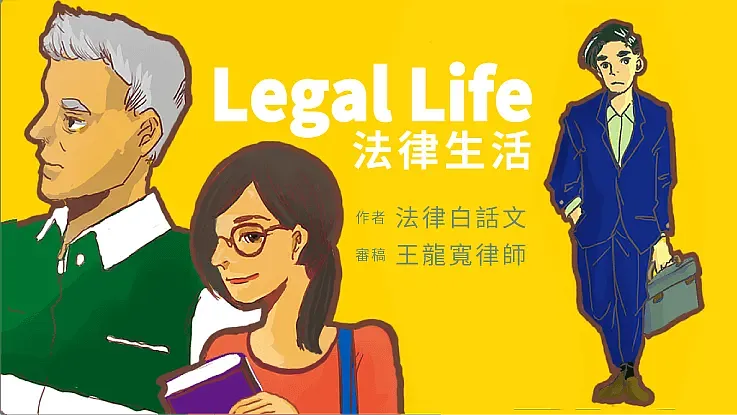
[Legal Life] Finale: "Law is Life," A Few Things Legal Life Wants to Tell You
Last edited: 2026-11-04
After reading the Legal Life article series, do you feel that law is both a distant and yet ever-present reality? Under the high degree of specialization in modern society, the law not only deals with ubiquitous power relations, but also strives to maintain social order, minimize life risks, and ensure the realization of justice. Just like the popular saying goes, "The law should not serve prejudice." Therefore, all interpersonal interactions may involve rights, obligations, and various legal relationships you can or cannot imagine.
"Law" has always been one of many social phenomena; it simultaneously reflects people's living experiences and points to the moral norms of people "as a community of life." It may stem from conventional facts, the rationality born from the convergence of various opinions, or perhaps from intuitive feelings of injustice. Therefore, Legal Life hopes to resonate with readers' inner beliefs or doubts about the law through small figures and short stories.
Small Stories, Big Insights
Anyone (or our friends and family) could be the elderly grandmother who tragically lost her life under wheels due to insufficient street lighting (along with her elderly partner who bears the grief of bereavement alone), Chün-ming who panicked after accidentally hitting someone, Chieh-yun who has a strong sense of justice but a rather bumpy life, Tu-p'ing who made mistakes in his youth and now faces difficulties in job hunting, T'ai-sheng who is doing quite well yet walking on the edge of the law, Yü-ling who suffered sexual harassment in the workplace, Ming-chieh who became a target of personal attacks due to stereotypes, or Jui-chu and her child whose lives underwent drastic changes after being caught in the crossfire.
How should we face it when we make mistakes? Taking traffic accidents as an example, in Episode 1, we discussed the legal liability for hit-and-run, and in Episodes 7, 9, 12, and 20, we explored what frequently heard terms like conditional non-prosecution (suspension of prosecution) and summary judgment mean legally. When we become suspects or defendants, what rights do we have when facing the police or prosecutors (see Episodes 2, 3, 4, 13, and 14)? Should we remain silent or cooperate (see Episodes 5 and 6)? When one is young, is there room for turnaround (see Episodes 21 and 23)?
And when we become victims, whether or not to file a lawsuit is often the most agonizing question; if we do sue, how should we go about it? Episodes 8 and 11 discussed the common practice of "using criminal charges to force civil settlement," while Episode 18 reminded us of our right to use an interpreter; however, in a Taiwanese society that always hopes to "turn big issues into small ones and small issues into nothing," we are even more eager to ask if there are other avenues for compensation or relief (Episode 8)? Episode 10 discussed how to handle subsequent insurance claims when a traffic accident occurs!
Yet "the law protects those who know the law," and legal awareness for self-protection is extremely important. Time not only ages people, but also hastens the statute of limitations for rights (see Episodes 15 and 25). However, if you want to sue or are being sued and have no money, what should you do? Episode 22 introduces the "legal aid system" coming to the rescue, and Episode 30 provides some advice on how to choose, understand, and cooperate with an attorney.
Often, what is even trickier is what to do when the opposing party is your boss or supervisor. Therefore, Episodes 16, 17, 24, 25, 26, and 27 all tell us that as job seekers or employees, we should stand firm for our rights and let the law help us reverse the de facto power imbalance. When facing the state, should we swallow our grievances or fight back with all our might? Episode 20 tells us how to reclaim justice! Finally, when the opponent is a spouse or family member sharing our lives, things are most heartbreaking—what should we do if we want a divorce (see Episodes 28 and 29)?
It's the Law, and It's Life!
Society as a whole is like a dynamic, aggregated, and open system, where interpersonal relationships are easily pulled or influenced by countless butterfly effects. Very often, we easily make "legal acts" that feel almost imperceptible yet carry liability everywhere, or we encounter "legal effects" rushing toward us and forcing us to make choices. Simply resigning ourselves to bad luck cannot truly help us seek good fortune, avoid misfortune, or defuse crises. Avoidance is not only shameful but often useless; a better approach is self-strengthening and equipping ourselves to understand the possibilities and significance of each option.
As the villain Huoyun Xieshen once said, "Walking the jianghu, how can one avoid getting knifed?" Living in this world, it is inevitable to encounter unfair treatment due to gender, race, nationality, criminal record, or other reasons, or even situations like sexual harassment, deprivation of personal liberty, or denial of the right to access a court. The discussions in Legal Life regarding the Sexual Harassment Prevention Act, Code of Criminal Procedure, Police Power Exercise Act, Police Duties Ordinance, and Personal Data Protection Act not only tell us how to protect ourselves and seek relief, but also offer practical insights on how to interpret legal terminology.
Yet, are the remedies provided by the law effective? Within the context where "sentiments, reason, and law" permeate society, how to seek justice without damaging relationships becomes an agonizing dilemma for lawmakers, judges, and even the parties involved at every moment. The discussions in this series regarding the Act of Gender Equality in Employment, Gender Equity Education Act, Criminal Code, Juvenile Justice Act, and the Part on Family of the Civil Code are actually addressing the issues between human sentiments and legal principles, and how to make the law the last line of defense.
Aside from these intimate issues, this series also attempts to raise some deeper questions worth pondering repeatedly: What is the significance of various social insurances? Beyond regularizing, criminalizing, and privatizing the task of public risk management, what protections might ordinary people lose or gain from them? Modern social affairs are trivial and complex; under the high overlap of politics, economy, culture, and family life, the public and private spheres are gradually becoming difficult to distinguish, and this blurred boundary is also manifested in various fields of social law (which are both public and private).
Regarding this part, the multiple regulations cited in Legal Life highlight this characteristic—namely, the situation of "public-private mixing." For instance, the Labor Standards Act, Labor Insurance Act, Labor Pension Act, and Consumer Protection Act all possess this nature of public authority intervening in private law matters in order to uphold justice among private individuals. In addition, we also discussed social regulations with higher publicness, such as the Act Governing the Punishment of Violation of Road Traffic Regulations, Narcotics Hazard Prevention Act, and Compulsory Automobile Liability Insurance Act.
Incidents of David fighting Goliath can be seen everywhere in society. Should the law strictly guard the bottom line of "minimum morality," or should it use public authority to grant an opportunity to overturn the overall power structure? The discussions in this series regarding the Act for Settlement of Labor-Management Disputes, Employment Service Act, Immigration Act, Compensation Act, and Legal Aid Act all actually demonstrate that the law has the goal of actively intervening in unequal power relations. Individuals can only prevent their rights from falling asleep by making good use of them.
Have You "Legal Life-d"?
After deeply understanding the law in our daily lives, we should also further ponder: What is the purpose and meaning of the intervention of public authority? The law possesses compulsory force and also serves an educational and admonitory function for the public; it is universal, yet frequently permits exceptions to protect vulnerable groups. In the process of understanding the law, while eagerly searching for regulations or opinions that are helpful (or hindering) to oneself, the feeling of "Ah, I see, I've learned a lesson" naturally wells up. However, our legal consciousness or legal sentiment should not be confined to a passive, defensive "sense of responsibility."
The distance between law and daily life, at first glance, sounds as if it were very far—so far that we might doubt whether we are like citizens in a rule-of-law society, and so far that we tend to overlook its intensity and personal relevance. This seems somewhat contradictory to the idea of "using severe penalties in troubled times," which has caused divergence in Taiwanese society in recent years. Rooted in ancient thoughts from the Rites of Zhou and the Book of Han, this idea is showing signs of a revival today, reflecting the aforementioned bizarre phenomenon of the "severance of law and people's lives." This is because people, while appealing to public authority, neglect the possibility that public authority might backlash against ordinary life.
Secondly, it is evident that public discussions regarding government overreach and precisely where it overreaches are somewhat lacking, or such discussions overlook the impact of social structures on individuals, such as the predicaments of several protagonists in the stories. Socialized citizens do not have minds that are truly like blank slates, nor has our society ever truly given us the opportunity of a "veil of ignorance." Therefore, we can only do our best to listen to, communicate with, and understand one another in order to eliminate existing prejudices or stereotypes in our minds, making it possible to make decisions that are most self-benefiting without harming others.
Therefore, besides hoping that readers will not lightly resign themselves to bad luck and brush it off when facing legal problems, this series also hopes that readers can step up to participate in the discussions and mobilizations of various public issues concerning their own rights and interests. For only by starting from ourselves (and the people we care about) can we empathize and speak up and fight for the "voiceless" in society, radiating outward to influence the current legal order which may still have loopholes. Conversely, every single one of these small inspirations and actions will also feed back into ourselves and the people, matters, and objects around us.
Under the requirements of the rule of law, government power must be bound by law, and any component operating for the state machinery must also be subject to the people's will. Therefore, the promotion and rooting of rule-of-law education, aside from helping people understand their own rights and obligations, is more importantly about recognizing the spirit of "democracy" and "equality" within the constitutional order, so as to counter the rule of man based on the personal will of rulers or politicians, or populism that disregards the principle of fundamental rights protection. Only then will there be an opportunity to initiate a Legal Life belonging to the Taiwanese people, helping Taiwan transform into a rule-of-law society where everyone can pursue justice.
法律生活 Legal Life
This article is an AI-generated translation of the original Chinese text. In the event of any discrepancy, the Chinese version shall prevail.
