
Judge-State and Rule of Law State
Last edited: 2026-11-08
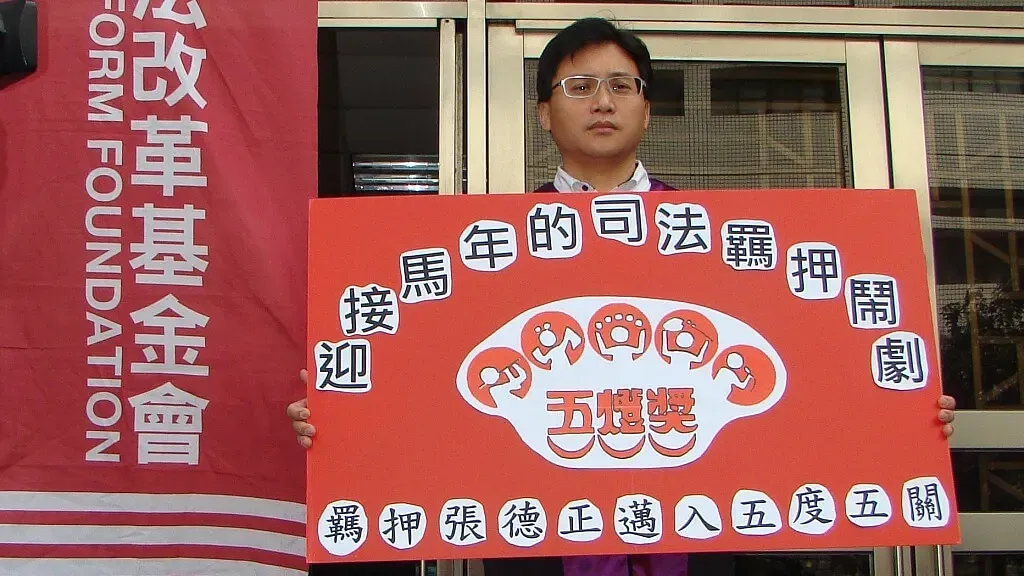
The big Lunar New Year blockbusters are hitting theaters one after another, and the most eye-catching of them all must be the realistic documentary about ramming the Presidential Office and denouncing judicial injustice. The case in the film bounced back and forth between the District Court and the High Court through "five rounds," until the defendant was finally released on bail. It may well be the most important case on pretrial detention in the history of Taiwan's rule of law. Look closely at the arguments traded between the two courts, or at what the "legal experts" in the film contend, and they all revolve around one concept: "likelihood of reoffending." To understand what is really at stake in this series of exchanges, please read your humble film critic's introduction below to the "preventive detention" system in the Code of Criminal Procedure.
Preventive detention is in fact an exception to the general detention system. It was only raised for review by legislators in 1997, during the amendments that returned detention power to the courts as required by Judicial Yuan Interpretation No. 392. During committee review, a legislator stated explicitly that because, in investigations at the time, the detention system was powerless even when it was known that a crime might be committed, a preventive detention system should be introduced concretely and clearly. Based on the specific categories of cases with high reoffending rates proposed by the Judicial Yuan, Article 101-1 was enacted as a preventive detention mechanism to prevent defendants from reoffending, separate from general detention under Article 101 of the Code of Criminal Procedure. Thus preventive detention is possible only for violations of the specific provisions listed in Article 101-1. And because such a system is like convicting a person without trial for future crimes that do not yet exist, and is highly controversial constitutionally, it is strictly limited to the categories of offenses specified by the legislature. For example, defendants charged with sexual offenses may be subject to preventive detention, but defendants charged with homicide may not.
The legislative history shows that general detention and preventive detention serve entirely different purposes. The former is to preserve evidence and witnesses and ensure the defendant appears in court; the latter is to prevent reoffending. The general detention system was not created to prevent defendants from reoffending, so a court cannot, merely because a defendant may reoffend, use general detention to carry out what is in effect preventive detention. That is the heart of the dispute between the Taipei District Court and the Taiwan High Court. Through its rulings, the High Court revealed its thinking: because this is a high-profile case and the defendant had announced he might reoffend, even though the charge does not qualify for preventive detention, the seriously injured defendant, barely able to move, should still be held under the serious-offense detention provision of Article 101 of the Code of Criminal Procedure in order to maintain public order.
Ladies and gentlemen, tell me: if someone has committed a crime, does that mean he will necessarily commit crimes in the future? Does that make sense? In courtroom terms, "preventive detention seriously conflicts with the presumption of innocence." That is why judges must strictly follow the statutory elements when using preventive detention. In this case, if detention had been ordered to satisfy "the expectations of certain people or groups," judges would inevitably have placed themselves above the law. Fortunately, the District Court judges showed tremendous courage and turned the drama around with a stunning comeback. Although, under pressure from their seniors, they may have given ground on some elements, they consistently maintained that without an express legal provision the defendant could not be detained. One cannot help but admire these young District Court judges for upholding the "rule-of-law state" spirit of judicial independence and adjudication according to law. They countered "self-righteousness" with "the law alone." They countered the "judge-state" with the "rule-of-law state."
The District Court's rulings ring out: "It is not the case that detention is necessary simply because the Presidential Office was the target of the crime," and "Placating the public and satisfying some people's urgent demand for retribution are not grounds or reasons for the court to consider in deciding whether to detain a defendant." The Taipei District Court has produced the finest rule-of-law education series. Audience, please give these young judges who refused to bow to their seniors' pressure a resounding round of applause! Bravo! Encore!
This article is an AI-generated translation of the original Chinese text. In the event of any discrepancy, the Chinese version shall prevail.
