
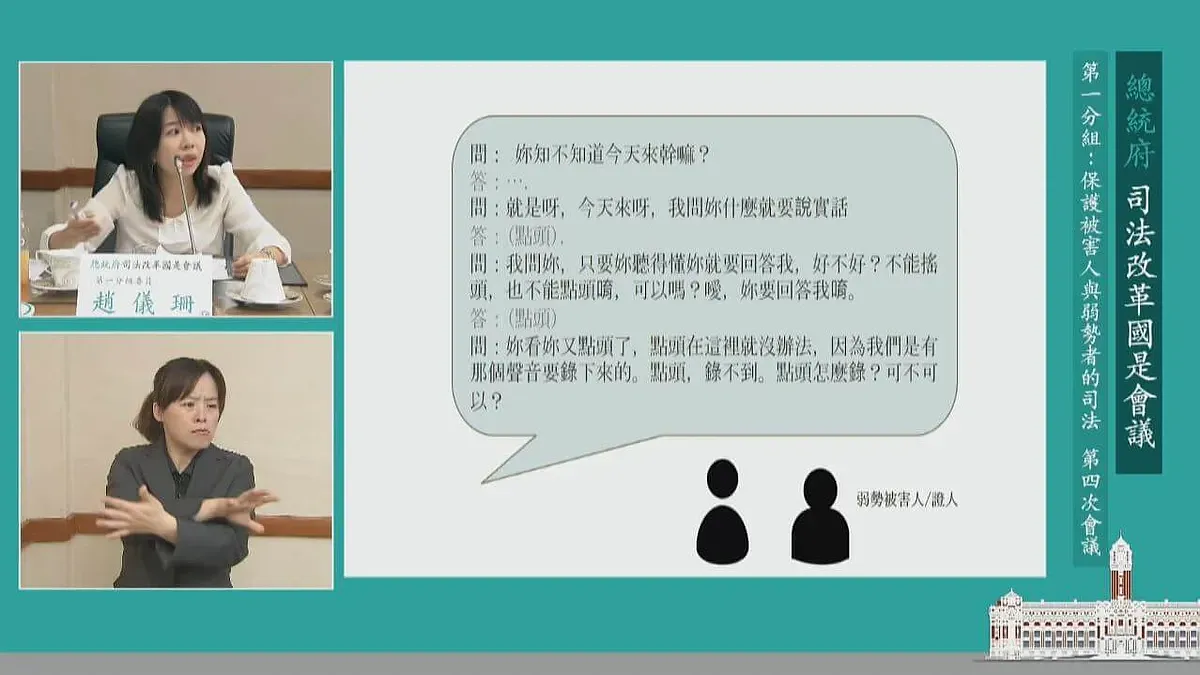
Brief Notes: The 4th Meeting of the 1st Division of the Presidential Office's National Judicial Reform Conference
Last edited: 2026-08-24
This meeting lasted for five and a half hours, during which two proposals were confirmed: "Establishing protection and assistance mechanisms for vulnerable individuals in judicial proceedings" and "Strengthening interpretation resources and establishing language certification mechanisms for court interpreters to build a barrier-free communication court environment."
Regarding the proposal "Establishing a mechanism to effectively protect the judicial rights and interests of indigenous peoples" submitted by committee members Chen Min-yuan and Huang Sung-li, it will be left for subsequent discussion as the meeting time had expired.
Regarding the proposal "Establishing protection and assistance mechanisms for vulnerable individuals in judicial proceedings," the committee considered that specific group names would lead to stigmatization (e.g., indigenous peoples, new immigrants). Based on the principle that vulnerability in the judiciary transcends groups and classes, it was ultimately resolved to use "socially vulnerable individuals in the judicial system" as an umbrella term.
The resolution for this proposal is as follows:
Based on the constitutional principle of equality and the fundamental human rights value of protecting the rights of vulnerable individuals, the judicial system should construct comprehensive judicial assistance plans and policies for socially vulnerable individuals in the judicial system—including those with physical or mental disabilities, children and juveniles, and those who fail to receive adequate protection under due process due to language, cultural, or other factors (such as communication or comprehension difficulties, or victims of major crimes). These plans and policies should be comprehensively applied to all types of judicial cases (litigation, non-litigation, enforcement, and related administrative procedures, etc.) to safeguard the special needs of socially vulnerable individuals regarding their access to justice. The Executive Yuan, in conjunction with the Judicial Yuan, is requested to study the following reform plans from both regulatory and implementation perspectives to realize institutional protections for socially vulnerable individuals in the judicial system:
Conduct nationwide empirical research on the implementation effectiveness of current protection or assistance mechanisms for socially vulnerable individuals in the judiciary (including vulnerable individuals participating in judicial proceedings as witnesses, defendants, victims, etc., especially regarding the relevant treatments and post-assistance for types of crimes involving persons with physical or mental disabilities), review existing domestic laws and regulations, and propose more specific and clear directions for legislative amendments concerning overly abstract and generalized matters in judicial protection and assistance mechanisms, so as to facilitate the establishment of unified protection and assistance norms for socially vulnerable individuals in the judiciary.
Formulate unified standard norms across case types (including various types of litigation, non-litigation, enforcement, and related administrative procedures, etc.) for "protecting vulnerable victims," "protecting vulnerable defendants," and "protecting other vulnerable individuals participating in judicial proceedings." These norms should include, for example, preliminary assessment/screening, psychological counseling or assistance prior to interrogation/court appearance, legal aid, professionals assisting in interrogation or cross-examination (judicial inquirer system), interpreters, being accompanied by appropriate persons, and isolated interrogation, so that law enforcement personnel can clearly identify the plight of socially vulnerable individuals in the judiciary and provide relevant judicial protection services and measures.
Review current laws concerning protection measures and systems for different types of socially vulnerable individuals in the judiciary in accordance with United Nations core human rights conventions (such as the International Covenant on Civil and Political Rights, the International Covenant on Economic, Social and Cultural Rights, the Convention on the Rights of Persons with Disabilities, the Convention on the Rights of the Child, the Convention on the Elimination of All Forms of Discrimination against Women, and the International Convention on the Elimination of All Forms of Racial Discrimination), allocate sufficient budgets and staffing, and actively enhance the protection of socially vulnerable individuals in the judiciary. Examples include prohibiting the use of lie detectors on vulnerable victims or defendants, ensuring that socially vulnerable individuals in the judiciary fully understand the notification of rights, and reviewing matters such as the competence to stand trial and the competence to serve sentences for socially vulnerable individuals in the judiciary.
Regarding the proposal "Strengthening interpretation resources and establishing language certification mechanisms for court interpreters to build a barrier-free communication court environment," the committee considered that the core issue lies in the government's limited resources. In addition to instructing competent authorities to revise regulations, it also encouraged the President to integrate resources through inter-branch meetings.
The resolution for this proposal is as follows:
In view of barriers such as deafness, muteness, language, and culture that cause communication or comprehension difficulties for such socially vulnerable individuals in the judiciary when participating in judicial proceedings, thereby affecting the realization of their right of access to justice, the government should allocate sufficient budgets and staffing, strengthen judicial interpretation resources, and establish the professionalism of judicial interpreters in order to provide adequate reasonable accommodation and construct a barrier-free and friendly judicial environment. Relevant units are requested to study the following specific reform plans:
Fully inject training funds and effectively enhance training capacity:
Increase the budget for interpreter training and improve subsidy practices. In addition to appropriately compiling annual budgets, relevant subsidy regulations can also be revised to respond to needs. For example, the Ministry of Justice should amend Article 4, Paragraph 1, Subparagraph 7 of the "Regulations on the Revenue, Expenditure, Utilization, and Supervision Management of Subsidies from Deferred Prosecution Fines and Plea Bargaining Fines," changing the subsidy usage provision from "Other businesses that have a significant and direct helpfulness to crime victims or crime prevention" to "Other businesses that have a significant and direct helpfulness to crime victims and the protection of socially vulnerable individuals in the judiciary, or to crime prevention," so as to facilitate professional training plans proposed by professional groups or organizations related to various languages to receive adequate subsidies, thereby fully injecting training funds and effectively enhancing training capacity.Request the Judicial Yuan to amend the "Regulations on the Appointment of Specially Contracted Interpreters for Courts" to ensure interpreter professionalism:
Amend Article 4, Paragraph 1, Subparagraph 2 of the "Regulations on the Appointment of Specially Contracted Interpreters for Courts"—changing "Photocopies of certification documents showing language proficiency at or above the intermediate level issued by language testing institutions lawfully established and approved by the government" to "Photocopies of certification documents showing translation proficiency at or above the intermediate level issued by language testing institutions lawfully established and approved by the government"—and, once the shortage of professional judicial interpretation personnel is improved, delete the provision in Subparagraph 3 of the same paragraph: "Where applicants are unable to submit the language proficiency certification documents of the preceding subparagraph, they may use photocopies of certification documents showing continuous residence for five years or more in the region or country where the language they are proficient in is spoken," so as to establish the professional status of court interpreters rather than allowing anyone who merely understands the respective language to serve.Instruct relevant organs to establish language certification examinations at all levels to strengthen the professional standards of interpretation personnel:
The Ministry of Labor of the Executive Yuan is requested to model court interpreters for various language categories after the sign language translation certification system. The Ministry's Skill Certification Center should integrate existing professional manpower to establish language certification examinations at all levels for relevant languages, so as to enhance public credibility and strengthen the professional standards of interpretation personnel, thereby facilitating the selection and utilization of talent and safeguarding communication quality.Establish a judicial interpreter talent pool and expand the capacity of its professional manpower:
The Judicial Yuan, in conjunction with the Executive Yuan, is requested to jointly establish a judicial interpreter talent database, expand the capacity of its professional manpower, make information public for various units to select and appoint, and formulate selection standards for judicial interpreter personnel and reasonable, unified payment benchmarks conforming to market mechanisms to ensure barrier-free communication throughout judicial affairs.Revise relevant norms so that parties may independently select interpreters:
If a litigation party considers that the retained interpreter does not meet their needs due to attitude, conduct, conflict of interest, degree of professionalism, or other factors, in addition to asking the judicial unit to replace the interpreter, the litigation party shall have the right to independently select an interpreter from the roster of judicial interpreters established in the judicial interpreter talent database. However, in exceptional circumstances, with the consent of the judicial unit, they may independently select a suitable non-listed interpreter.Request the Judicial Yuan to study the use of interpretation or CART (Communication Access Realtime Translation) services for deaf, mute, or language-uncomprehending persons to enhance interpretation quality and comply with the provisions of the Convention on the Rights of Persons with Disabilities.
Relevant judicial documents should provide appropriate methods for persons who do not understand Chinese to comprehend the gist of such documents:
The Judicial Yuan, in conjunction with the Executive Yuan, is requested to study appropriate methods regarding relevant judicial documents (such as translating judicial documents into English or the person's native language, or having interpreters orally explain the gist of judicial documents) so that persons who do not understand Chinese can comprehend the gist of such documents, thereby realizing the purpose of constructing a friendly judicial environment and protecting linguistic judicial vulnerable groups.-
The next meeting is scheduled for Tuesday, May 2, to discuss the issue of 'Protecting Crime Victims.'
This article is an AI-generated translation of the original Chinese text. In the event of any discrepancy, the Chinese version shall prevail.
