
Op-Ed | Administrative Officials? Judicial Officials? The Century-Old Dilemma of Prosecutors
Last edited: 2026-08-24
※ Originally published on ETtoday
The 3rd Division of the National Conference on Judicial Reform is set to discuss the controversial issue of the status of prosecutors in its 5th meeting. According to media reports, Minister of Justice Chiu Tai-san recently published an article in the Prosecutors' Forum promising to firmly defend the judicial-official attribute of prosecutors.
Taiwan's laws are primarily received from countries such as Japan, Germany, and the United States. In all three of these countries, the prosecutorial power belongs to the executive power, prosecutors are administrative officials, and, based on the warrant principle (referred to by Germans as the judge-reservation principle), they generally lack the power of compulsory disposition. Strangely, however, under the current circumstances where prosecutors are subordinate to the Executive Yuan, Taiwan's Ministry of Justice insists that prosecutors possess a judicial-official attribute, and consequently argues that prosecutors are not bound by the warrant principle and may exercise the power of compulsory disposition. Even though the Grand Justices negated this argument regarding the power of detention in J.Y. Interpretation No. 392, and legislators amended the law in 2001 and 2007 respectively to return decisions on searches and wiretapping to the courts in accordance with the warrant principle, the Ministry of Justice remains unwavering in its resolve.
Under the framework of the separation of powers, only judges constitute the judicial power. Since prosecutors are not judges, prosecutorial power naturally does not fall under the judicial power. This is a simple logical question: How is it possible for prosecutors to possess a judicial-official attribute? Prosecutors are subordinate to the Ministry of Justice, and the Ministry of Justice is under the jurisdiction of the Executive Yuan. If prosecutors are not administrative officials, what could they possibly be?
Since Minister Chiu intends to defend the judicial-official attribute of prosecutors during the National Conference on Judicial Reform, shouldn't he clarify the simple logical question above before the meeting so that the division members can have a clear discussion? Another issue that Minister Chiu should clearly explain to facilitate the division's discussion is his definition of the so-called judicial-official attribute.
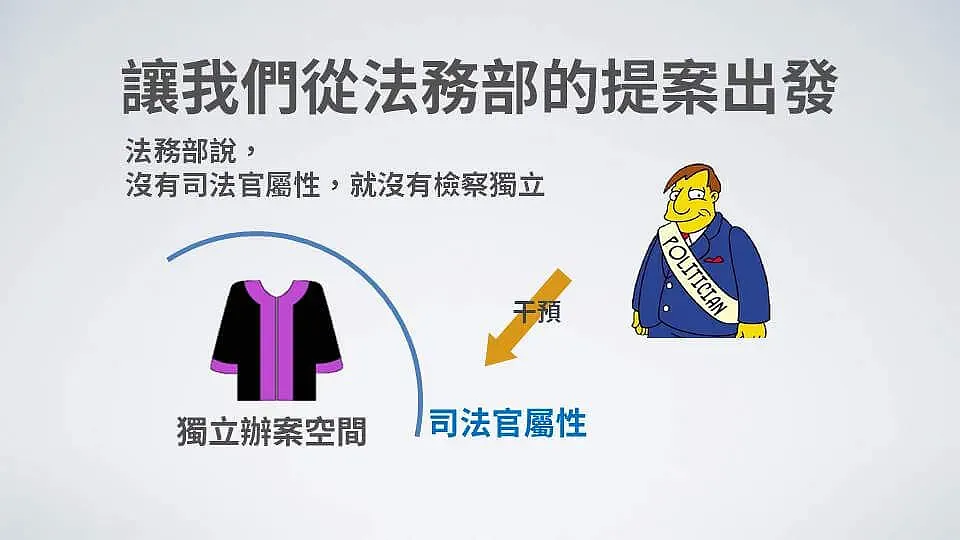
Neither the U.S., Japan, nor Germany has the term "judicial official" (司法官) as a reference point. So what on earth is a judicial official? The Ministry of Justice has always claimed that the judicial-official attribute is meant to guarantee the independence of prosecutors and protect them from political intervention. Yet, before Minister Chiu clarifies the substance of the concept of the judicial-official attribute, it is truly impossible to understand how a judicial-official attribute can achieve this purpose. To delve deeper, since prosecutors are not judges, the so-called independence of prosecutors cannot possibly be equivalent to judicial independence in adjudication. Therefore, what exactly are prosecutors being independent of? And under the constraint of the principle of prosecutorial unity (檢察一體), just how far are they supposed to be independent?
In Germany and Japan, the principle of prosecutorial unity stems precisely from the fact that prosecutors are administrative officials and must still obey the orders of their superiors. Unless Taiwan's prosecutors are "Batman" (drawn from Aesop's fables, where during a war between birds and beasts, the bat constantly changes its identity depending on which side is advantageous, abruptly claiming to be of the feathered tribe or a mammal belonging to the beasts), how can they simultaneously possess a judicial-official attribute while being bound by the principle of prosecutorial unity? If the judicial-official attribute and prosecutorial independence are both hollow rhetoric, does this hollow rhetoric actually cover up the unconstitutional reality that prosecutors wield excessive power and violate the warrant principle? Does it facilitate the Ministry of Justice in exploiting the concept of judicial independence to mislead the public, disallowing outside scrutiny into the internal operations of the prosecutorial system, making the prosecutorial system even more closed and opaque than the general administrative system, and consequently making the principle of prosecutorial unity even easier for chief prosecutors to abuse? The hollow concept of a judicial-official attribute will not safeguard the legitimate exercise of prosecutorial power; rather, it is sugarcoated poison. Can Minister Chiu afford not to explain it clearly?
Tracing legal history reveals that the so-called judicial-official attribute of prosecutors is actually an error born from misunderstanding the concept of judicial power when the prosecutorial system was introduced from the late Qing dynasty over a century ago.
In 1906, in order to introduce Western legal systems, the Qing court established the Beijing School of Law and hired Japanese scholars such as Okada Asataro (岡田朝太郎) to serve as lecturers at the school. These Japanese scholars introduced the prosecutorial system of Japan's Meiji Criminal Procedure Code (hereinafter the Meiji Criminal Procedure Code) to the Qing court, influencing the formation of the prosecutorial system in the late Qing dynasty.
The Meiji Criminal Procedure Code inherited the French legislative model: prosecutors were positioned as administrative officials, a preliminary examination system was adopted, and the power of compulsory disposition was vested in preliminary examination judges. According to Okada Asataro's explanation, the reason Japan adopted the preliminary examination system was: "Prosecutors are indeed administrative officials, must obey the orders of superiors, and lack an independent character as well as the guarantee of lifelong tenure. If prosecutors were allowed to handle preliminary examination affairs, there would be fear that they would blindly follow superiors' orders, abuse compulsory methods, and trample upon civil rights. Adjudication officials are not like this; they possess an independent character, enjoy the guarantee of lifelong tenure, and can stand above fame, fortune, and power to implement fair and just dispositions. Therefore, preliminary examination affairs should be controlled by adjudication officials, not by prosecutors."
The Law on the Organization of Courts, compiled in 1907 and promulgated in 1910, together with the Provisional Regulations for Trial Halls at All Levels, compiled in 1907 and implemented in 1909, constituted the prosecutorial system of the late Qing dynasty. Imitating the Meiji Criminal Procedure Code, prosecutorial offices were attached to trial halls, a preliminary examination system was adopted, and prosecutors were permitted to request and participate in preliminary examinations. However, Okada Asataro believed that while preliminary examination is a trial in form, it is substantively still a litigation preparation aimed at preparing for the public trial; thus, he argued that preliminary examination should be a power within the scope of the prosecutor's power of public prosecution, and criticized France and Japan for having judges conduct preliminary examinations as an infringement upon the power of public prosecution. From the perspective of the separation of powers and the warrant principle, Okada's view was undoubtedly a monumental mistake, yet his view influenced the 1910 Draft Criminal Procedure Act. That draft treated preliminary examination as a statutory investigative means conducted by prosecutors, stipulating that preliminary examination prosecutors could execute all necessary dispositions to discover evidence and criminals in order to determine whether a case should be sent for public trial. Okada Asataro highly praised this world-first innovation: "The Draft Chinese Criminal Procedure Act treats preliminary examination as a disposition to prepare for public prosecution prior to prosecution, conducted by the prosecutorial office. Measured against legal principles, it has no shortcomings; this is a characteristic of Chinese criminal procedure law and truly the newest legal precedent in the world." "Hereafter, countries revising their criminal procedure codes will undoubtedly take China as their model."
Because organizationally, prosecutorial offices were attached to trial halls, and influenced by Okada's erroneous view of judicial power, the powers of preliminary examination judges were allocated to prosecutors. Thus, the Qing court equated judges and prosecutors in its official system, thereby remodeling the concept of a judge and coining a world-unique term: "judicial official" (司法官), used to collectively refer to judges (推事) and prosecutors. Since then, judges and prosecutors have been examined and appointed together under the Provisional Regulations on the Examination and Appointment of Judicial Officials. The Law on the Organization of Courts promulgated at the same time also used a special chapter to regulate the "Appointment of Judges and Prosecutors," giving tenured prosecutors the same lifelong tenure protection as judges—a rarity in comparative law.
Interestingly, although prosecutors and judges were collectively referred to as "judicial officials," when regulating the independent exercise of duties by prosecutors, the Qing court specified that prosecutors are administrative officials: "The prosecutorial office is an organ of judicial administration; therefore it is a single-person system, differing from trial organs which may be a single-person system, a compromise system, or a collegiate system." Consequently, Article 102 of the Provisional Regulations for Trial Halls at All Levels stipulated the principle of prosecutorial unity: "Prosecutorial offices at all levels are linked as one body; regardless of rank or jurisdictional boundaries, all duties that a prosecutor ought to perform may be commissioned and delegated by the order of a superior prosecutorial official." It can be seen that, regardless of whether judicial official is a product of a mistaken concept of judicial power, viewed from the historical and temporal environment when the term was invented, it was at most an organizational law concept in official systems. To use it in operational law (criminal procedure law) to argue that prosecutors are not bound by the warrant principle, or to argue that they should enjoy the same powers as judges, is inevitably an inappropriate analogy.
Following the founding of the Republic, because the Beiyang government largely inherited the legal system of the former Qing dynasty, the Regulations on Criminal Procedure promulgated in 1921 inherited the errors of the aforementioned Draft Criminal Procedure Act, empowering prosecutors to execute compulsory dispositions against persons and property. After the Nationalist Government completed the Northern Expedition and assumed political power, the Code of Criminal Procedure enacted in September 1928 and in force to this day not only officially abolished the preliminary examination system, but also continued the Beiyang government's Regulations on Criminal Procedure, granting prosecutors powers of compulsory disposition entirely equivalent to those of judges. Moreover, in terms of official organization, the practice of confusing judges and prosecutors under the name of judicial officials, examining and training them together, and sharing the Court Organization Act and the Judges Act—a co-residence under the same roof—has continued all the way to the present.
Looking back now, the "judicial-official attribute" has unexpectedly reached its centenary. Despite being a hundred years old, no one has ever clearly seen what it actually is. Prosecutors have thus continuously faced the identity dilemma of whether they are judges, prosecutors, or "Batman"—belonging to neither? When will Minister Chiu help prosecutors figure out, "Where is my home?"
This article is an AI-generated translation of the original Chinese text. In the event of any discrepancy, the Chinese version shall prevail.
