
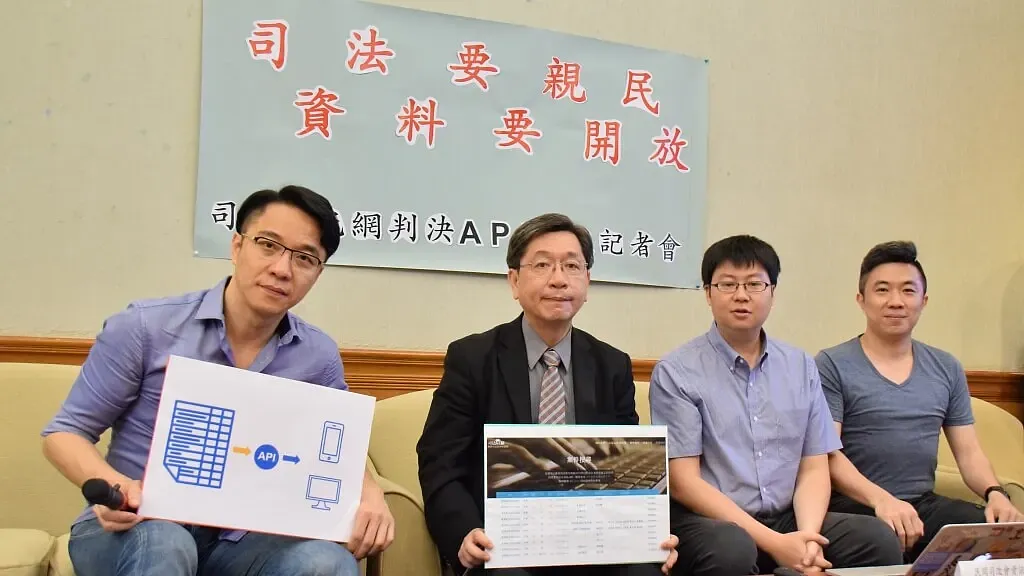
The Judiciary Must Be Accessible and Data Must Be Open: Press Conference on the Judicial Sunshine Net Judgment API
Last edited: 2026-08-24
(Download press conference slides)
The Judicial Sunshine Net, developed by the Judicial Reform Foundation (JRF), recently added a "Judgment API function" and built a case search engine using this feature. In addition to making legal databases more convenient for the public, the JRF hopes that through the development and demonstration of this new feature, the Judicial Yuan (and the Ministry of Justice) will be urged to further strengthen the opening of judicial data and understand the importance of formulating forward-looking digital policies.
Lack of Information Flow Leads to Misunderstandings
For a long time, the website of the Judicial Yuan has not been user-friendly. Although the Judicial Yuan provides functions such as "Judgment Search," "Court Session Schedule Inquiry," and "Division Assignment Tables," the interface is outdated and difficult to use on mobile phones. Furthermore, it is very cumbersome to use this data for value-added utilization. Taking the search for judgments as an example, in the past, if one tried to share a judgment, the website would revert to the original search interface. If searched by case number, the interface would simultaneously display various related judgments or rulings for that case, which is not conducive for the public to search, share, and discuss the content of judgments, and has also led to many citizens' misunderstandings of the judiciary.
However, it is worth acknowledging that the Judicial Yuan has made quite a few improvements recently. In addition to instructing courts at all levels to publish lists of judges, the Information Management Department of the Judicial Yuan has also made single URLs for judgments publicly available for sharing, and the judgment search page now allows multiple selections of courts at various levels, which can be said to be much more convenient than in the past. Regarding judgments, the Judicial Yuan also regularly packages judgments every month, placing them on the government's open data platform in open formats and with open licenses for public use. These are all gratifying instances of openness and progress.
Appreciating Recent Actions While Minor Issues Remain
Despite these improvements, there are still many minor issues with this data. Regarding single URLs for judgments, the URLs provided by the Judicial Yuan are overly cluttered and difficult to remember. At the same time, due to outdated systems, the line-breaking issues in judgments cannot be fixed, and the encoding of judgments still uses the legacy Big5 encoding rather than the currently more universal UTF-8 encoding. This results in many rare and difficult characters failing to display properly, and prevents judgments from handling foreign languages such as Japanese and Korean. Other queryable data, such as court session schedules, are deleted after the court session has taken place, preventing advanced utilization. As for the directory of judges promised by the Judicial Yuan, not only are the open URLs for each court inconsistent, but the formats of the body text also vary, and some are even released in PDF format, making further advanced use difficult.
We hope the Judicial Yuan can continuously improve these issues. Regarding judgments, the judgment system of the Judicial Yuan should be re-planned to replace past outdated systems with modern information systems; in addition to encoding conversion, the drafting of judgments should also be more standardized. Regarding court session schedules, we hope that in the future the Judicial Yuan can also release court session schedules as open data for public use to analyze case progress or allow vendors to create apps that remind people of court dates. Regarding the directory of judges, we hope the data can be released via a single, unified URL rather than having each court operate independently.
The JRF's "Judicial Judgment API"
At the same time, to demonstrate the potential advanced utilization of judicial data once opened, the JRF added the "Judicial Judgment API" on the foundation of the Judicial Sunshine Net. API stands for Application Programming Interface, which is an access interface provided for computer programs. For example, many people now have bus apps on their mobile phones that can accurately show how many minutes a bus will arrive. This is because the government provides an API for estimated bus arrival times, allowing these mobile apps to directly and instantly access the API in the background to accurately display bus arrival information on the interface, making it much more convenient for many people to use.
In the judicial sphere, if judgments could be released in the form of an API, future developers would not need to go to great lengths to build their own databases. They could more easily use the API to search and access judgments, or create reminder functions for case judgments so that citizens concerned about a case can see the judgments they care about as soon as possible. If court session schedules were provided for public access via an API, developers could create apps to remind parties or attorneys of court dates, making life more convenient for many people.
The Judicial Sunshine Net has opened the judgment API so that future developers, when developing websites, can directly access judgment data via the API. As long as the data fields are properly designed, websites will not need to store massive amounts of data in their own databases, but can instead stand on the shoulders of the Judicial Sunshine Net to quickly develop the websites they need.
The development team spent a lot of time re-planning the presentation format of the API and opened the data API for various sectors to interface with and utilize. They hope that through well-designed APIs and the interfacing of other websites, various possibilities of data application can be presented.
To demonstrate how the API can be used, the Judicial Sunshine Net utilized the judgment API function to build a case search engine similar to that of the Judicial Yuan, capable of searching all cases and judgments since January 1, 2016. The URL for each case adopts an easy-to-read, independent URL, upon which we have also added court sessions crawled since September 2016, as well as the ability to search by the names of judges and attorneys. Of course, many features are still being progressively refined, but through this case search engine, we want to tell the Judicial Yuan that developers can accomplish a great deal through APIs.
The development of the "Judicial Sunshine Net" judgment API function was made possible with special sponsorship from the g0v Civic Tech Grants. Thanks to their sponsorship, the JRF had more resources to develop and improve the API functions, and to build the demonstration search and judgment display interfaces.
Judgments Should Provide More Structured Data
While developing the judgment API, we also attempted to analyze the attorneys and judges related to the case from the judgment text. In fact, however, this is data that could already be further structured and released directly from the judgment data, including cited legal provisions, sentencing terms, evidence evaluation, and so on. In reality, such data should be processed by judges while writing judgments, and stored and released in a structured manner so that judgment data can have more and better applications.
From the data format of judgments, it can also be seen that the Judicial Yuan should re-examine how judges write judgments and ponder how new information technologies can enhance judges' drafting efficiency, reduce the burden on judges in writing judgments, and even ease other tasks. For example, through a well-designed information system, after a judge fills in case-related data, evidence, cited legal provisions, and sentencing terms, the information system could quickly generate a partial draft of the judgment, allowing the judge to modify it as a basis to become part of the judgment, and release the filled information together as judgment-related data. In addition to making judgment writing more efficient for judges, designing the system to prevent judges from omitting important data can help judges reduce errors in judgments. Building such a system may require time during the evaluation phase to review requirements and adjust architecture, but once well-made, it can enhance the work efficiency of thousands of judges across Taiwan.
Of course, APIs are only one form of openness; allowing the public to download via open formats and open licenses is also fantastic. The Judicial Sunshine Net hopes that through the API it has built, the Judicial Yuan, the Ministry of Justice, and the public can all explore the various possibilities of data openness together. It also hopes that more people will analyze this data, analyze judicial problems, and provide beneficial information to serve as a reference for the people when approaching the judiciary or for official judicial decision-making.
The case information for the Judicial Sunshine Net's open judgment API comes from crawling the official website of the Judicial Yuan. The JRF hopes that through the planning and opening of this API, it can demonstrate and help the Judicial Yuan and the Ministry of Justice understand that open data is not scary, and that it is an important part of making the judiciary accessible to the people. Going a step further, we look forward to the Judicial Yuan and the Ministry of Justice re-examining the importance of digital policies, understanding that the digital age has arrived, and formulating forward-looking judicial digital policies. We believe that through the assistance of information technology, it will not only strengthen judicial transparency, but also further improve the working environment and efficiency of judicial personnel.
Judicial Sunshine Net Case Search Interface: https://sunshine.jrf.org.tw/search
g0v Civic Tech Grants: Judicial Sunshine Net Open API Project: https://grants.g0v.tw/projects/58749ce08798fb001e73251c
API Documentation: https://sunshine.jrf.org.tw/api
Attendees
Lin Yung-sung, Attorney at Law / Chairman, Judicial Reform Foundation
Kao Jung-chih, Attorney at Law / Executive Director, Judicial Reform Foundation
Mars / CEO, 5Floor Professional Information Studio
Lin Yu-tsang / Information Specialist, Judicial Reform Foundation
Press Contact
Kao Jung-chih, Executive Director, Judicial Reform Foundation — 02-2523-1178
This article is an AI-generated translation of the original Chinese text. In the event of any discrepancy, the Chinese version shall prevail.
