
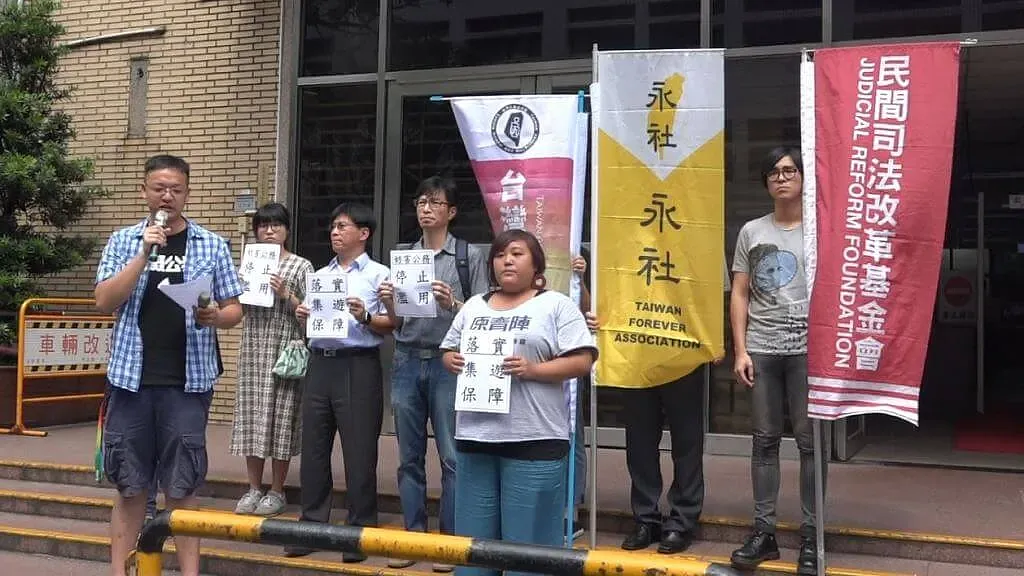
Freedom of Assembly Unprotected, Obstruction Charges Abused: Press Conference Before the Second-Instance Hearing in the "Passing by the Zhongzheng First Precinct" Case
Last edited: 2026-08-28
On the evening of April 11, 2014, crowds spontaneously "passed by the Zhongzheng First Police Precinct" after the precinct improperly dispersed an assembly held by the Referendum Action Alliance and issued an unconstitutional administrative disposition declaring that "no future assemblies will be permitted." Four participants—Savungaz Valincinan, Tao Han, Hung Chung-yen, and Hsiao Nien-cheng—were indicted. On December 30, 2016, the Taipei District Court found all four defendants guilty of charges such as "obstructing public officials" and "insulting a public official." Following their appeal, the first trial of the second instance is scheduled for this afternoon (May 11).
In light of the long-delayed enactment of an Assembly and Parade Protection Act, and the increasingly frequent use of provisions in the chapter on "Offenses of Obstructing Public Officials"—such as obstructing public officials and insulting a public office or public official—along with other criminal and administrative regulations to punish and restrict assemblies and parades, the Alliance to Reform the Bad Assembly and Parade Law, the Judicial Reform Foundation, the Taiwan Association for Human Rights, Taiwan Forever, and the Taiwan Higher Education Union, together with defendants from this and other cases, held a joint press conference at 2 p.m. today in front of the Taiwan High Court. They called on the executive and judicial branches to swiftly enact a protection act that "fully realizes the right of assembly and parade," review other abused regulations, and cease using judicial litigation or administrative dispositions to force participants of assemblies and protests to bear unnecessary costs!
The defendants in this case heavily criticized that while police have long engaged in various rough enforcement tactics against citizens' protests, they are rarely held accountable—the police officers who committed violence during the Executive Yuan incident remain unidentified to this day. Conversely, whenever citizens' protests show the slightest offense, whether through physical contact or fierce rhetoric, even if no actual harm is caused, they are almost invariably prosecuted under offenses related to obstructing public officials. This is a clear, deliberate, and severe suppression of citizens' right to assemble and protest, aimed solely at silencing those who raise problems rather than solving the problems themselves.
Supporting organizations emphasized that whether an assembly or parade is "peaceful" should be the sole focus. Urgency, spontaneity, the presence of a ringleader, prior notification, and politeness should never become reasons to restrict citizens' right to assembly or to impose criminal penalties. Even if protesters have physical contact with police, consideration should be given to whether the conduct itself forms part of speech expression, or whether it constitutes questioning and blocking improper government administration. If so, it should also be regarded as part of peaceful assembly and protest, and should not be arbitrarily penalized. Crucially, Article 30 of the current Assembly and Parade Act—which specifically imposes harsher penalties targeting protesters—should not stand.
Supporters further criticized criminal penalties for insulting a public office or a public official as authoritarian remnants. In many countries, mere criticism or insults directed at national symbols or institutional authority are regarded as falling within the scope of freedom of speech and have been decriminalized. Taking Kao Jo-hsiang's protest against the exclusion of part-time teaching assistants from labor insurance, where she crushed an egg on a civil servant, as an example: if the civil servant felt offended, civil remedies could be pursued, but no official duties were obstructed, and the state has no grounds to afford special protection to high-ranking government officials or to additionally prosecute individuals through harsher criminal laws. Taiwan's retention of the offenses of insulting a public office or public official is "a symbol of non-democracy."
Furthermore, in January of this year, when the Taiwan Higher Education Union protested at the Ministry of Education demanding the inclusion of part-time teachers under the Labor Standards Act, members were referred by police to the prosecutors office for alleged violations of the Assembly and Parade Act. This demonstrates that the Assembly and Parade Act remains a vital tool for the government to suppress protesters. Regarding the amendment of relevant regulations, the Alliance and various organizations call upon the government: assemblies, parades, and petitions are citizens' most fundamental means of making their voices heard, and the government should return the streets to the toiling masses. In addition to promptly applying the Covenants to guarantee the right to peaceful assembly and parade, deleting unnecessary procedural and administrative restrictions, amending the Assembly and Parade Act and other regulations, and abolishing offenses targeting protest behaviors, the government must also avoid abusing police force to excessively interfere with protest actions, improve police human rights training, and ensure the police do not become enforcers suppressing the people. Naturally, the government must also stop routinely threatening and excluding protesters through other regulations such as the offense of public endangerment and the Waste Disposal Act, or through administrative measures like the establishment of restricted zones and forced dispersal.
At the conclusion of the press conference, attendees chanted slogans together: "Freedom of assembly unprotected, obstruction charges abused," and "Protest is justified—stop abusive prosecutions." The defendants then entered the High Court for the first trial hearing of the second instance.
Moderator
Hung Chung-yen / Student, Graduate Institute of Social Development, Shih Hsin University
Attendees
Savungaz Valincinan (Member, Indigenous Youth Front; Defendant for obstructing public officials in the Zhongzheng First Police Precinct incident)
Tao Han (Student, Fu Jen Catholic University; Defendant for insulting a public official in the Zhongzheng First Police Precinct incident)
Hung Chung-yen (Student, Graduate Institute of Social Development, Shih Hsin University; Defendant for assembly and parade offenses and insulting a public office in the Zhongzheng First Police Precinct incident)
Kao Yung-cheng (Attorney, Chairman of Taiwan Forever)
Kao Jo-hsiang (Student, Graduate Institute of Sociology, National Chengchi University; Defendant for insulting a public official in the part-time assistant egg-crushing incident)
Chen Cheng-liang (Secretary-General, Taiwan Higher Education Union; Associate Professor, Graduate Institute of Social Development, Shih Hsin University)
Wang Hsi (Legal Staff, Taiwan Association for Human Rights)
Ho Yu-lun (Research Fellow, Judicial Reform Foundation)
Supporting Organizations
Alliance to Reform the Bad Assembly and Parade Law
Judicial Reform Foundation
Taiwan Association for Human Rights
Taiwan Forever
Taiwan Higher Education Union
Tsai Jui-yueh Dance Research Institute
Press Contact
Hung Chung-yen, Student, Graduate Institute of Social Development, Shih Hsin University — 02-2388-3997
This article is an AI-generated translation of the original Chinese text. In the event of any discrepancy, the Chinese version shall prevail.
