
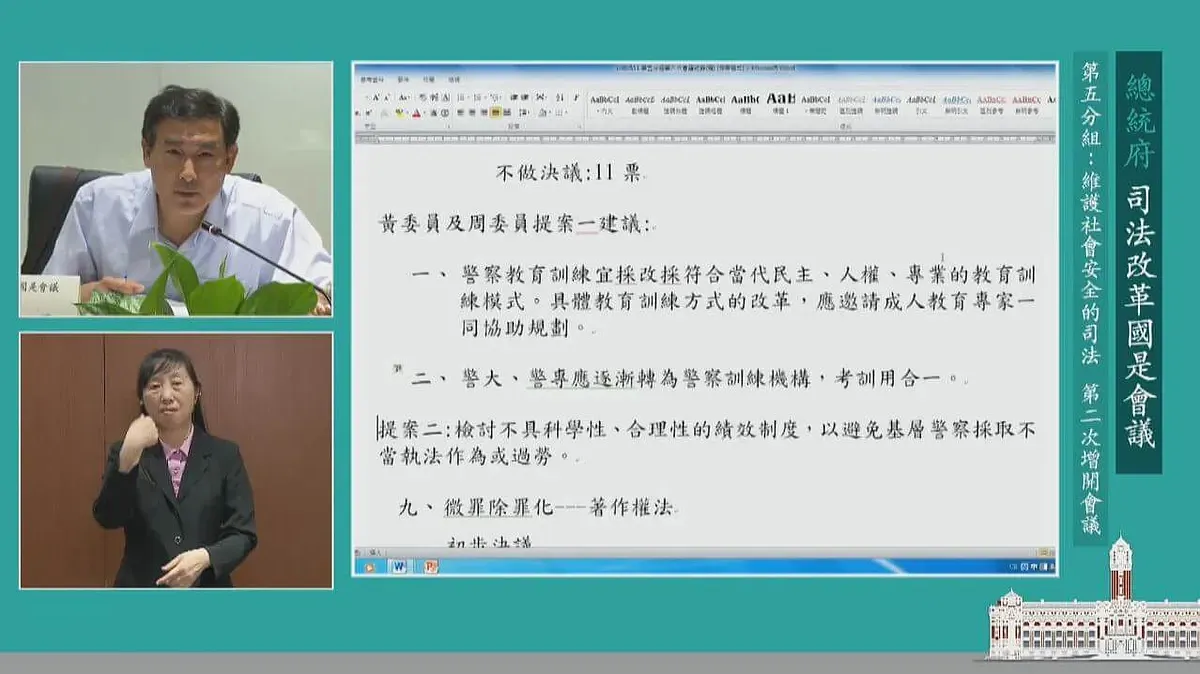
Review: The Second Additional Meeting of the Fifth Division of the Presidential Office's National Judicial Reform Conference
Last edited: 2026-08-28
This meeting lasted approximately five hours and reached resolutions on issues including 5-4-4 Police Crime Prevention Strategies, 5-3-6 Corporate Crime, 5-4-1 Reintegration of Ex-offenders into Society and Supporting Measures, and 5-4-5 Review of the Adult Probation System.
The National Police Agency was invited to report on "Investigation Management, Investigation Practices and Dilemmas," and the Director-General of the Agency of Corrections participated in discussions on 5-4-1 Reintegration of Ex-offenders into Society and Supporting Measures and 5-4-5 Review of the Adult Probation System. The Director-General of the Agency of Corrections also provided numerous suggestions regarding the resolutions.
This division previously resolved on May 4 to invite Mr. Chang Chung-hsin to report on the "Decriminalization of Minor Copyright Infringement Offenses." However, for this meeting, Mr. Chang instead submitted an email response of approximately 2 pages containing his views on the matter, along with his previous analyses and web links concerning the "Decriminalization of Minor Copyright Infringement Offenses." The chairperson further instructed the Intellectual Property Office to provide this division with the draft amendments to the Copyright Act.
Regarding point 2 of resolution 5-3-1 on reviewing anti-corruption legislation, "Sunshine laws, conflicts of interest, and information disclosure for legislative bodies and political appointees; the Agency Against Corruption is requested to analyze the implementation effectiveness and problems of current laws," this division resolved to request the Agency Against Corruption to propose a reform plan (framework) by June 8 for discussion by the members.
Regarding preliminary resolution point 3 of 5-3-2 on strengthening measures to prevent defendants from fleeing, "The competent authorities shall analyze the charges for unexecuted cases where defendants failed to appear during trial and current unexecuted cases where defendants failed to appear between 2013 and 2015, and provide this for the committee's reference." Because the Ministry of Justice has prepared its report but the Judicial Yuan has not yet prepared its own, this matter will be discussed at the next meeting. Meanwhile, the discussion on "Article 312 of the Code of Criminal Procedure should be studied so that upon the pronouncement of a judgment, the court shall re-evaluate whether the defendant's detention is necessary or if other alternative measures should be used to prevent the defendant from fleeing," which was deferred at the last meeting, also could not be discussed in time at this meeting.
Regarding the issue of 5-4-4 Police Crime Prevention Strategies, this division previously passed a resolution on March 30 recommending that "the Ministry of the Interior reconfirm and report back." As seen from the Criminal Investigation Bureau's report at this meeting, the content appears unchanged. The Criminal Investigation Bureau still insists on three major issues: depositing judicial documents at police stations, escorting fugitives, and abolishing the Regulations Governing the Direction of Judicial Police. The division meeting considered these three issues to have a low degree of correlation with judicial reform and thus did not reach corresponding resolutions. However, regarding police performance in crime prevention, the chairperson instructed: "(1) The National Police Agency is requested to provide an explanation regarding the content of the performance evaluation system. (2) The Ministry of Justice is requested to explain whether any systemic problems exist in its cooperation with police units that lead to the failure in implementing judicial social safety cases. (3) The proposing member (Member Chou Su-hsien) is requested to provide concrete data."
Regarding matters such as startup loans for ex-offenders, the chairperson instructed the Taiwan After-Care Association under the Ministry of Justice to provide data on after-care loans for the past three years.
The content of the first additional meeting of the Fifth Division was a visit to Ming-Yang Senior High School. The relevant materials were not provided online and were only verbally explained by the chairperson.
The next meeting will be held on May 18 to discuss the issues from this meeting that have not yet been fully discussed, as well as issues related to juvenile and gender-friendly judicial systems.
Discussion Subtopics and Opinions
Regarding 5-4-4 Police Crime Prevention Strategies, the discussion lasted approximately 140 minutes. The National Police Agency pointed out that the "Regulations Governing the Direction of Judicial Police," a rule from the Period of Political Tutelage—specifically Article 9, which states that "those subject to the command and orders of prosecutors and judges shall immediately comply and shall not delay under any pretext," and Article 12, which states that "for matters of reward and punishment executed pursuant to the preceding article, the competent chief prosecutor or court president shall, in addition to notifying the direct superior of the person rewarded or punished, report to the Ministry of Justice or the Judicial Yuan, and forward the matter to the competent civil service personnel agency for registration"—makes the police objects who can be arbitrarily directed or even controlled through rewards and punishments by prosecutors and judges. They consider this outdated and hope this division can pass a resolution to abolish it. They also hope that police officers will no longer be occupied with escorting fugitives and storing judicial documents. Regarding the escort of fugitives, police officers are often forced to run back and forth across the north and south, east and west. The Criminal Investigation Bureau also mentioned that given current technological advancements, prosecutors and courts should place greater consideration on technological interrogation and trials. Regarding judicial documents, the Criminal Investigation Bureau hopes that post offices can undertake the task of depositing judicial documents, which should not be borne by police bureaus.
Regarding the abolition of the "Regulations Governing the Direction of Judicial Police," Member Yu Li-chen mentioned that this is a matter subject to legislative amendment discussions, and both the Judicial Yuan and the Ministry of Justice oppose its abolition; thus, this proposal seemingly does not need to be discussed at this meeting. Members Tsai Hsiu-chuan, Liu Shu-chiung, and Lu Ying-chieh mentioned that abolishing the "Regulations Governing the Direction of Judicial Police" is too granular an issue and does not need to be discussed by the National Conference on Judicial Reform.
Regarding the escorting of fugitives and the deposit of judicial documents, Members Huang Hsu-tian and Lai Fang-yu mentioned that these are interconnected issues. Because judicial documents deposited at police stations still result in situations where defendants fail to receive them, defendants become fugitives due to not receiving judicial documents, which consequently generates the fatigue issue of having to escort numerous fugitives over long distances. Conversely, police bureaus should not be exempted from the task of "depositing judicial documents." Members Li Ming-hung and Hsu Shih-feng mentioned that if the police do not escort fugitives to the competent court and instead expect remote technological interrogation and trials, it is prone to causing prosecutors and judges to have insufficient information, making interrogation and trials difficult.
Ultimately, the members voted to decide that the issue of abolishing the "Regulations Governing the Direction of Judicial Police" would not be discussed. Regarding the escort of fugitives, the chairperson instructed: "To balance the rights and interests of the parties involved, reduce the risk of police escorting fugitives over long distances, and avoid wasting excessive police force that would affect public safety maintenance work itself, for fugitive cases, the nature of the case shall be distinguished, and for minor offenses, the resolution of long-distance transfers through technological equipment such as video conferencing shall be studied. Regarding the escort of fugitives, the National Police Agency is requested to provide data (number of persons) on long-distance fugitive escorts for minor offenses and propose relevant legislative amendment opinions; the Criminal Division of the Judicial Yuan shall provide data after the meeting (this proposal is temporarily reserved)." This proposal is reserved.
Regarding the issue of police performance metrics, Member Chang Kuan-ming and the Criminal Investigation Bureau considered this to be an internal police administrative management issue with no necessity for discussion in the National Conference on Judicial Reform. Members Chou Su-hsien, Yu Li-chen, and Wang Yi-fan all believed that certain performance calculation methods distort police operational practices and indeed affect judicial operations. However, the Criminal Investigation Bureau denied on the spot that any such performance distortion exists. The chairperson consequently instructed: "(1) The National Police Agency is requested to provide an explanation regarding the content of the performance evaluation system. (2) The Ministry of Justice is requested to explain whether any systemic problems exist in its cooperation with police units that lead to the failure in implementing judicial social safety cases. (3) The proposing member (Member Chou Su-hsien) is requested to provide concrete data."
As for the abolition of militarized education in police academies, and whether the Central Police University and the Taiwan Police College should be merged, Member Chou Su-hsien mentioned that militarized education and training are not conducive to demanding that police enforce the law according to democratic and human rights principles, which no longer meets social expectations. The Criminal Investigation Bureau stated that it does not know what society's expectations of the police are, but current practices strictly follow relevant police education laws and regulations. Regarding whether the Central Police University and the Taiwan Police College should be merged, Member Chou Su-hsien reiterated the contents of the original proposal and added issues concerning the promotion limitations faced by graduates of the Taiwan Police College under the distinction between the two institutions, as well as the difficulty of leadership for certain Central Police University graduates who enter the workplace immediately as senior frontline officers. Member Chang Kuan-ming emphasized that the very existence of the Central Police University provides diversity to the police force and has driven many important police reforms. A final vote was taken on this matter, deciding not to make a resolution within the Judicial Reform Conference.
Regarding 5-3-6 Corporate Crime, Member Lin Chih-jui merely reported for about 7 minutes on the reasons for formulating the preliminary resolution, and the members present expressed no dissenting opinions.
Regarding 5-4-1 Reintegration of Ex-offenders into Society and Supporting Measures, the discussion lasted approximately 60 minutes. Members Lin Wen-wei and Liu Pei-yuan expressed concern over whether there are adequate vocational training measures within prisons to help ex-offenders reintegrate into society; Members Tsai Hsiu-chuan and Liu Shu-chiung mentioned that consideration should be given to establishing social enterprises in organizations outside the government to increase the possibility of ex-offenders entering the workplace; Member Liu Shu-chiung expressed concern regarding the approval status of startup loans for ex-offenders, and concerning this matter, the chairperson instructed the Taiwan After-Care Association under the Ministry of Justice to provide data on after-care loans for the past three years.
Regarding 5-4-5 Review of the Adult Probation System, the discussion lasted approximately 50 minutes. The written report by the Ministry of Justice stated that in 2016, the caseload for probation officers totaled 104,611 cases, while the budgeted staffing quota for probation officers was only 225, representing a severe shortage of personnel where existing cases have stretched staff thin beyond full capacity. Moreover, probation officers lack establishment for professional psychologists, which is detrimental to the effectiveness of treatment. In addition to handling protective supervision directed by prosecutors, probation officers also handle judicial protection work such as legal advocacy, anti-vote-buying, anti-drug, and restorative justice operations. As a result, probation officers in various prosecutors' offices are currently required to rotate weekend and weekday shifts for electronic monitoring operations to execute electronic monitoring cases, which risks failing to handle the monitoring and rule violations of sex offenders in a timely manner due to excessive operational burdens, easily creating the risk of delayed execution.
Member Chen Hung-ta also agreed that the caseload of probation officers is excessive and overly complex, lacking a dedicated "Probation Act"; Member Lu Ying-chieh likewise agreed that the caseload is excessive and overly complex; Member Wang Yi-fan stated that the Probation Act is similar to the Act Governing the Assignment of Judicial Personnel, resembling a recurring zombie issue. Furthermore, when the Juvenile Justice Act was amended in 1997, to conform to the legislative purpose of the Act, probation officer titles were amended to "Juvenile Investigator" and "Juvenile Protection Officer," and "juvenile probation operations" were also changed to "juvenile investigation and protection operations." The amendment to the Court Organization Act on February 4, 2015, even formally amended probation officer titles to "Juvenile Investigator" and "Juvenile Protection Officer." Moreover, surveys conducted by the Judicial Yuan in 1997 and 2008 of personnel related to juvenile operations under its jurisdiction showed that over 85% of personnel advocated maintaining the status quo, opposed unification, and emphasized that juvenile probation and adult probation are different matters and should not be merged under a single Probation Act. Member Hsu Shih-feng also agreed that juvenile probation and adult probation are different matters.
Regarding the meeting resolution on "5-3-4 Establishment of Sentencing Guidelines," Member Li Ming-hung mentioned that sentencing procedures would increase the burden on judges, shifting his stance to be more reserved compared to the last meeting; Member Hsu Shih-feng stated that emphasizing sentencing debates is currently hollow and it is indeed necessary to strengthen sentencing debates. Member Lu Ying-chieh questioned whether introducing amicus curiae into sentencing procedures is appropriate, as amicus curiae should only provide legal opinions rather than sentencing opinions; Preparatory Committee Member Hsu Yu-hsiu stated that amicus curiae can be individuals who know or have had contact with the defendant and can therefore provide opinions regarding sentencing. Since other members did not help clarify the exact function of amicus curiae, the chairperson instructed: "Member Hsu Yu-hsiu is requested to supplement information on expert witnesses and amicus curiae" regarding the resolution "5-3-4 Establishment of Sentencing Guidelines."
Meeting Resolutions
5-3-1 Review of Anti-Corruption Legislation
Regarding civil servant status and the exercise of public power, applying the same standard uniformly is inappropriate; categorization should be applied to conduct supervision with differing intensity. Additionally, for integrity supervision across various types of civil servants (members of legislative bodies at all levels, political appointees, career civil servants, judicial personnel, etc.), it is recommended that authority be unified.
Regarding sunshine laws, conflicts of interest, and information disclosure for legislative bodies and political appointees, the Agency Against Corruption is requested to analyze the implementation effectiveness and problems of current laws, review whether regulations and practical conditions comply with international conventions, benchmark national standards, and global anti-corruption trends while reflecting the expectations of Taiwanese society, and propose a reform plan (framework) for member discussion before the end of the final division meeting. (Passed with 15 votes)
5-3-2 Strengthening Measures to Prevent Defendants from Fleeing
Under current Article 116-2 of the Code of Criminal Procedure, measures providing alternatives to detention are insufficient; feasible measures should be designed with reference to legislative examples from various countries, balancing the connotations of international conventions, defendants' rights and interests, and flight prevention effects, to study alternative measures to detention.
Considering Taiwan's international situation and the difficulties in diplomacy, extradition, and mutual legal assistance, it is recommended to study amendments to the Code of Criminal Procedure allowing prosecutors to apply for the detention of defendants during trial who may face heavy sentences and are deemed to be at risk of fleeing, so as to prevent defendants from absconding. (Passed with 16 votes)
5-3-5 Crimes against the Administration of Justice
To ensure the proper exercise of state judicial power and discover the truth of facts, relevant crimes against the administration of justice should be studied, reviewing the crimes of destroying criminal evidence and perjury, adding the offenses of violating lawfully issued preservation orders and jumping bail/absconding after release, adding the offenses of interfering with witnesses and retaliating against whistleblowers and witnesses, and adding offenses obstructing criminal investigation and execution, so as to curb law enforcement obstruction behaviors such as abusing power and lobbying. (Passed with 16 votes)
5-3-4 Establishment of Sentencing Guidelines
The Judicial Yuan should study a two-stage trial procedure for conviction and sentencing; sentencing procedures should involve oral debate, strengthen victim participation, introduce systems for expert witnesses and amicus curiae, and establish appropriate supporting measures. (Member Hsu Yu-hsiu is requested to supplement information on expert witnesses and amicus curiae)
The Judicial Yuan's Sentencing Trend Recommendation System should establish sentencing factors and propose guidelines for case types of public concern—such as corruption crimes, financial crimes, food safety crimes, gender violence (including sexual assault), domestic violence and child abuse crimes, and heavy crimes (including life imprisonment and the death penalty)—and review standards for determining combined execution sentences. The establishment of sentencing factors should have its focus groups broadly incorporate opinions from civic groups, social welfare groups, and social reintegration groups. (Passed with 15 votes)
Preliminary Meeting Resolutions
5-4-1 Reintegration of Ex-offenders into Society and Supporting Measures
Review preparatory measures provided by correctional institutions for inmates prior to social reintegration:
Understand market demand, review vocational training courses in correctional institutions, and implement proper vocational training measures.
Fully communicate relevant information regarding employment counseling.
Formulate diverse treatments for inmates prior to release from prison, including the establishment of specialized halfway transition zones, to establish de-institutionalized living for inmates, enhance interpersonal interaction and independent living skills, and successfully transition back into society.
Encourage the private sector to promote social enterprise models to employ ex-offenders, and provide incentives for governments to hire ex-offenders without discrimination.
Strengthen the work and communication of the Agency of Corrections, adult probation, and the After-Care Association:
Establish halfway houses for ex-offenders to provide vocational training and employment matching mechanisms while offering necessary childcare assistance.
Actively establish a "Family Support System for Ex-offenders," focusing on service targets, deepening service content, and regularly implementing performance evaluations to maximize the effectiveness of family support.
Autonomous work outside prisons should be expanded in application:
If designed for the purpose of resolving inmate overcrowding, the pressure of insufficient management manpower, and social transition following an inmate's release from prison, the Agency of Corrections is requested to actively expand the quota for autonomous work outside prisons so that it holds substantive meaning.
State-owned enterprises should open quotas for individuals undergoing reintegration treatment: Cooperative manufacturers for autonomous work outside prisons are hard to come by; it is recommended that state-owned enterprises in various counties and cities open partial job quotas to individuals undergoing reintegration treatment inside correctional institutions, introducing training, internships, and work through industry-academia cooperation to provide such individuals with living allowances and help them acquire specialized professional skills.
5-4-5 Review of the Adult Probation System
Enact a dedicated "Probation Act" to integrate the operation and development of the probation system, enhance the professional competencies of probation officers, and achieve the professionalization of probation operations.
The government should moderately adjust probation manpower and resources, establish professional personnel such as psychologists, strengthen treatment measures for major cases such as sexual assault, and construct a rigorous social safety network.
5-4-4 Police Crime Prevention Strategies
To enhance police professionalism and law enforcement effectiveness, the Police Act and mission clauses and operational regulations of related police laws should be reviewed and amended, and education and training for police personnel at all levels should be implemented in accordance with the Police Education Act to respond to changing times.
5-3-6 Corporate Crime
It is recommended that the Ministry of Justice review the possibility of recognizing corporate criminal responsibility and the criteria for establishing subjective and objective elements regarding offenses in special laws of our country that impose dual penalties on corporations, such as environmental, food safety, financial, money laundering, and corruption offenses.
It is recommended that the Judicial Yuan study the rights and obligations of corporate defendants and their procedural participation in the Code of Criminal Procedure, and address issues such as whether conflicts of interest require recusal between corporate representatives and corporations during confiscation proceedings.
Regarding 5-4-4 Police Crime Prevention Strategies, the chairperson's preliminary opinion is: "To balance the rights and interests of the parties involved, reduce the risk of police escorting fugitives over long distances, and avoid wasting excessive police force that would affect public safety maintenance work itself, for fugitive cases, the nature of the case shall be distinguished, and for minor offenses, the resolution of long-distance transfers through technological equipment such as video conferencing shall be studied. Regarding the escort of fugitives, the National Police Agency is requested to provide data (number of persons) on long-distance fugitive escorts for minor offenses and propose relevant legislative amendment opinions; the Criminal Division of the Judicial Yuan shall provide data after the meeting (this proposal is temporarily reserved)."
Review Comments
When discussing what the police performance index should be, the chairperson mentioned: "What should the KPI (Key Performance Indicator) for police professionalism be? It has always been difficult to decide. Even assessing what the KPI of our own judicial reform resolutions would be is difficult." When discussing the content of resolutions, the chairperson mentioned: "Our resolutions should have the possibility of immediate execution. A resolution like 'The Republic of China government shall increase administrative efficiency' is not suitable because it is difficult to execute immediately." When discussing communication mechanisms for after-care protection mechanisms, the chairperson lamented: "This country simply has many methods, but most of them cannot be achieved; there is no way."
Taking the National Conference on Judicial Reform as an example, there will be nearly one hundred resolutions, each of which is a method. However, after Members Lin Yu-hsiung and Chen Chung-yen withdrew from the National Conference on Judicial Reform in protest, the Legislative Yuan also questioned the legitimacy of the National Conference on Judicial Reform. As stated by Hung Hsiu-chu, chairperson of the primary opposition party, the Kuomintang chairperson's office noted: "Chiu Hai-yuan, the convener of the judicial reform, stated regarding the positioning of the National Conference on Judicial Reform that it is 'a bit more than consultative.' According to the Constitution of the Republic of China, the constitutional system originally has dedicated units for the judicial system. Without constitutional authorization, any 'bit more' is impermissible under the Constitution. President Tsai, serving as 'President' under constitutional protection, should be the guardian of the Constitution of the Republic of China, yet she 'acts as a thief herself,' usurping rights not permitted by the Constitution, unconstitutionally authorizing a non-constitutional black-box organization, the 'National Conference on Judicial Reform,' to act as the executive unit for judicial reform." and "The Judicial Reform Foundation uses unscrupulous means to carry out Tsai's intentions; the resolutions of the National Conference on Judicial Reform only talk about ideals, not reality. The resolution process failed to consider domestic financial difficulties making execution unaffordable; empty talk of ideals makes the quality of the resolutions worrisome." How should the execution order of these 100-odd resolutions be prioritized in the future? Which resolutions must be implemented first to solve the problem of judicial trust? How can we avoid the National Conference on Judicial Reform being what Member Lin Yu-hsiung called "releasing sky lanterns"? If the direction decided by the Legislative Yuan happens to run contrary to the direction discussed by the National Conference on Judicial Reform, will it create another kind of distrust in the judiciary?
As the National Conference on Judicial Reform draws to a close, the future of the National Conference on Judicial Reform is truly as the chairperson lamented, regardless of whether it was intended as a veiled reference: "This country simply has many methods, but most of them cannot be achieved; there is no way."
This article is an AI-generated translation of the original Chinese text. In the event of any discrepancy, the Chinese version shall prevail.
