
Taiwan's First Chinese Political Prisoner
Last edited: 2026-08-29
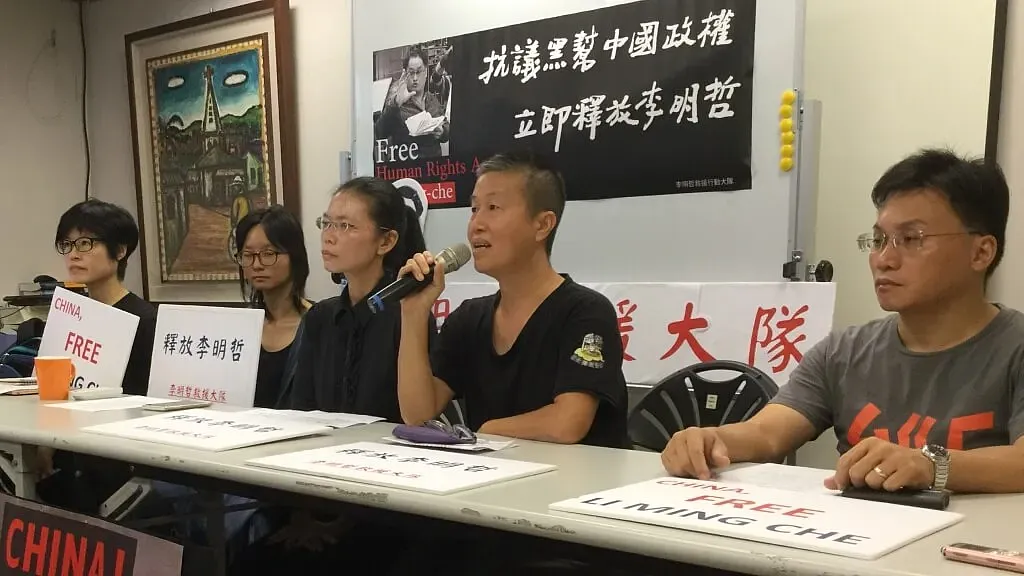
Lee Ching-yu, who was scheduled to attend a UN investigative hearing on September 12, suddenly received a call this Wednesday from a state-appointed lawyer in China notifying her that her husband, Lee Ming-che, would soon go on trial and asking her to prepare to attend the hearing. The following day, the Intermediate People's Court of Yueyang City, Hunan Province, issued a public notice announcing that the charge of "subversion of state power" against Lee Ming-che would be tried openly at 9:30 AM on September 11. He is the first Taiwanese person to be tried in a Chinese court under this charge.
The predecessor to the "crime of subversion of state power" was counter-revolution, a category of crime invented during the Kuomintang-Communist cooperation period in 1927. After the Kuomintang came to Taiwan in 1949, the crime of counter-revolution was transformed into Article 2, Paragraph 1 of the Statute for the Punishment of Sedition, becoming a lethal weapon used against political prisoners. Political prisoners did not disappear from Taiwan until the Independent Taiwan Association case triggered student strikes and the abolition of the Statute for the Punishment of Sedition in 1991.
Across the strait, crimes such as anti-party and counter-revolutionary offenses have produced countless political prisoners since 1949. It was not until China promoted judicial reform in 1997 that the crime of counter-revolution was transformed into the "crime of subversion of state power." However, this was merely changing the medicine without changing the cure; the charge continues to be used against political dissidents. The recently deceased Nobel Peace Prize laureate Liu Xiaobo is the most prominent example.
Criminal acts of subversion of state power include both violent and non-violent, public and non-public actions. Whether it is instigating an armed coup or implementing peaceful evolution, publicly expressing opinions or privately discussing views, as long as one harbors doubts about the ruling regime of the Communist Party in their heart, it can be deemed a crime. The targets of punishment under this offense are also extensive. Taking the publication of books, periodicals, or audio-visual products as an example, as long as a publication is deemed to contain content that subverts state power, all persons participating in its publication, printing, reproduction, distribution, and dissemination are subject to punishment.
What is most characteristic of "Chinese characteristics" is the ultimum remedium (last resort) nature of the "crime of subversion of state power": if other charges can be used to deal with political prisoners, this charge need not be invoked. China's prosecution of Lee Ming-che under the "crime of subversion of state power" indicates that he did not violate ordinary legal provisions in China, making him a pure political prisoner.
Since participating in the petition for the "Open Letter from Civil Society on the Xu Zhiyong Incident" in 2013, Lee Ming-che has actively participated in China's public interest lawyer group, using his meager salary to send money to rights defenders and their families imprisoned by China. He has given books to Chinese netizens wanting to understand Taiwan's democracy and freedom, and has posted his thoughts on cross-strait current affairs in his WeChat Moments. In Taiwan, these are the most basic civil rights. Lee Ming-che is merely an ordinary Taiwanese person, yet upon going to China, he has become a political prisoner sharing the same conviction as Liu Xiaobo.
Back then, Liu Xiaobo's wife was absent from the Nobel Peace Prize ceremony due to obstruction by China. Today, Lee Ming-che's wife is similarly obstructed from attending the UN meeting. In the eyes of the people of Taiwan, the defendant in this trial is not Lee Ming-che, but China's judiciary. If Lee Ming-che cannot receive a fair trial! If his crime is merely advocating for democracy and freedom! If Lee Ching-yu is placed under house arrest and never returns! What Lee Ming-che will secure is the historical positioning of being Taiwan's first Chinese political prisoner, while what China's judiciary will lose is the trust of all the people of Taiwan.
※ This article was published in Apple Daily on 2017/9/9
This article is an AI-generated translation of the original Chinese text. In the event of any discrepancy, the Chinese version shall prevail.
