
Are the Courts and Prosecution No Longer Cozy?
Last edited: 2026-07-27
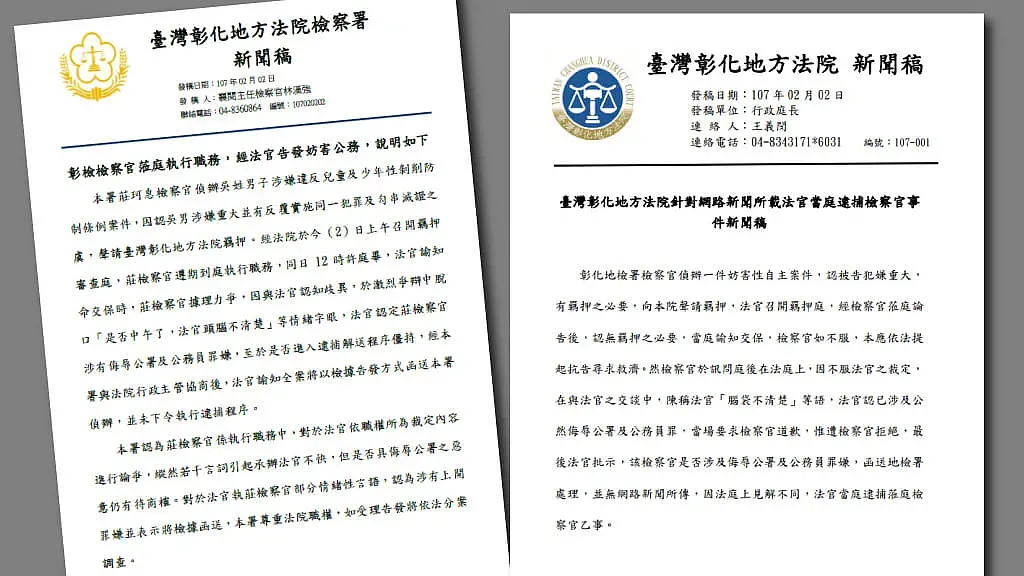
Photo/Retrieved from the websites of the Changhua District Prosecutors Office and Changhua District Court
The judiciary serves the functions of settling disputes and realizing justice, occupying a sacred and solemn position. The "courtroom" is the venue where judicial proceedings take place, where judges, prosecutors, and attorneys wear robes and maintain a solemn demeanor to conduct rigorous rituals within a courtroom equipped with administrative support personnel and bailiffs ensuring security—all of which serve to proclaim the majesty of the law.
The "judge" is the final, neutral, and impartial adjudicator within the courtroom, and maintaining order is both a judge's right and obligation. Disruptors may be ordered to leave, and any conduct that disrupts courtroom proceedings may constitute criminal liability. In practice, to avoid displeasing the judge who holds final decision-making power, it is both professional conduct and human nature for prosecutors, defense counsel, and parties to the litigation to maintain a polite or even respectful attitude.
This recent dispute between a judge and a prosecutor in Changhua has sparked debate. Because the power to decide whether to detain a defendant rests with the judge, prosecutors can express dissatisfaction through the "interlocutory appeal" procedure or re-apply for detention after gathering new evidence. However, Prosecutor Chuang engaged in an argument with the judge and uttered emotional remarks such as, "Is it noon yet, and is the judge's head unclear?"
Although the prosecutor's conduct challenging courtroom order was inappropriate, it is questionable whether it was severe enough to warrant criminal liability. At the very least, pursuant to Article 13 of the Prosecutor Ethics Code: "In the performance of their duties, prosecutors shall be based on an appropriate professional attitude." This matter could have been handled through administrative supervision or evaluation mechanisms.
High-Ranking Officials Intervening Without Evading the Appearance of Impropriety
What deserves attention is the development "outside the courtroom." Synthesizing the press release issued by the Changhua District Prosecutors Office and media reports, when the dispute occurred, the judge seemingly instructed bailiffs on the spot to "arrest and escort" the prosecutor. After startling the high-ranking officials of both the court and the prosecutors office into "negotiating and communicating," the judge changed the disposition to a formal "referral" to the prosecutors office, sparing the prosecutor the humiliation of being arrested. However, regarding circumstances involving the arrest of a flagrant offender, there was still room for high-ranking court and prosecution officials to sit down and "fix things behind the scenes." This kind of practice by the court and prosecution failing to avoid the appearance of impropriety is arguably what truly damages the dignity of the judiciary.
Furthermore, if criticizing a judge as having an "unclear head" results in a formal referral, what happens when judges and prosecutors direct emotional language at ordinary people? There is no shortage of practical examples; for instance, a judge once remarked during a court hearing that the plaintiffs were merely "talking nonsense" and "making up stories." When the indignant plaintiff filed a complaint, the Judge Evaluation Commission held that the judge's language was merely "colloquial" and lacked any malicious intent to insult or unreasonably reprimand. Compared to the Changhua incident this time, the standard of tolerance applied between "officials and citizens" differs by a wide margin.
In this dispute between the judge and prosecutor, the "high-ranking" officials of the court and prosecution acted like one big happy family, but frontline personnel no longer buy into this dynamic. Optimistically speaking, this might be interpreted as Taiwan truly moving step by step toward the path of "separation of the judiciary and the prosecution." The only regret is that the conflict between the judge and the prosecutor could not be sublimated into a constructive conflict of legal debate and logical reasoning. When things did not go their way, the prosecutor resorted to personal attacks, and upon facing criticism, the judge immediately brandished severe penalties. These are the fundamental reasons why the judiciary fails to gain the trust of the people. It goes without saying what kind of treatment powerless and vulnerable citizens would encounter.
※ This article was published in the Apple Daily on 2018/02/05
This article is an AI-generated translation of the original Chinese text. In the event of any discrepancy, the Chinese version shall prevail.
