
Good Laws Cannot Enforce Themselves: Implementing Transitional Justice Starts with the TJC and the Courts
Last edited: 2026-07-27
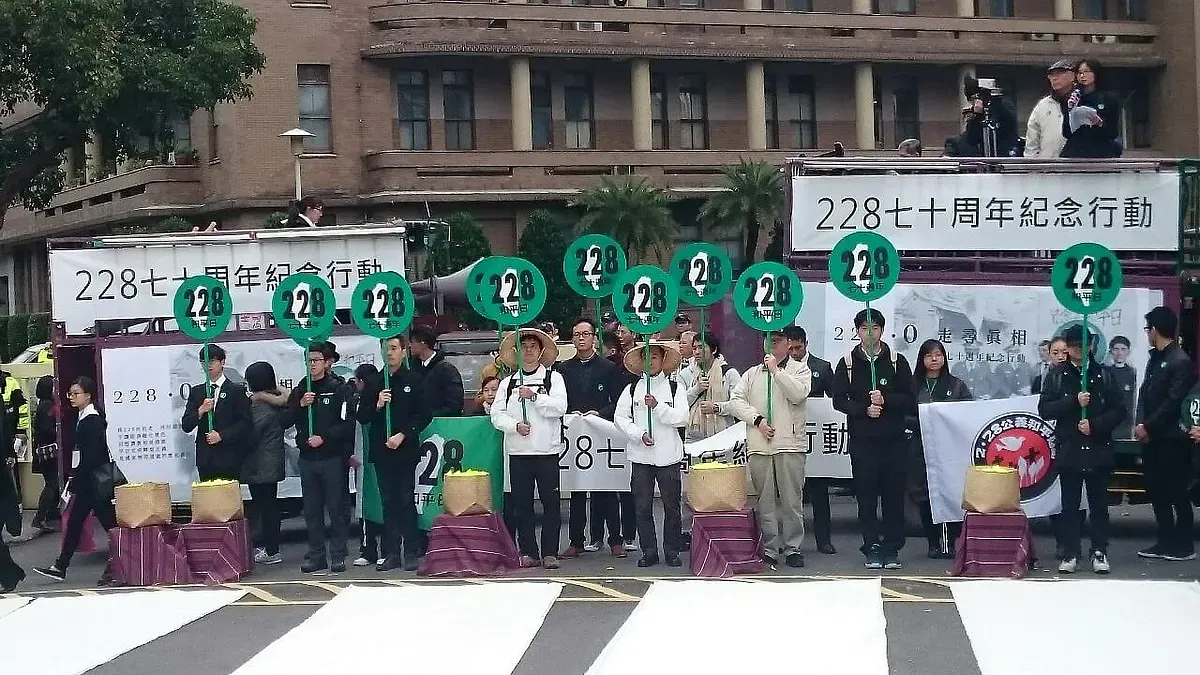
Photo/ 70th February 28 Memorial Action
Every year, the February 28 Peace Memorial Day is a time for the people to examine whether the government is truly implementing transitional justice. Last year, Gemma Legislative Yuan passed the Act on Promoting Transitional Justice (referred to as the Transitional Justice Act). We should highly commend the government's willingness to investigate the truth, open archives, and restore history.
Article 21 of the Transitional Justice Act heavily delegates authority to the "Transitional Justice Commission" (referred to as the TJC) to issue more detailed regulations. Furthermore, if people are dissatisfied with the TJC's decisions, they may also seek relief from the courts. Therefore, whether the spirit of the Transitional Justice Act can be implemented depends on the efforts of both the TJC and the courts. With the February 28 Peace Memorial Day approaching, this article offers several points regarding Article 6 of the Transitional Justice Act concerning the "remedying of judicial injustices" for the TJC and the courts to reference in the future.
Providing Archives to Enable Victims to Seek Relief
First, Paragraph 1 of Article 6 of the Transitional Justice Act only stipulates that "criminal" cases from the authoritarian rule period should be reinvestigated, excluding "administrative" or "civil" cases. For example, during the martial law period, the government used unjust laws to extensively expropriate land. When landowners argued after the lifting of martial law that the expropriation was invalid and filed lawsuits to reclaim their land, these also constituted issues of transitional justice. Therefore, it is recommended that if the relevant archives obtained by the TJC during its truth-seeking process involve victims whose administrative and civil rights have been infringed upon, the TJC can proactively notify the victims so that they can legally file for retrial relief with the courts.
Second, Paragraph 2 of Article 6 of the Transitional Justice Act stipulates that judicial injustices may be remedied "by means such as" identifying perpetrators and holding them accountable. The problem is that the provision states perpetrators "may" be identified rather than "shall" be identified. Although the purpose is to balance the privacy rights of individuals mentioned in the archives with the victims' right to know, the provision still lacks specific criteria for whether identification should occur.
Perhaps this issue can draw inspiration from the Stasi Records Act of former East Germany, where victims have the right to inspect the real names of Ministry for State Security personnel. Personal files of public figures and public officials can, as a rule, be opened for inspection if they involve the roles they played in contemporary history, the exercise of political power, or the execution of official duties. Therefore, the TJC might emulate the German experience to determine whether to identify perpetrators. Even if a decision is made to conceal a perpetrator's name, victims should still be granted the opportunity for judicial relief, and the courts may also review the matter by referencing the aforementioned standards.
Clarifying Perpetrators and Publishing Their Names
Finally, regarding the accountability of perpetrators, Paragraph 2 of Article 6 of the Transitional Justice Act stipulates that perpetrators "may" rather than "shall" be held accountable. Furthermore, the statute does not explicitly specify what laws should apply to such accountability—whether criminal, administrative, or political liability—nor does it state whether holding perpetrators accountable is exempt from the statutes of limitations under current laws.
In the practice of transitional justice, if perpetrators are not held accountable, lessons cannot be learned. As time passes and people gradually forget, totalitarian rule can easily repeat itself, making transitional justice impossible to implement. However, even without explicit statutory provisions, the TJC and the courts may still take lawful actions. For example, in the process of restoring the truth, the TJC's investigation reports or court judgments can "clarify perpetrators" and "publish their names," ensuring at least that perpetrators face social and moral condemnation, which also falls within the scope of accountability.
The Public Has a Responsibility to Monitor the TJC and the Courts in Implementing Transitional Justice
When the Transitional Justice Act was promulgated on December 27 last year, politicians and the mainstream media mostly focused on legislators using the Act as a political bargaining chip over the Labor Standards Act, or on controversies such as changing school and street names associated with authoritarian symbols. They rarely paid attention to the fact that remedying judicial injustices, restoring history, and holding perpetrators accountable are equally important missions of the Transitional Justice Act. After the passage of the Act, the object of public oversight will shift from the past Legislative Yuan to the TJC and the courts. It is hoped that the Premier will nominate candidates for TJC commissioners as soon as possible and submit the nominations to the Legislative Yuan for consent, allowing the TJC to begin operations on schedule by the middle of this year.
Good laws cannot enforce themselves. Ensuring that the TJC and the courts implement transitional justice requires the attention and support of the public. On February 24 at 1:30 PM, nearly 50 civil society organizations will gather at the intersection of Nanjing West Road and Taiyuan Road in Taipei to participate in the 71st February 28 Peace Memorial Day action. The march will pass by buildings associated with the February 28 Incident and recount related historical events. We sincerely invite you to join us as we gaze into the past, plant our feet firmly in the present, and look forward to the future.
※ This article was published in the PTS News Issue Center on Feb. 22, 2018
This article is an AI-generated translation of the original Chinese text. In the event of any discrepancy, the Chinese version shall prevail.
