
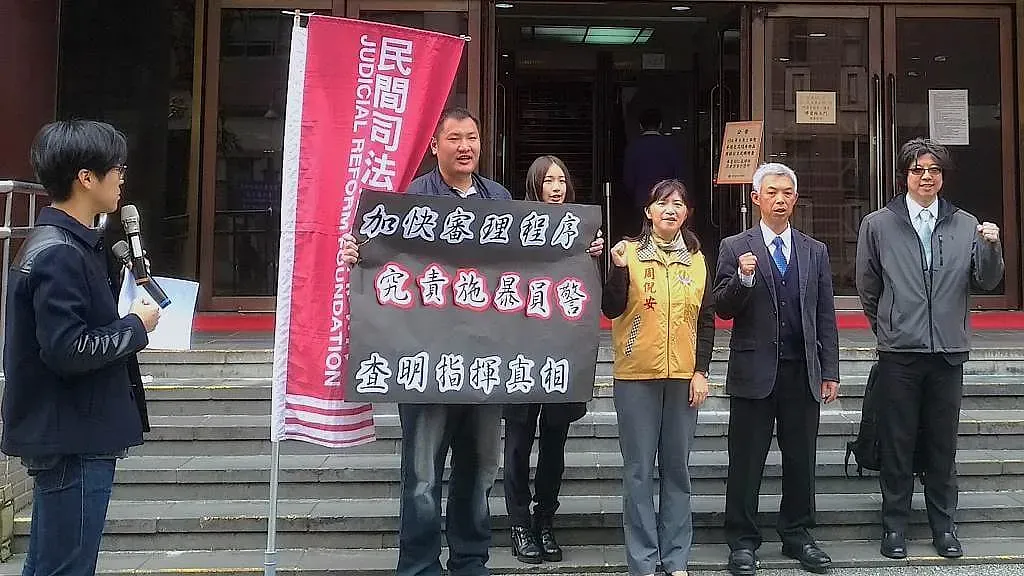
Speed Up the Trial, Hold Violent Police Officers Accountable, and Uncover the Truth About the Chain of Command: Pre-Hearing Press Conference in Legislator Chou Ni-an's Private Prosecution Against Former Taipei City Police Commissioner Huang Sheng-yung
Last edited: 2026-11-08
Today (March 7) is the hearing in the attempted murder private prosecution brought by former Legislator Chou Ni-an against former Taipei City Police Commissioner Huang Sheng-yung. Three and a half years have passed and the case has gone through two judges, yet it has remained in preparatory proceedings and is only now about to enter trial on the merits. Although the current judge has shown a proactive attitude and is assisting the private prosecutors in requesting relevant evidence from administrative agencies, the private prosecutors remain in a passive position if the administrative agencies refuse to cooperate. We call upon administrative agencies to have the courage to face their mistakes, provide relevant evidence, and allow the court to hold the police officers who committed acts of violence on that day accountable while restoring the truth behind the command operations.
On March 24, 2014, during the Anti-Black Box Service Trade Agreement Movement, crowds occupied the Executive Yuan, triggering a large-scale violent clearance by the police, after which multiple individuals filed private prosecutions. Among the 42 people who initially applied to join the litigation, 8 have successively withdrawn due to the prolonged proceedings, and the Supreme Court also held that parties in court only hold the status of victims, making it full of uncertainty for the majority of parties whether this case can successfully hold Huang Sheng-yung accountable. The withdrawal of multiple lawsuits was not because they had forgiven and decided to abandon prosecution, but rather due to a sense of disappointment in the state government and an unwillingness to further expend time and energy on the litigation process. Most of the aforementioned 42 private prosecutors underwent hospital injury examinations with obvious injuries and comprehensive evidence. One of them is former Legislator Chou Ni-an, who suffered violent police attacks and beatings resulting in orbital bone fractures, rib fractures, thigh contusions, and a concussion, which was verified and reported by the media and garnered widespread national attention.
The parties who were present and subjected to the violent clearance that day sought to find the police officers who inflicted violence upon them through judicial litigation, uncover the truth of the incident, and obtain due relief, based on their trust in the judiciary. However, due to the non-cooperation of administrative agencies coupled with the passivity of some judges, numerous private prosecution cases have seen no substantive progress. We hope that the court can value the rights that parties are due, rather than wearing down the will of the parties and the pro bono legal team through delaying tactics over months and years, leaving them exhausted, disappointed with the court, and resentful of the government. Is a withdrawal of a lawsuit achieved through the loss of public trust truly the outcome the court wishes to achieve?
State law enforcement should comply with the principle of proportionality. Facing peaceful and non-violent assembly crowds, the police actually resorted to violence such as striking at their feet with the edges of riot shields and hitting their heads with batons. It should be known that these citizens beaten and injured were merely sitting or lying on the ground, unarmed, and did not engage in further active resistance. Under such circumstances, how on earth did this meet the conditions for using weapons under the Police Weapons Use Act? Yet, citizens waiting quietly to be carried away did not know that what awaited them was cruel and merciless violence.
Worse still, prior to executing the "clearance," the police actually drove the media away, used a kettling tactic to corral the assembly participants, and then had riot police without identification badges attack them one by one. Is this really the proper approach when facing an assembly crowd? Was this not a planned violent suppression? Yet the identities of the perpetrators remain difficult to uncover. Even when the legal team had exhausted all evidentiary capabilities by providing on-site command deployment maps and even identifying a specific police officer who should have carried out the attack, the court still dismissed the cases on the grounds that the parties could not identify the perpetrators, or treated them as the same case as another and issued judgments of dismissal. Is the court, too, using a kettling tactic—driving the parties away one by one until the matter quietly dies?
From another perspective, what matters even more to the general public is full protection of the right of access to the courts. Having clearly suffered state violence and initiated lawful prosecution, victims are left wandering helplessly between courts due to the state's prior inaction and subsequent non-cooperation, with no truth and no compensation. Such half-hearted protection of the right of access to the courts is the current reality of this case. We hereby call upon the judges to actively conduct trials and the administrative agencies to face the situation bravely, so that the truth may be restored and those who bear responsibility must face judgment.
Attendees
318 Anti-Black Box Service Trade Agreement Pro Bono Lawyer Team
and Parties to the Case, Chou Ni-an et al.
This article is an AI-generated translation of the original Chinese text. In the event of any discrepancy, the Chinese version shall prevail.
