
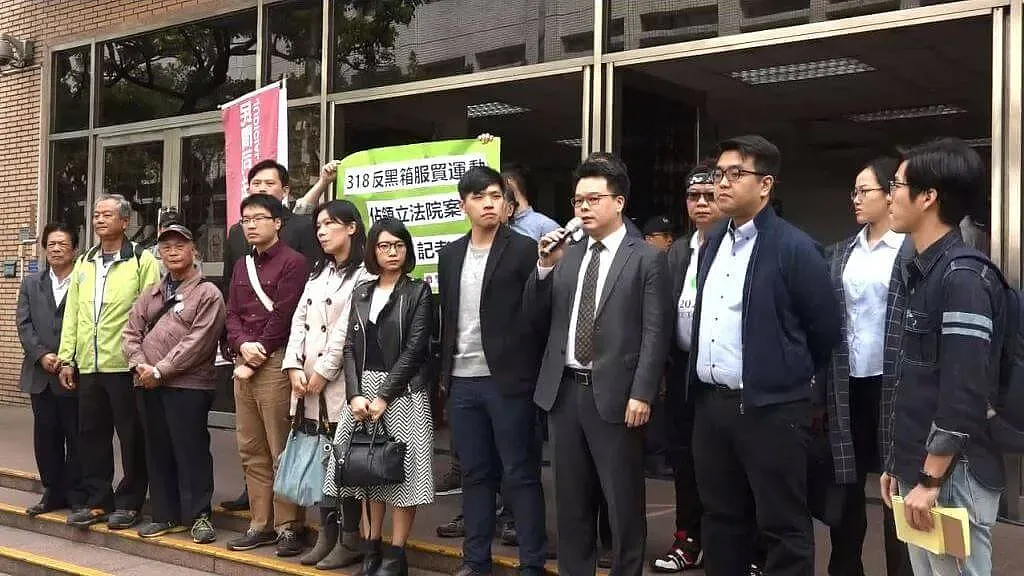
318 Anti-Black Box Service Trade Agreement Movement: Press Conference on the Second-Instance Judgment in the Legislative Yuan Occupation Case
Last edited: 2026-11-08
Today (March 13), the Taiwan High Court delivered its second-instance judgment concerning 22 participants in the Legislative Yuan occupation during the "318 Anti-Black Box Service Trade Agreement Movement." We welcome the judgment: the court was evidently able to examine the significance of the entire civil disobedience movement from a constitutional standpoint, rather than clinging solely to the literal text of statutory provisions.
Looking back at this Anti-Black Box Service Trade Agreement Movement, it stemmed from Kuomintang (KMT) Legislator Chang Ching-chung's blatant disregard for legislative rules, when he seized a 30-second window to forcefully send the Cross-Strait Service Trade Agreement to the plenary session for archival record. This is the origin of the "black box" controversy. It was a constitutional crisis that openly violated democratic procedures, showed contempt for the separation of powers, and allowed executive power to hollow out legislative power through party discipline. Faced with such a situation, if we were still to expect democratic-minded free citizens to obediently submit and accept it, it would be as if the people had an obligation to accept unlawful acts committed by the state. Therefore, the people's response was to step forward, defend the democratic constitutional order, and exercise their right of resistance through assembly and procession.
To take a step back, given the circumstances at the time, when the KMT ignored the public backlash, even if a re-vote had been held, the KMT would still have been highly likely to forcefully pass the bill relying on its numerical advantage, reducing the process to a circular argument of empty words, and substantive democracy would have long since vanished into thin air. In particular, the consequence of the agreement taking effect immediately upon being filed for record was bound to profoundly impact all aspects of the nation, including the economy, society, and people's livelihoods. Such an irreversible, abrupt change loomed like an approaching storm, ultimately igniting a backlash from the general public, especially the student demographic.
The courts and the people share an obligation to safeguard the operation of the Constitution. In the fight against the black-box Service Trade Agreement, the people have already resisted. As one of the three branches of government, the judiciary should stand up to check and balance the executive and legislative branches when they violate the democratic constitutional order, reflecting constitutional awareness in its judgments. The Taipei District Court in the first instance of this case previously rendered a progressive judgment on this matter, citing the legal principles of "civil disobedience" to articulate that the actions of the parties concerned did not constitute a narrow violation of the law, but rather an act of disobedience responding to illegal and unconstitutional state actions.
Regarding the prosecutor's appeal on the charge of "instigating others to commit offenses," it clearly belittled the numerous participants of the Anti-Black Box Service Trade Agreement Movement by assuming they lacked any capacity for judgment and engaged in so-called "criminal acts" merely due to the words of a few. As for the charges of obstructing public officials and insulting a public office, there was no criminal intent to begin with; these actions formed part of the political freedom of speech exercised through assembly and procession. The court has clearly incorporated the significance behind these actions into its review, rendering a judgment consistent with the Constitution.
Throughout the entire Anti-Black Box Service Trade Agreement Movement, aside from the Legislative Yuan occupation case, there is also the related private prosecution case concerning the Executive Yuan still underway. Although the injuries are an established fact, the lack of cooperation from executive agencies means the police officers who committed violence on that day remain difficult to hold accountable. Can the truth never come to light? Does no one in the executive branch need to take responsibility? We hereby call upon the ruling party—which successfully achieved a rotation in power inspired by the Anti-Black Box Service Trade Agreement Movement—to take a clear stance on the Executive Yuan private prosecution case, actively cooperate with and face the judiciary, and restore the justice rightfully owed to the parties involved.
We welcome the High Court's second-instance judgment. The entire Anti-Black Box Service Trade Agreement Movement should be viewed as an expression of the will of "civil disobedience," rather than merely something to be punished using criminal law. The pro bono legal team highly commends the court for taking this into account. We also hope that, in light of the numerous recent protest cases, this case can serve as a landmark judgment, serving as a wake-up call to the prosecution and police systems to jointly uphold the people's constitutional rights across the executive, legislative, and judicial branches, respect assemblies and processions, and protect the people's freedom of speech.
Attendees
318 Anti-Black Box Service Trade Agreement Pro Bono Lawyer Team
Attorney Lin Chun-hung (Representative Spokesperson)
Attorney Li Ai-lun
Attorney Lin Tzu-lin
Attorney Huang Po-chang
Parties to the Case
Huang Kuo-chang
Tsai Ting-kuei
Chen Wei-ting
Li Hui-jen
Wang Wen-pin
Wang Hsi-ho
Chou Fu-yi
Chuang Cheng-yang
Chen Ting-hao
Chen Chien-pin
Huang Kuo-yang
Yu Neng-sheng
Media Contact
Tsai Shang-yu / Specialist, Pro Bono Lawyer Platform, Judicial Reform Foundation (02)2523-1178#20
This article is an AI-generated translation of the original Chinese text. In the event of any discrepancy, the Chinese version shall prevail.
