
Defending Democracy, Peaceful Assembly Is Not a Crime: Pre-Hearing Press Conference on the March 23 Executive Yuan Occupation Case
Last edited: 2026-11-08
Today is the second-instance oral argument hearing in the March 23 Executive Yuan Occupation Case. The defendants and the legal team hope the second-instance judges will draw on the judgment in the March 18 Legislative Yuan Occupation Case, respect the freedoms of speech and assembly guaranteed by the Constitution, curb the police and prosecutors' readiness to prosecute citizens under the Criminal Code, and acquit the defendants. Furthermore, while the state's judiciary keeps prosecuting citizens who took part in the occupation four years ago, it has never identified the police officers who committed violence that day, nor clarified the responsibility of commanders at each level. Such a lopsided approach can hardly convince the public. We hope the judges will recognize the value of the Anti-Black Box Service Trade Agreement Movement for Taiwan's constitutional democracy and give it due weight in their judgment.
Both the Occupation of the Legislative Yuan and the Occupation of the Executive Yuan Were Part of the Anti-Black Box Service Trade Agreement Movement
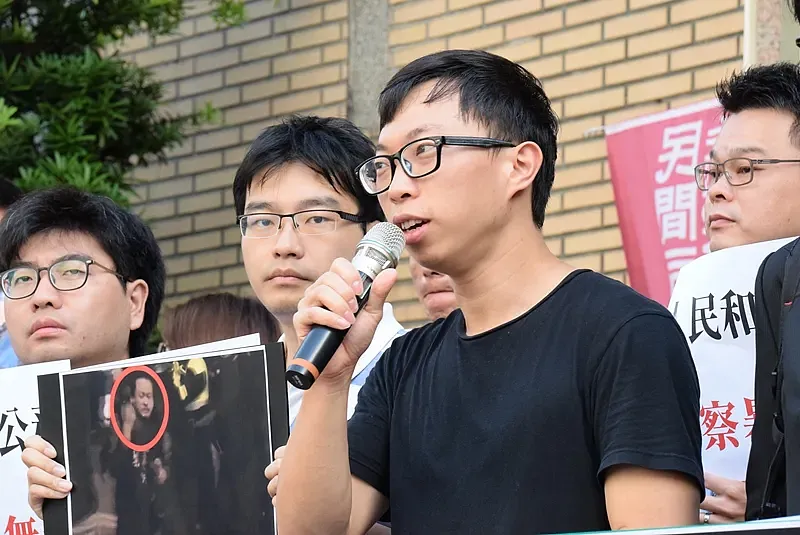
 Photo / Wei Yang, defendant in the Executive Yuan occupation case
The first-instance judgment of the March 23 Executive Yuan occupation case sentenced a total of 11 people to imprisonment for offenses such as obstructing public officials and damaging property under the custody of public officials. The first-instance court handled the occupation of the Legislative Yuan and the occupation of the Executive Yuan separately, turning a blind eye to the reality that both constituted a single, holistic movement. It deliberately used separation-of-powers theories to distinguish between the functions of the Legislative Yuan and the Executive Yuan, and subsequently denied the legitimacy of occupying the Executive Yuan on the grounds that other lawful remedies were available, contrary to what ordinary people expect of the state. Given the circumstances at the time, the occupation of the Legislative Yuan had reached a stalemate. If occupation was a necessary means, its evaluation should not differ simply because the Executive Yuan was occupied. Moreover, subsequent facts proved that it was precisely the occupation of the Executive Yuan that opened up the possibility for further dialogue.
Both the Legislative and Executive Branches Are Targets of Our Protest
The first-instance judgment of the March 18 case affirmed the application of civil disobedience to the occupation of the Legislative Yuan. Although the second-instance court no longer relied on civil disobedience as the grounds for acquittal, it still defended the application of the constitutional freedoms of speech and assembly in this case. We believe that the occupation launched in protest against the black-box Service Trade Agreement naturally deserves the same treatment. Whether it is the legislative branch or the executive branch, both must be accountable to public opinion. We hope the second-instance court will not get bogged down in a semantic dispute over whether an institution is a representative body or an executive one, but will instead safeguard the people's freedoms of speech and assembly from a constitutional standpoint.
Perpetrators of State Violence Still "Person Unknown," Yet Judicial Prosecution Continues Unabated
 Photo / Pro Bono Attorney Yu Po-hsiang
We deeply regret to see that, on the one hand, the state spends a massive amount of time and litigation resources prosecuting individuals who participated in the occupation, while on the other hand, it easily lets go of the police officers who committed violence at the time. Nearly a hundred people were injured in the state violence incident that night, yet no one needs to bear corresponding responsibility. The violent police officers cannot be found, and the commanders not only escaped discipline but have since been promoted. All of these issues test the current government's capacity for self-reflection regarding state violence and whether the judiciary can serve as the final line of defense against government dereliction of duty. We hope that the state can reliably hold the derelict police officers of that night accountable and implement proper police education to prevent similar incidents from happening again.
Expecting the Judgment to Manifest the Spirit of "Civil Disobedience" and Defend the Democratic Constitutional Order
The defendants and the defense counsel re-emphasize that the action of occupying the Executive Yuan was no different from occupying the Legislative Yuan; both were acts of resistance by the people in response to the Ma Ying-jeou administration's disregard for public opinion. Whether or not the occupied site was a public opinion institution should not be the point of contention in this case. The second-instance judges should value the spirit of civil disobedience and the right of resistance, safeguard the people's freedoms of speech and assembly, and render acquittals for the 17 second-instance defendants (including the 6 who were acquitted in the first instance but appealed by the prosecutor).
Attendees
Defendants- Li Kuan-ling
- Lin Chien-hsing
- Lin Tang-yu
- Hsu Che-jung
- Chen Ting-hao
- Huang Kuo-yang
- Liu Chien-ming
- Liu Ching-wen
- Hsieh Sheng-yu
- Wei Yang
- Attorney Yu Po-hsiang
- Attorney Wang Po-hsuan
- Attorney Wang Shuo
- Attorney Wang Lung-kuan
- Attorney Ho Chao-tung
- Attorney Li Ai-lun
- Attorney Wu Yi-te
- Attorney Lin Tzu-hsiang
- Attorney Lin Chun-hung
- Attorney Lin Chi-ying
- Attorney Hung Wan-heng
- Attorney Hung Chia-cheng
- Attorney Weng Kuo-yen
- Attorney Kuo Te-tien
- Attorney Chen Hsueh-hua
- Attorney Tseng Wei-kai
- Attorney Huang Shu-fang
- Attorney Huang Yi-wen
- Attorney Chao Wei-cheng
- Attorney Tsai Ya-ying
- Attorney Hsueh Chin-feng
- Wei Yang
- Chen Wei-ting
- Hsu Che-jung
- Huang Kuo-yang
- Liu Ching-wen
- Yu Po-hsiang
This article is an AI-generated translation of the original Chinese text. In the event of any discrepancy, the Chinese version shall prevail.
