
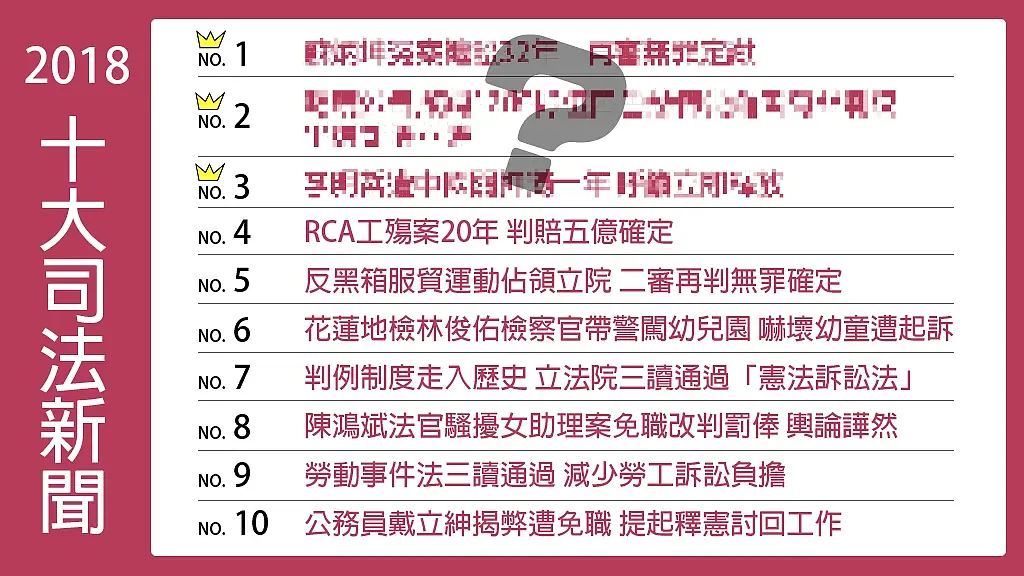
[Poll Results] A Year of Mixed Blessings: Top 10 Judicial News Stories of 2018
Last edited: 2026-08-29
Looking back at 2018, Taiwan's judicial system underwent many major reforms, several judicial integrity incidents occurred, and major progress was made in numerous high-profile cases.
In November 2018, the Labor Incident Act was passed. In the future, workers, who are often in a disadvantaged position in labor-management relations, will be able to obtain fairer judicial trials and care when facing labor disputes. At the end of the year, the Legislative Yuan passed the Constitutional Court Procedure Act after three readings, giving citizens whose constitutional rights have been infringed upon by unconstitutional judgments the opportunity to have those judgments reviewed.
2018 was also a year in which judicial integrity was subjected to intense public scrutiny. On Women's Day, the suspected sexual harassment case involving Judge Hung-Pin Chen, which was commuted from dismissal to a lenient fine of one year's salary, caused public incomprehension. Mid-year, the incident occurred where Hualien prosecutor Chun-Yu Lin, out of overprotection for his daughter, rushed into a kindergarten to interrogate young children. Both cases severely damaged the overall image of judicial personnel and dealt a blow to public trust in the judiciary.
However, encouragingly, several major judicial cases were also settled in 2018. The wrongful conviction case of Ping-Kun Su, which had dragged on for over 30 years, was finalized with an acquittal in a retrial, clearing his name. The RCA occupational disease lawsuit was won definitively, securing belated justice for the workers. The case involving the occupation of the Legislative Yuan during the movement against the anti-transparent Cross-Strait Service Trade Agreement was once again acquitted upon second appeal, laying a stable foundation for Taiwan's freedom of speech and democratic development.
The poll results show that high public concern was directed toward two major events: the announcement by the Transitional Justice Commission to revoke wrongful convictions of judicial injustices committed during the authoritarian period, and the completion of one year since the detention of Taiwan's democracy activist Lee Ming-che by China, which is currently under authoritarian rule.
The judiciary in 2018 was a mix of blessings and concerns. On the positive side, systems offering more comprehensive protection of public rights will be implemented in the future, and inspiring, epoch-making judgments have been delivered. On the negative side, establishing sound judicial integrity still has a long way to go, requiring the joint efforts of all judicial personnel. As the Lunar New Year approaches and a new year begins, we hope the judiciary will move toward self-discipline among judicial personnel and the maintenance of a sound atmosphere, making the judiciary even more worthy of the public's trust.
-
NO.1 Su Ping-Kun Wrongful Conviction Dragged on for 32 Years, Finalized with Acquittal in Retrial
Su Ping-Kun was originally a furniture store owner with a successful local business. Thirty-two years ago, he was unfoundedly implicated in a jewelry store robbery case. Not only was he subjected to brutal torture, but he was also wrongfully convicted. Although he was once granted a presidential pardon, he could never wait for the judiciary to give him a verdict of acquittal. Embarking on this long journey to clear his name, Su Ping-Kun finally obtained a favorable outcome in 2018, becoming the first victim of a wrongful conviction whose crime and sentence were pardoned and subsequently vindicated through a retrial.
Short Commentary Mr. Su Ping-Kun was acquitted on Father's Day in 2018, but upon walking out of the courtroom, he bluntly stated that "justice has come too late," and the 32-year journey to clear his name left him unable to feel happy. When this case was sentenced, after reading the principal text, the presiding judge expressed sympathy for Mr. Su in a speech, pointing directly to the three major flaws on the part of the judiciary, prosecutors, and police that caused this wrongful conviction. While it is always somewhat regrettable that justice arrives late, it is hoped that this case will prompt the state apparatus to reflect deeply, thoroughly review the root causes of wrongful convictions, and prevent anyone else from being wronged for even a single day.
-
NO.2 President Announces Revocation of Guilty Verdicts for Over 1,200 White Terror Victims, Redressing Judicial Injustice
On October 6, 2018, at the announcement ceremony for the revocation of guilty verdicts held by the Transitional Justice Commission, President Tsai Ing-wen apologized to political victims: "I'm sorry, you've waited a long time." More than 1,200 political victims of the White Terror period officially became innocent persons more than thirty years after the lifting of martial law.
Short Commentary The suffering brought by martial law rule in Taiwan transcended provincial origins, classes, and regions; the physical and mental torture was not limited solely to political victims or their families and surviving dependents. Following the lifting of martial law in 1987, the ruling authorities launched various efforts attempting to redress the harm caused by martial law; however, these were limited only to political victims and failed to systematically clarify the responsibilities of the state and society. The Transitional Justice Commission, established in 2018, precisely inherits this mission. The announcement ceremony for the revocation of guilty verdicts may be the most direct and significant work for the victims and their families, but for us who were not political prisoners, it equally proclaims: "The state relinquishes its past accusations of rebellion, and we shall construct and consolidate our hard-earned free and democratic constitutional order."
-
NO.3 Lee Ming-che Detained in China for a Full Year; Immediate Release Demanded
Taiwanese human rights activist Lee Ming-che was detained and arrested by the Chinese government for paying attention to China's democratic movement and sharing Taiwan's democratic experiences with Chinese friends online. The People's Court of Hunan Province sentenced Lee Ming-che to 5 years in prison for the crime of subversion of state power, making him the first Taiwanese national to be imprisoned under this charge. By 2019, Lee Ming-che had been detained in China for nearly two years. The Taiwanese government, along with Taiwanese and international human rights organizations, actively campaigned and advocated for Lee Ming-che's rescue, calling on the Chinese government to release Lee Ming-che immediately.
Short Commentary Freedom of speech is a universal human rights value, and for Taiwanese people, it is as commonplace as breathing and drinking water. Lee Ming-che merely shared his ideals for democracy, yet was deemed to be subverting the Chinese regime, subjected to illegal detention and sentencing, and even arbitrarily transferred between prisons and denied family visits. From the Lee Ming-che case, the people of Taiwan have concretely observed the actual implementation of China's judicial procedures, enabling them to deeply appreciate the preciousness of a free and democratic system. With Lee Ming-che's detention approaching two years, the people of Taiwan have not forgotten. We call on the Chinese government to release Lee Ming-che immediately and not to intimidate our nationals by violating domestic laws and infringing upon human rights, otherwise China's human rights record will never be trusted.
-
NO.4 20 Years of the RCA Occupational Disease Case: Finalized Judgment Orders NT$500 Million in Compensation
Between 1967 and 1992, while producing televisions and electrical appliances in Taiwan, the Radio Corporation of America (RCA) used volatile trichloroethylene and tetrachloroethylene as cleaning agents. Without proper preventive measures, workers inhaled and contacted them in large quantities. Furthermore, RCA arbitrarily dumped cleaning agents within the factory grounds, pumped them into the underground via motors, or buried them in dug holes, severely polluting the soil and groundwater and even having workers drink the groundwater. This caused workers and even nearby residents to develop cancer or medical abnormalities more than a decade later. According to expert assessments, the cancer risk for nearby residents was 10 to 1,000 times the conventionally accepted level, and the hazard index for non-cancer risks was 16 times the conventionally accepted level.
In August 2018, the Supreme Court ruled that RCA should compensate 262 employees or their families with over NT$500 million, setting the record for the highest compensation amount in an occupational disease case in Taiwan's judicial history.
Short Commentary The RCA case is a transnational environmental pollution case. Beyond being a classic textbook example in public health and medicine, it is also a classic legal judgment analyzed as follows: First, epidemiological causation. Whether the victims' onset of illness has a causal relationship with RCA's pollution activities over a decade prior, and whether the victims or RCA should bear the burden of proof. Second, the starting point of the statute of limitations for torts. Whether the 10-year statute of limitations for torts starts from the time of pollution or the time of onset of illness. Third, the piercing the corporate veil principle.
The large-scale soil and groundwater pollution caused by RCA has cost Taiwan a heavy price, giving birth to the Soil and Groundwater Pollution Remediation Act. The victims proudly call themselves Taiwan's version of "Erin Brockovich," and through prolonged joint struggle, they have finally obtained belated justice.
-
NO.5 Occupation of the Legislative Yuan During the Anti-Transparent Service Trade Agreement Movement: Second Appeal Again Acquitted
In 2014, opposition to the Legislative Yuan's review of the Cross-Strait Service Trade Agreement sparked the movement against the anti-transparent service trade agreement. The Taipei District Prosecutors Office indicted 22 student movement leaders, including Huang Kuo-ch'ang, Lin Fei-fan, and Ch'en Wei-t'ing, on charges of instigating others to commit crimes, obstructing public officials, violating the Assembly and Parade Act, and insulting public offices. The Taipei District Court ruled in the first instance that the case met justification grounds such as "civil disobedience" and acquitted them; the prosecutors, dissatisfied, continued to appeal. On March 13, 2018, the Taiwan High Court delivered its second-instance judgment, dismissing the appeal and upholding the original acquittal.
Short Commentary The movement against the anti-transparent service trade agreement stemmed from Legislator Chang Ch'ing-chung disregarding parliamentary rules and taking advantage of an opportunity to forcibly submit the service trade agreement bill to the院會 for recordation—this is the origin of the "black-box service trade" controversy. Such a constitutional crisis of openly violating democratic procedures ultimately provoked a backlash from the nationwide public, especially the student population. On the evening of March 18, 2014, by occupying the Legislative Yuan, they expressed the demand to "defend democracy and return the service trade agreement."
The first-instance judgment invoked the legal theory of "civil disobedience," affirming that the actions of the parties in this case did not constitute a narrow violation of the law, but rather an act of disobedience responding to illegal and unconstitutional state actions. The second-instance court, through the method of constitutional review, demonstrated constitutional awareness in its judgment, holding that when the people express dissatisfaction, protests, or criticisms regarding government policies or the exercise of state public power, such political symbolic speech—provided it does not exceed the principle of fair comment—should be given maximum protection and tolerance by the state, and the people's freedom of speech and freedom of assembly should receive the highest degree of protection.
-
NO.6 Hualien District Prosecutor Lin Chün-yu Leads Police into Kindergarten, Terrifying Young Children and Indicted
Prosecutor Lin Chün-yu, on the grounds of suspecting that his child was being bullied at the kindergarten, led police officers to barge into the kindergarten during class hours. Disregarding the teachers' dissuasion, he openly questioned numerous kindergarten pupils, subjecting the children present to extreme terror. This abuse of power led the Ministry of Justice to suspend him from duty at the first instance, and the Control Yuan subsequently made an impeachment decision.
Short Commentary Prosecutors and police, as pursuers of crime, hold immense power and should exercise their duties even more cautiously. If they abuse power or even knowingly break the law, they naturally cannot command the trust of the public in the courtroom, and all conscientious judges and prosecutors will be dragged down by such individual cases, becoming objects of public distrust. Prosecutor Lin Chün-yu "interrogated" young children in front of all the little ones, not only casting a psychological shadow on the children but also arousing public skepticism toward prosecutors holding judicial resources. We hope that while punishing individual cases, the government should also properly review the elimination mechanism for incompetent judges and prosecutors, and avoiding the frustration of judicial prestige through institutional amendments to the Judges Act is the fundamental way to address the root cause.
-
NO.7 Precedent System Passes into History; Legislative Yuan Passes the Constitutional Court Procedure Act in Three Readings
The Legislative Yuan passed the Constitutional Court Procedure Act in three readings on December 18, 2018, which will take effect on January 4, 2022. In addition to lowering the threshold for legislators to petition from one-third to one-quarter, the draft has three major highlights: introducing a system for reviewing judicial judgments for constitutionality, establishing review panels and lowering the consensus threshold, and disclosing the authoring Grand Justice along with transparent voting.
Short Commentary Since 2015, the JRF has held press conferences demanding legal amendments to add a constitutional petition system (namely, the current constitutional review of judicial judgments). However, at the time, the Judicial Yuan stubbornly opposed it, preventing unconstitutional judgments from petitioning the Grand Justices for constitutional interpretation and relief. It was not until 2017, during the National Judicial Reform Conference driven by civil forces, that a resolution was reached to establish the constitutional review system for judicial judgments, after which the Judicial Yuan submitted a draft containing it.
In addition, the Constitutional Court Procedure Act introduces a review panel mechanism to swiftly screen cases, and the threshold for whether a case is unconstitutional has been lowered from the past two-thirds to one-half, which can enhance the operational efficiency of the Constitutional Court. Finally, written judgments will indicate the name of the authoring Grand Justice and record the names of the Grand Justices who voted for or against the main text, making judgments more open and transparent while maintaining the integrity of the argumentation.
-
NO.8 Judge Hung-Pin Chen's Harassment of Female Assistant Commuted from Dismissal to Salary Fine, Causing Public Uproar
While serving as a judge at the Taipei High Administrative Court, Judge Hung-Pin Chen disregarded his married status and engaged in suspected harassment of his assistant. After he was impeached by the Control Yuan, the Disciplinary Court originally ruled to dismiss him from his judicial position. However, following a retrial petitioned by Judge Hung-Pin Chen, the Disciplinary Court revoked the original judgment under Disciplinary Retrial Judgment No. 1 of the 105th Year (2016) on March 8, 2018, changing the penalty to a fine equivalent to one year's salary, arousing public anger.
Short Commentary As Taiwanese society progresses, the prevention of workplace sexual harassment and the concept of gender equality have taken deep root in people's hearts. This Disciplinary Court judgment determining that Judge Hung-Pin Chen only needed to pay a fine for sexually harassing his assistant clearly fails to meet public expectations regarding the image and integrity of judges, and has even been criticized by outsiders as condoning sexual harassment. As the disciplinary organ for judges, the Disciplinary Court should have established behavioral standards through its judgment that all judges nationwide could follow, yet it made such an absurd determination, dealing yet another heavy blow to public trust in the judiciary!
-
NO.9 Labor Incident Act Passed in Three Readings to Reduce Workers' Litigation Burden
The Legislative Yuan passed the Labor Incident Act in three readings on November 9, 2018, scheduled to take effect one year later. In the future, when labor disputes arise, they can be handled in a more prompt, appropriate, professional, effective, and equal manner.
The highlights of the Labor Incident Act are as follows: First, workers can choose the jurisdiction of the court. Even if a worker is a defendant, they may still request a transfer to any court with jurisdiction. Second, reduction of workers' litigation burden. Workers can have litigation fees reduced or exempted and expand the scope of legal aid; if litigation causes major difficulties in a worker's livelihood, the court may order the employer to make advance payments of certain compensation or damages. Third, giving labor unions mechanisms to intervene in labor-management disputes in advance, as well as the rights to act as workers' assistants and file class-action lawsuits. Fourth, prompt progression of mediation and litigation procedures. The parties and the court have the obligation to promote mediation and litigation; mediation shall in principle be concluded with three sessions within three months, and litigation procedures shall in principle be concluded with a single date of debate, with the first instance to be tried and concluded within six months. Fifth, courts shall form a "Labor Mediation Committee," assisted by professional commissioners alongside judges. Sixth, adjustment of the burden of proof. Employers have the obligation to produce documents, including wage ledgers and worker attendance records. If the employer raises a defense that wages are non-regular allowances or that workers had rest periods during attendance hours, the employer shall also bear the burden of proof.
Short Commentary The enactment of the Labor Incident Act is a consensus between official and private sectors, and this time it also received bipartisan support in the Legislative Yuan, giving relatively disadvantaged workers a better chance to obtain fair judicial trials when facing labor disputes. Furthermore, both labor and management can resolve disputes more promptly and resume their original lives. However, the Labor Incident Act is only the starting point. Future reliance on civil society monitoring—including the formulation of related subsidiary regulations and the concrete implementation by courts—is necessary to provide workers with more comprehensive protection.
-
NO.10 Civil Servant Li-Sheng Tai Dismissed for Whistleblowing, Files Constitutional Petition to Win Back Job
Civil servant Li-Sheng Tai was originally employed at the Hsinchu County Livestock Disease Control Center. Unable to bear his superiors demanding that he falsify accounts and use public funds for private purposes, he turned himself in to the anti-corruption unit. The judge presiding over TLi-Sheng Tai's corruption case considered that he bravely blew the whistle undeterred by pressure, and exempted him from personal criminal punishment. However, after the judgment became final, Li-Sheng Tai was subjected to "dismissal" and "permanent disqualification from employment" ratified by the Hsinchu County Government due to the exemption-from-punishment verdict. After exhausting all judicial remedies, the JRF assisted Li-Sheng Tai in filing a constitutional petition.
Short Commentary Li-Sheng Tai hoped to end long-standing malpractice in the civil service system through reporting. The verdict exempting him from punishment, granted by the judge based on Tai Li-sheng's courage in whistleblowing, unfortunately met the conditions of a "guilty verdict" resulting in disqualification from re-employment under the provisions of the Civil Service Employment Act. Consequently, Li-Sheng Tai was "disqualified from re-employment" by law. Li-Sheng Tai's experience is clear proof that the current legal system traps whistleblowers in injustice. We hope the Grand Justices will declare this provision unconstitutional, allowing Li-Sheng Tai to return to his beloved job, and the government should also swiftly pass a Whistleblower Protection Act so that more conscientious civil servants can bravely step forward to expose the dark plots of agencies!

This article is an AI-generated translation of the original Chinese text. In the event of any discrepancy, the Chinese version shall prevail.
