
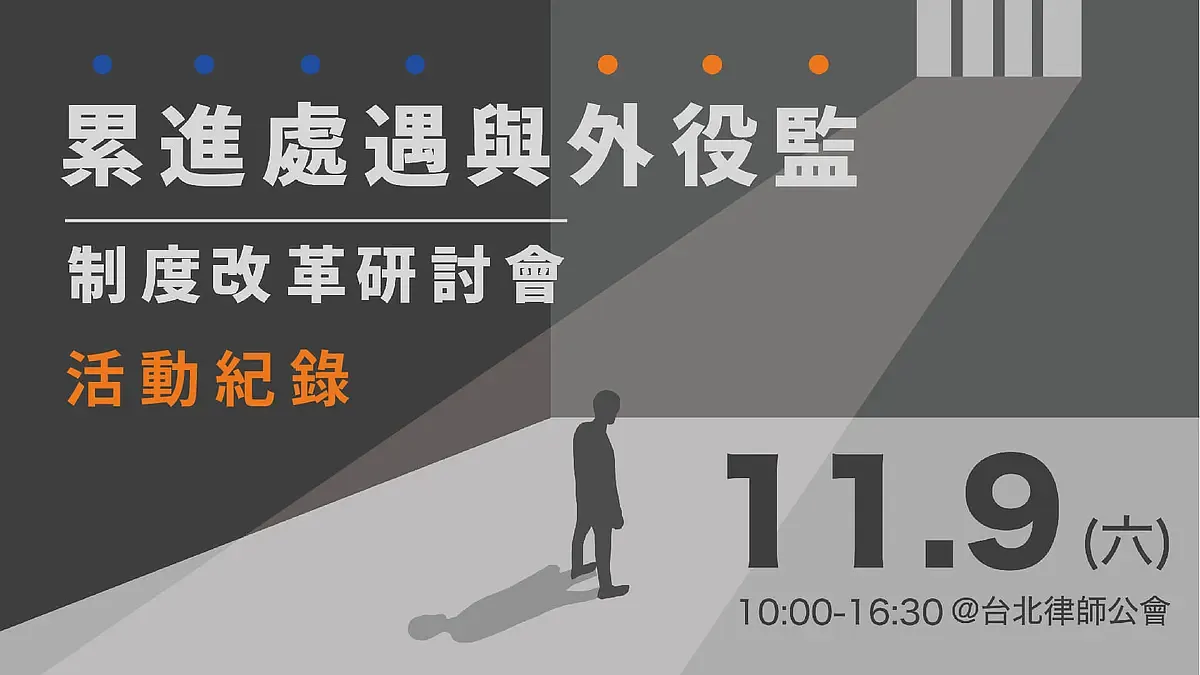
Event Record | Seminar on Progressive Treatment and Open Prison System Reform
Last edited: 2026-11-09
※ Click the "" icon in the upper right corner of the video above to view the complete playlist of the seminar videos.
On November 9, the Judicial Reform Foundation and the Taipei Bar Association jointly held the "Seminar on Progressive Treatment and Open Prison System Reform" at the Taipei Bar Association. The event invited scholars, civil society actors, and government officials to engage in multi-party dialogue and gather diverse opinions to facilitate future discussions and promotion of prison administration reform.
Opening Remarks
Guest Ch'en Yü-fan / Executive Director, Taipei Bar Association

Issues concerning penal institution human rights were not on the agenda of the 1999 National Judicial Reform Conference. It was not until the 2016 Judicial Reform Conference that prison-related issues began to be explored. Although Taiwan has made progress, it has been too slow. Judicial Yuan Interpretations No. 755 and 756 opened a window, but they have yet to be truly implemented at the execution level. We hope that experts and scholars from all sectors concerned with prison human rights can engage in more exchanges. A single seminar may not be enough, and we look forward to second and third installments in the future, starting with the issues of progressive treatment and open prisons.
Session I Review of the Open Prison System
Moderator Huang Hung-hsi / Senior Inspector, Agency of Corrections; Ph.D., Department of Criminology, Central Police University

The operational objectives of the Agency of Corrections are aligned with everyone's: hoping to assist inmates in successfully returning to society. The detention environment and treatment methods of the open prison system are the closest to general society, which is why it is considered one of the mechanisms best able to help inmates reintegrate into society. Taiwan's open prison system is basically consistent with those abroad, having evolved from extra-mural labor.
Presenter Lin Cheng-yu / Assistant Professor, Department of Law, Fu Jen Catholic University

Professor Lin Cheng-yu's report combed through the formation processes and positioning of open prisons in Japan and South Korea, discussing whether open prisons should be positioned as open-style prisons for specific inmates, or as intermediate treatment for all inmates prior to release with the purpose of reintegration. He argued that if positioned as open treatment, custody levels should be used to differentiate; if positioned as intermediate treatment, offender rehabilitation mechanisms should intervene earlier, making the crime category less important while focusing instead on observing sentence-serving conditions and reintegration needs.
Discussant Ch'en Hui-min / Chairperson, Taiwan Association for Prisoners' Rights

Chairperson Ch'en Hui-min mentioned that the Taiwan Association for Prisoners' Rights has conducted four prison visits up to this year, observing that ordinary prisons suffer from immense pressure and severe overcrowding. Only upon visiting the Bade Open Prison—which was not overcrowded during their first visit—did they witness a completely different approach to treatment. The decrease in first-time offense rates alongside the increase in recidivism rates in Taiwan indicates severe problems in the reformative function of correctional institutions. Rebuilding inmates' social skills before they re-enter society constitutes a true social safety net. Bringing in resources from health and welfare departments is a model more conducive to social safety than simply locking people away.
Discussant Lai Yung-lien / Associate Professor, Department of Criminology, Central Police University

Professor Lai Yung-lien also believes that open prisons should be positioned as intermediate treatment, ensuring that all inmates pass through an open prison before release to better facilitate their social reintegration. Current practices position them more like open treatment, which is precisely why the black-box and unfair selection problems of "who should be chosen after all" arise.
Session II Treatment and Social Reintegration in Ordinary Prisons and Open Prisons
Moderator Lin Chun-hung / Executive Director, Taipei Bar Association

The "Prison Act" is currently under discussion in the Legislative Yuan this session. The legal profession hopes to gain a deeper understanding of this matter and has therefore invited various experts to provide explanations. This session features a report by Professor Huang Tsung-min, who shared Japan's relevant systems and compared them with Taiwan's progressive treatment and open prison systems, alongside invited National Consultative Conference members and offender rehabilitation counselors to participate in the discussion.
Presenter Huang Tsung-min / Associate Professor, Department of Law, Chinese Culture University

Professor Huang Tsung-min's report detailed how Japan implements prison management measures in the absence of prison overcrowding and with adequate staff-to-inmate ratios. In 2006, Japan abolished the progressive treatment system, with parole standards primarily determined by the prospect of reintegration. Whether an inmate enters an open-prison-like institution is decided based on different ratings derived from treatment assessments. At the end of the report, he summarized public reactions and official attitudes in Japan regarding a 2018 prison escape incident at an open-style facility.
Discussant Liu Pei-yüan / Member, National Conference on Judicial Reform; Volunteer, Taiwan Offender Aftercare Association

Attorney Liu Pei-yüan echoed the view that open prisons should serve as intermediate treatment and supported the abolition of progressive treatment. He argued that the standards of progressive treatment conflate obedience to prison rules and authority with the willingness to reform and reconnect with society. However, rehabilitation capacity cannot be equated with rule-obedience, and inmates who have been incarcerated longer are precisely those in greater need of intermediate treatment to bridge back into society. Regarding the Japanese prison escape case, Attorney Liu pointed out that the motives for escaping are all related to "self-governance," noting that the internal prison self-governance in Japan resembles our country's trusty (雜役) system—both rely on prisoners policing prisoners, which sometimes seems to replicate gang culture, running counter to social reintegration and generating future issues regarding the scope of prison complaints.
Discussant Cheng I-lung / Counselor, Shilin Branch, Taiwan After-Care Association

Teacher Cheng I-lung echoed the aforementioned skepticism regarding the positioning of open prisons, arguing that the reintegration benefits of open prisons should be utilized primarily for those lacking resources, rather than the privileged individuals currently found inside open prisons. Drawing on his years of experience in offender aftercare, he shared the difficulties of rehabilitation, including food, clothing, housing, transportation, technological divides, and finding employment.
Session III Reform of the Progressive Treatment Regulations
Moderator Kao Yung-cheng / Control Yuan Member

Control Yuan Member Kao Yung-cheng explained the origins of this seminar. The Control Yuan receives approximately 17,000 petition cases each year, 40% of which are judicial cases. Among them, the proportion of petitions filed by inmates is quite high, mostly concerning standards for parole review, sentence reduction, and similar matters. These issues deserve discussion and study, which led him to propose to the Taipei Bar Association and the Judicial Reform Foundation that they jointly organize a seminar to invite various sectors to research and deliberate.
Presenter Li Li-chüan / Ph.D. Student, Graduate Institute of Law, National Chung Cheng University; Board Member, Taiwan Association for Prisoners' Rights

Starting from Judicial Yuan Interpretation No. 755, Teacher Li Li-chüan's report emphasized that the protection of inmates' fundamental rights should not differ based on their status. The current progressive treatment system fails to implement investigation and classification systems, resulting in impairment of inmates' rights and hindering reintegration, and therefore warrants ongoing reflection and reform.
Discussant Lu Ying-chieh / Professor, Department of Law, National Chung Cheng University

Professor Lu Ying-chieh argued that the most important implication of what the Grand Justices left unsaid is not the issue of habitual offenders, but rather the "Directions for the Classification of Inmates in Correctional Institutions under the Agency of Corrections, Ministry of Justice." All provisions of these directions are rooted in a mindset of management and discipline, entirely deviating from the modern prison execution trend centered on individualized treatment. Failing to consider inmates' risk factors and individual treatment needs, these directions should be subject to continued oversight aimed at their abolition.
Discussant Li Mao-sheng / Professor, Department of Law, National Taiwan University

Professor Li Mao-sheng suggested that progressive treatment and habitual offenders are not actually closely related, though habitual offenders certainly constitute a form of differential treatment. He argued that habitual offenders do present an issue of violating Article 57 of the Criminal Code, and that the Grand Justices fail to understand that the execution of a sentence and the execution of punishment are distinct concepts: the former is retributive execution, whereas the purpose of the latter is to promote social reintegration. The further along a sentence progresses, the stronger the penal execution aspect should become. Whether through a merit system or a progressive treatment system, both should be implemented in stages.
This article is an AI-generated translation of the original Chinese text. In the event of any discrepancy, the Chinese version shall prevail.
