
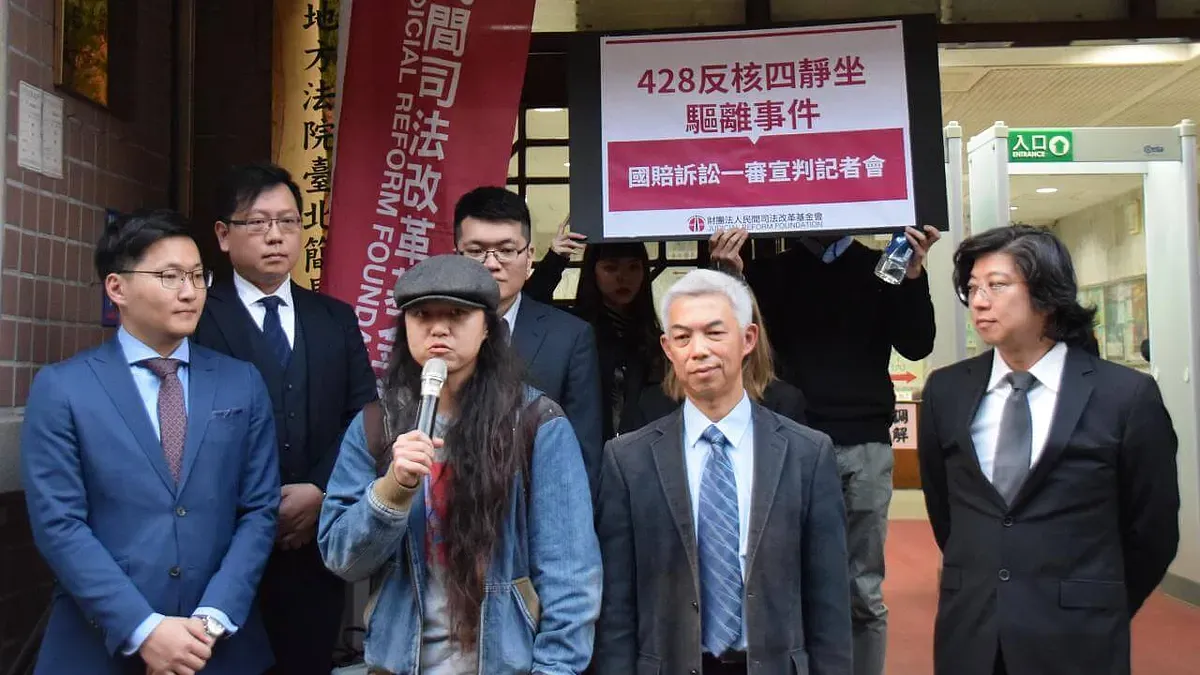
Press Conference on the First-Instance Judgment of the State Compensation Lawsuit regarding the April 28 Anti-Nuclear 4 Sit-in Eviction Incident
Last edited: 2026-07-27
In the early morning of April 28, 2014 (the 103rd year of the Republic), citizens staging a sit-in on Chung Hsiao West Road to express their anti-nuclear demands were evicted by police using unlawful violence and high-pressure water cannons. Among them, 15 citizens who suffered bodily injury or property damage filed a state compensation claim against the Taipei City Government and the Taipei City Police Department. The Taipei District Court Civil Division delivered its first-instance judgment on this incident today. The court ruled that the Taipei City Government should pay a total of approximately NT$420,000 in compensation to 12 plaintiffs, and the Taipei City Police Department must pay property damages of NT$34,000 to one of the plaintiffs. The pro bono legal team expressed relief that the majority of plaintiffs were granted state compensation.
The assembly on April 27, 2014, was a spontaneous and peaceful sit-in by the people before the government continuously failed to give a positive response to anti-nuclear demands. While expressing their demands peacefully and rationally, the plaintiffs and others were unexpectedly subjected to unlawful infringement by state violence. This was ordered by the then-Mayor of Taipei, Hao Lung-pin (Hao, Lung-pin). Mayor Hao held a press conference around 23:00 that day, emphasizing that "no matter what methods are used, traffic in Taipei City must return to normal tomorrow morning." Under this time-limited eviction order, the City Police Department began forced eviction.
The legal team argued state compensation on two levels. First, the police eviction violated procedural justice because the dissolution order was not issued by the precinct chief in the first place, thereby directly infringing upon the people's freedom of assembly. Furthermore, the means of eviction were inherently unlawful as they substantially violated the principle of proportionality. Backed by superior police force, the police surrounded the peacefully sitting citizens, directly deployed water cannons, and shot high-pressure water jets directly at vital parts of the human body. The strong impact caused large bruises, contusions, and even hematuria on the backs and buttocks of some plaintiffs. Another plaintiff felt nauseous with internal organs churning for days due to the impact of the water cannon, suffering significant physical and mental trauma.
Ironically, court investigations revealed that at the very moment the police used such dangerous police equipment as water cannons, Taiwan had not yet established any relevant regulations governing the use of water cannons. It is thus evident that the illegality of this forced eviction cannot be understood merely as improper handling by individual police officers; rather, accountability must be traced to the systemic deficiencies in handling regulations by the City Government and the City Police Department, and administrative authorities must be held accountable to a certain extent.
In fact, this eviction incident occurred merely a little over a month after the "March 24 Executive Yuan Violent Eviction Incident." With such lessons close at hand, the government, when dealing with people taking to the streets to express their demands, failed to review and improve through successive experiences; instead, it repeatedly deviated from the spirit of a democratic and free state in safeguarding freedom of assembly.
On the political rights spectrum, governments fear assembly even more than they fear people merely expressing opinions. This is because assembly is not only a manifestation of speech, but also the expression of collective opinion. Through such expression of collective opinion, the resulting inconvenience and pressure placed upon the government serve as the means for powerless people to convey their will, and constitute the most critical key to ensuring that democratic politics does not fail. Therefore, the Taipei City Government's violent eviction of peacefully assembled citizens for the sake of smooth traffic was not merely a misbalancing of rights by the government, but a complete obliteration of the function and value of freedom of assembly itself.
The legal team thanks the court for being willing to exercise the judiciary's function of checks and balances and accountability in the face of administrative abuse of power. We also want to particularly emphasize that such a judgment will not leave frontline police officers at a loss; rather, establishing transparent and enforceable standard operating procedures (SOPs) for law enforcement is the only way to prevent frontline police officers from engaging in illegal actions under the pressure of orders issued by high-ranking officials. We call upon the City Government and the City Police Department to make compensation with humility, drop their appeals, and gain a better understanding of the boundaries of police equipment use from the experience of this case. In future street protests, they should no longer treat the people as enemies and evict them using methods that violate human rights and impair the freedom of assembly.
Attendees
Representatives of the Pro Bono Legal Team
Attorney Yu Po-hsiang (Yu, Po-hsiang)
Attorney Chiu Ch'i-hung (Chiu, Ch'i-hung)
Attorney Chang Heng-chia (Chang, Heng-chia)
Attorney Hung Wei-sheng (Hung, Wei-sheng)
Attorney Lin Chien-hung (Lin, Chien-hung)
Attorney Tsai Hsiu-fang (Tsai, Hsiu-fang)
Party Representatives
Hung Sheng-ch'ao (Hung, Sheng-ch'ao)
Kuo Jui (Kuo, Jui)
Wu Jün-yen (Wu, Jün-yen)
Press Contact
Pro Bono Legal Platform, Judicial Reform Foundation Attorney Li Ming-ju (Li, Ming-ju)
This article is an AI-generated translation of the original Chinese text. In the event of any discrepancy, the Chinese version shall prevail.
