
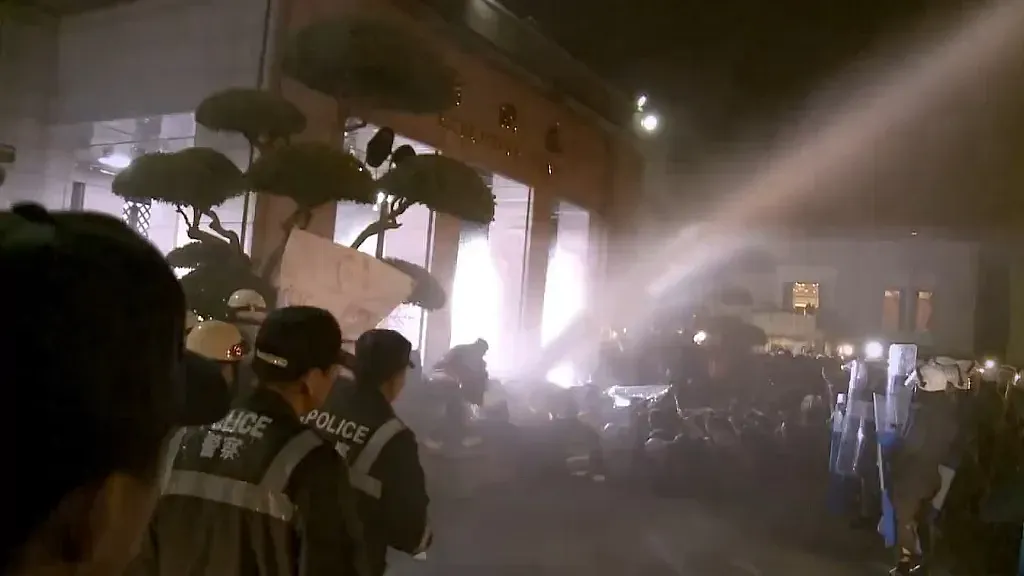
[Statement] On the Eve of the Sixth Anniversary of the March 24 Executive Yuan Violent Clearance: Second-Instance Judgment in the Private Prosecution Against Former Taipei City Police Commissioner Huang Sheng-yung
Last edited: 2026-11-07
Today, the Criminal Division of the Taiwan High Court delivered its second-instance judgment in the private prosecution brought by former legislator Chou Ni-an against former Taipei City Police Department Commissioner Huang Sheng-yung regarding the March 24 violent clearance of the Executive Yuan. The court dismissed the private prosecutor's appeal and upheld the acquittal of Huang Sheng-yung, an outcome which the pro bono legal team deeply regrets.
As the sixth anniversary of the March 24 violent clearance of the Executive Yuan approaches, the path for the people to hold state violence accountable remains fraught with difficulty. To this day, the judiciary has failed to fulfill its function of checking administrative abuses of power and holding accountable the police officers who committed assaults that night, as well as the police commanders and administrative heads who ordered the clearance.
During the proceedings of this case, the new system for victim participation in criminal procedure was passed in December of last year. Consequently, some victims were finally able to formally participate in the litigation as victims and voice their opinions. However, what victims hope for, even after being willing to set aside their work to appear in court six years later, is not merely the chance to speak in a courtroom. Rather, what they hope for most is that the court will use its judgment to tell the police that the exercise of public authority through unscrupulous means to achieve an objective is illegitimate. Furthermore, such illegality is not solely the responsibility of frontline officers; those in power within the chain of command should not hide behind bureaucracy to evade responsibility.
More than thirty years have passed since Taiwan moved from authoritarianism to democracy. If, when facing protests, we remain stuck in an era where public authority may be exercised by any means necessary to achieve a goal, how can the people be free from the fear of state violence the next time they take to the streets? And how can we pride ourselves on upholding the spirit of democracy and the rule of law, distinct from China and Hong Kong?
Although the court of first instance in this case acknowledged that violence occurred that night, it nevertheless held that Huang Sheng-yung, who served as the core commander within the police system at the time, bore no responsibility. Today, the second-instance court held that the clearance was carried out in accordance with the law, while the criminal facts regarding attempted murder and injury could not be proven, thus dismissing the appeal. Although the reasoning differs slightly from that of the first instance, it once again fails the expectations placed on Taiwan's judiciary by the private prosecutor, the victims, Taiwanese society, and citizens at home and abroad who seek freedom and democracy.
Regarding this case, the legal team will discuss with the client and decide whether to appeal. This case is merely one of those related to the March 24 violent clearance of the Executive Yuan, and the legal team remains fully committed to every single case. We still hope that in a Taiwan that prides itself on freedom and democracy, the checks and balances of the separation of powers can function effectively, and that Taiwan's judiciary can ensure the tragic history of "victims but no perpetrators" regarding state violence during the authoritarian rule era is never repeated.
This article is an AI-generated translation of the original Chinese text. In the event of any discrepancy, the Chinese version shall prevail.
