
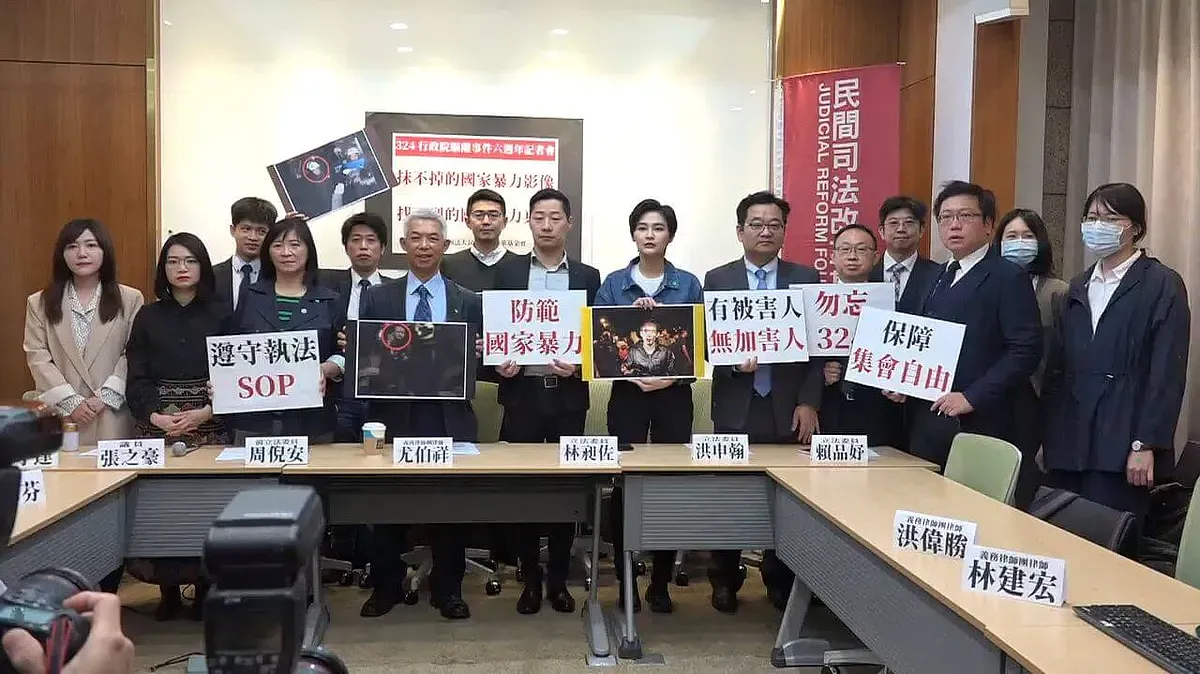
Images of State Violence That Cannot Be Erased, Truth About State Violence That Cannot Be Found ~ Press Conference on the Sixth Anniversary of the March 24 Executive Yuan Violent Clearance
Last edited: 2026-11-07
Six full years have passed since the March 24 violent clearance of the Executive Yuan. According to records in the Ministry of Health and Welfare's emergency medical system alone, major hospitals dispatched ambulances at least 61 times and treated over 200 people injured by police officers' unlawful and abusive violence that night—and this is merely the tip of the iceberg regarding the actual number of casualties. Afterward, because prosecutors failed to actively prosecute the police officers who committed violence that night, 48 victims—risking being prosecuted by the state in return—gained the courage to file private prosecutions with the Taipei District Court, accusing the violent police officers, then-Premier Chiang Yi-huah, then-National Police Agency Director-General Wang Cho-chun, then-Taipei City Police Commissioner Huang Sheng-yung, then-Zhongzheng First Precinct Chief Fang Yang-ning, and others of offenses including attempted murder, attempted aggravated assault, assault, and coercion.
However, after six years of trials, the private prosecutions against the "unidentified police officers" have ended in final defeat, and the court also acquitted the then-Taipei City Police Commissioner Huang Sheng-yung. Under the government's inaction, six years after this incident, not a single police officer who exerted unlawful violence against the public nor any police commander who allowed the violence to occur has been held accountable.
State Violence Laid Bare in the Courtroom
Over the past six years, in private prosecution cases and state compensation cases related to March 24, the courts examined the police's evidence-gathering video footage from that night in open court. This reconstructed the fact that fully geared police officers (many without armbands) beat seated protesters with police batons, struck them with the edges of riot shields, punched and kicked them, or directed high-pressure water jets straight at their heads, torsos, and limbs. These acts of brutality clearly violated the Act Governing the Use of Police Weapons and other regulations and Standard Operating Procedures (SOPs). Both the victims and members of the public attending the hearings saw that naked state violence had indeed occurred that night.
The pro bono legal team has compiled selected clips examined in open court to recreate the scenes across various areas of the Executive Yuan compound that night through the "Executive Yuan Map," while also presenting the litigation experiences and sentiments of the victims over the past six years: https://324.jrf.org.tw/.
The Tragic History of "Victims but No Perpetrators" Is Repeating Itself
"Victims but no perpetrators" is the norm for crimes of state violence. Taiwan has witnessed violent crackdowns throughout its authoritarian rule era—such as the Chungli Incident, the Kaohsiung Incident, and the May 20 Farmers' Movement—yet no one has ever been held accountable for these acts of state violence. Following the end of the authoritarian rule era, such methods were not eradicated alongside democratic transition. From the Wild Strawberry Movement to March 24, police officers could still ignore the law to arbitrarily beat assembly and protest participants, and still no officials or police officers needed to bear corresponding responsibility for these violent acts and numerous victims.
Over the past six years, in the process of accompanying March 24 victims in petitioning the courts for accountability, we have once again understood why the responsibility for the violent suppression of assemblies and processions is so difficult to pursue: prosecutors, who hold the state's power to investigate crimes, turned a blind eye to such state violence and were unwilling to actively investigate. The police system investigated itself for six years, yet failed to uncover a single police officer who violently attacked the public. As for the high-ranking police officials who served as commanders that night, they had long since retired or risen through the ranks. Under the bureaucratic system, with layer upon layer of divided labor and shifted responsibility, agencies at all levels responded to the court's inquiries in unison with "Person Unknown," thereby evading responsibility perfectly. Meanwhile, crucial evidentiary materials rested predominantly with the government, leaving citizens lacking public authority in a disadvantaged position regarding the burden of proof, forced to try to piece together the truth of that night from fragmented evidence, and often struggling even to prove the fact that they themselves suffered unlawful violence.
Amid this mutual shielding among high-ranking police officials and officers, Taiwan's decades-long lament of state violence—"victims but no perpetrators"—has been performed once again, and the public remains unable to escape the fear of suffering unlawful violent injuries inflicted by police officers.
Holding Officials Accountable and Establishing Guidelines to Prevent State Violence from Recurring
The pro bono legal team, March 24 victims, and the elected representatives present today to care about this issue hereby call upon the administrative agencies, the Control Yuan, and the Legislative Yuan not to forget the painful lessons of the March 24 state violence. Because this incident signifies that the fundamental causes of the violent suppression of assemblies and processions during the authoritarian era have not yet been eliminated, and even if criminal prosecution yields no results or some parts are still ongoing, the police officers and police commanders who carried out the violence must still be held administratively accountable. Meanwhile, police units should also review police education and training, the use of police weapons, and SOPs for handling assemblies and processions, and make every effort to implement the provisions of the Act Governing the Use of Police Weapons and the Police Power Exercise Act into the process of police officers executing their duties. They must discard a law enforcement culture that cares only about results and disregards the process, avoid making frontline police officers scapegoats for state violence, practice true "administration in accordance with the law," thoroughly bid farewell to the shadow of violent suppression of assemblies and processions from the authoritarian era, and prevent the same state violence from happening again and again.
Appendix
| No. | Private Prosecutor | Defendant | |||
| Unidentified Violent Police Officers | Huang Sheng-yung (then Commissioner of the Taipei City Police Department) | Ma Ying-jeou (then President) Chiang Yi-huah (then Premier) Wang Cho-chun (then Director-General of the National Police Agency) Fang Yang-ning (then Chief of the Zhongzheng First Precinct) |
Hsueh Wen-jung (then Chief of the Da'an Precinct) Yang Hung-cheng (then Chief of the Nangang Precinct) |
||
| 1 | Chou OO | Not prosecuted by this private prosecutor | Dismissed by the court (The legal team attempted to consolidate this case into the Chou Ni-an case, but was rejected; they could only express opinions in the capacity of victims) | Chou OO died on March 31, 2015, and 37 victims took over the case. After the court dismissed the private prosecution by ruling, 23 of them filed interlocutory appeals; the High Court remanded the case, and proceedings are under way. | Not prosecuted by this private prosecutor |
| 2 | Wang OO | Judgment of dismissal final; petition for constitutional interpretation pending (The legal team attempted to consolidate this case into the Chou Ni-an case, but was rejected; they could only express opinions in the capacity of victims) | Not prosecuted by this private prosecutor | ||
| 3 | Chou Ni-an | Dismissed by the court | Huang Sheng-yung acquitted at both first and second instance | Not prosecuted by this private prosecutor | |
| 4 | Hsiao OO | Not prosecuted by this private prosecutor | Dismissed by the court (The legal team attempted to consolidate this case into the Chou Ni-an case, but was rejected; they could only express opinions in the capacity of victims) | Not prosecuted by this private prosecutor | |
| 5 | Lin OO and 18 others | Dismissed by the Supreme Court on January 31, 2020. | Among them, two filed private prosecutions against Hsueh Wen-jung; one case was dismissed by the court, while in the other Hsueh Wen-jung's first-instance acquittal became final. Additionally, 3 people filed private prosecutions against Yang Hung-cheng; Yang Hung-cheng was found not guilty in the first instance, and the second instance is currently pending. | ||
| 6 | Huang OO and 22 others | Lost; judgment final | Not prosecuted by this private prosecutor | ||
| 7 | Hsu OO | Dismissed by the court | Not prosecuted by this private prosecutor | ||
| 8 | Chou OO | Dismissed by the court | Not prosecuted by this private prosecutor | ||
| 9 | Chiang OO | Dismissed by the court | Not prosecuted by this private prosecutor | ||
| 10 | Liao OO | Not prosecuted by this private prosecutor | Not prosecuted by this private prosecutor | ||
Attendees
318 Anti-Black Box Service Trade Agreement Pro Bono Lawyer Team
Yu Po-hsiang / Attorney
Kuo Hao-jen / Attorney
Lin Chien-hung / Attorney
Hung Wei-sheng / Attorney
Wang Chen / Attorney
Hsiao Yu-hsin / Attorney
Hsueh Chin-feng / Attorney
Ho Chao-tung / Attorney
Chou Ni-an / Former Legislator
Freddy Lim / Legislator
Lai Pin-yu / Legislator
Hung Sun-han / Legislator
Huang Yu-fen / Councilor
Chang Chih-hao / Councilor
Wu Pei-yi / Councilor
Huang Shou-ta / Councilor
Press Contact
Attorney Lee Ming-ju, Staff Attorney, Judicial Reform Foundation
This article is an AI-generated translation of the original Chinese text. In the event of any discrepancy, the Chinese version shall prevail.
