
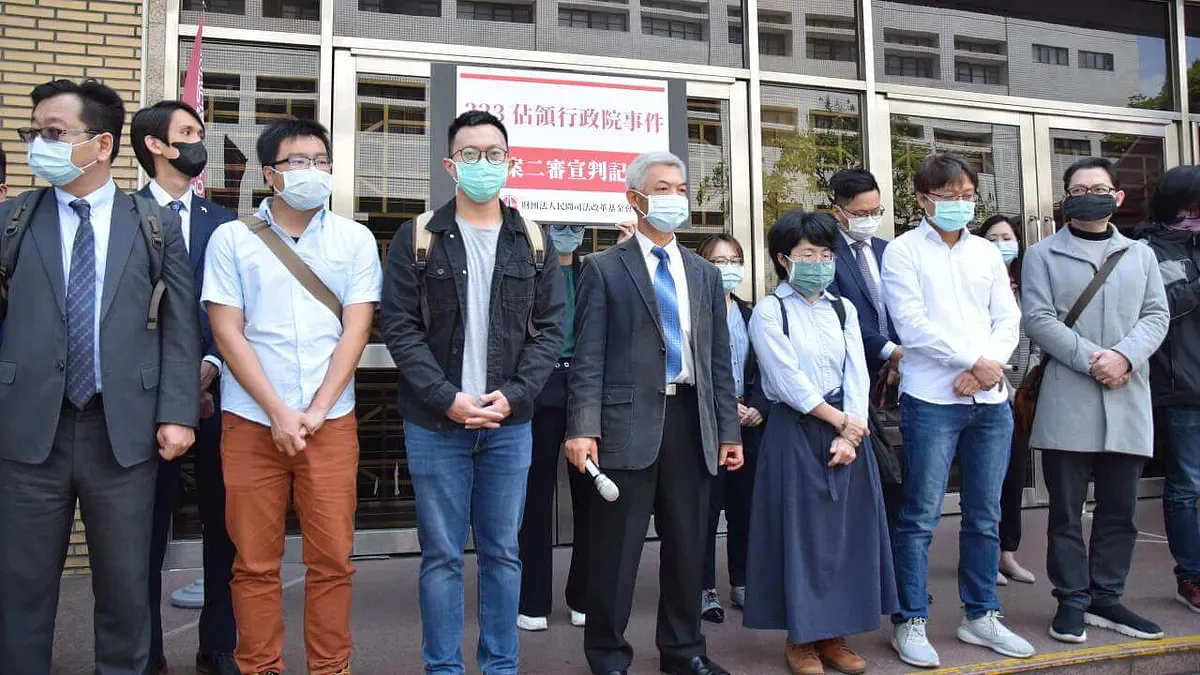
Second-Instance Judgment in the March 23 Executive Yuan Occupation Defense Case: 1 Acquittal, 16 Convictions
Last edited: 2026-11-07
The Criminal Division of the Taiwan High Court delivered its second-instance judgment in the March 23 Executive Yuan occupation case today. The judgment not only upheld the first-instance convictions but also reversed the acquittals of those indicted for "instigating others to commit offenses," convicting them instead. The pro bono defense team expressed regret and disappointment at this outcome.
Following the March 23 Executive Yuan occupation incident, prosecutors indicted as many as 132 people. For 126 of them, the government withdrew its complaints on the offenses prosecutable only upon complaint, and those charges were dismissed; however, 21 people still faced trial because they were charged with offenses that do not require a complaint. In April 2017, the court of first instance convicted 11 of these individuals and acquitted the other 10. Following appeals by both the prosecutors and the defendants, the case lost all of last year to the presiding judge's evident bias and the defense team's unsuccessful motion to disqualify him, and the trial resumed only this year. Yet just after the sixth anniversary of March 24, we are once again left disappointed in the judiciary.
More than thirty years have passed since Taiwan transitioned from authoritarianism to democracy. In our highly democratized contemporary era, we are still witnessing the prosecution and police systems exercising state power to pursue citizens who peacefully exercised their freedom of speech and assembly. Conversely, the prosecutorial system's efforts to investigate police violence fall far short of its pursuit of defendants who have made profound contributions to Taiwan's democracy. Today's judgment not only makes the convictions of eight defendants in this case final, but also reverses the acquittals of the defendants indicted for "instigating others to commit offenses." This fully highlights the authoritarian legacy that leads the judiciary to treat the people as enemies when it comes to social movements.
The actions of March 18 and March 23 shaped Taiwan's democratic landscape today and reinforced the awakening of contemporary popular sovereignty among the public. This movement should be viewed as a whole. While the defendants in the March 18 Legislative Yuan occupation case were all acquitted, the defendants in the March 23 Executive Yuan occupation case, six years later today, remain burdened by ongoing litigation and are paying a legal price for this movement.
The defendants in this case are brave participants who care about Taiwan's democracy and rule of law; they should not be forgotten by history. Today's judgment is deeply regrettable and disappointing, and the defense team continues to hope that the state will refrain from using judicial means to suppress protests. Regarding the parts of the case that can still be appealed, the defense team will discuss with their clients to decide whether to file an appeal.
Judgment List
| Indicted Offense | Name | First-Instance Judgment | Second-Instance Judgment | Appealable After Second Instance |
| Obstructing Public Officials | Chen Chien-pin | Imprisonment for 4 months, commutable to a fine | Appeal dismissed | X |
| Huang Kuo-yang | Imprisonment for 4 months, commutable to a fine | Appeal dismissed | X | |
| Chen Wei-cheng | Imprisonment for 4 months, commutable to a fine | Appeal dismissed | X | |
| Hsieh Sheng-yu | Imprisonment for 5 months, commutable to a fine | Appeal dismissed | X | |
| Hsu Che-jung | Imprisonment for 3 months, commutable to a fine | Appeal dismissed | X | |
| Wu Chung-tao | Imprisonment for 3 months, commutable to a fine | Appeal dismissed | X | |
| Liu Chien-ming | Imprisonment for 3 months, commutable to a fine | Appeal dismissed | X | |
| Lin Tang-yu | Imprisonment for 4 months, commutable to a fine | Appeal dismissed | X | |
| Damaging Property Under the Custody of Public Officials |
Li Kuan-ling | Imprisonment for 4 months, commutable to a fine | Appeal dismissed | O |
| Hsu Shun-chih | Imprisonment for 4 months, commutable to a fine | Appeal dismissed | O | |
| Instigating Others to Commit Offenses |
Hsu Shun-chih | Acquitted | Imprisonment for 2 months, commutable to a fine (to be executed together with the sentence for damaging property under the custody of a public official, for a total of five months) |
O |
| Wei Yang | Acquitted | Imprisonment for 4 months, commutable to a fine | O | |
| Chen Ting-hao | Acquitted | Imprisonment for 4 months, commutable to a fine | O | |
| Chiang Ping-lun | Acquitted | Imprisonment for 3 months, commutable to a fine | O | |
| Liu Ching-wen | Acquitted | Imprisonment for 2 months, commutable to a fine | O | |
| Lin Chien-hsing | Acquitted | Imprisonment for 3 months, commutable to a fine | O | |
| Hsu Li | Acquitted | Appeal dismissed (acquittal upheld) | -- | |
| Ko Ting-yu | Acquitted | Imprisonment for 2 months, commutable to a fine | O |
Attendees
318 Anti-Black Box Service Trade Agreement Pro Bono Lawyer Team
Attorney Yu Po-hsiang
Attorney Lin Chun-hung
Attorney Chu Ying-shan
Attorney Ho Chao-tung
Attorney Wang Lung-kuan
Attorney Hsueh Chin-feng
Attorney Tsai Hsiu-fang
Clients
Li Kuan-ling
Huang Kuo-yang
Chen Wei-cheng
Liu Chien-ming
Hsieh Sheng-yu
Wei Yang
Chen Ting-hao
Liu Ching-wen
Press Contact
Attorney Lee Ming-ju, Staff Attorney, Judicial Reform Foundation
This article is an AI-generated translation of the original Chinese text. In the event of any discrepancy, the Chinese version shall prevail.
