
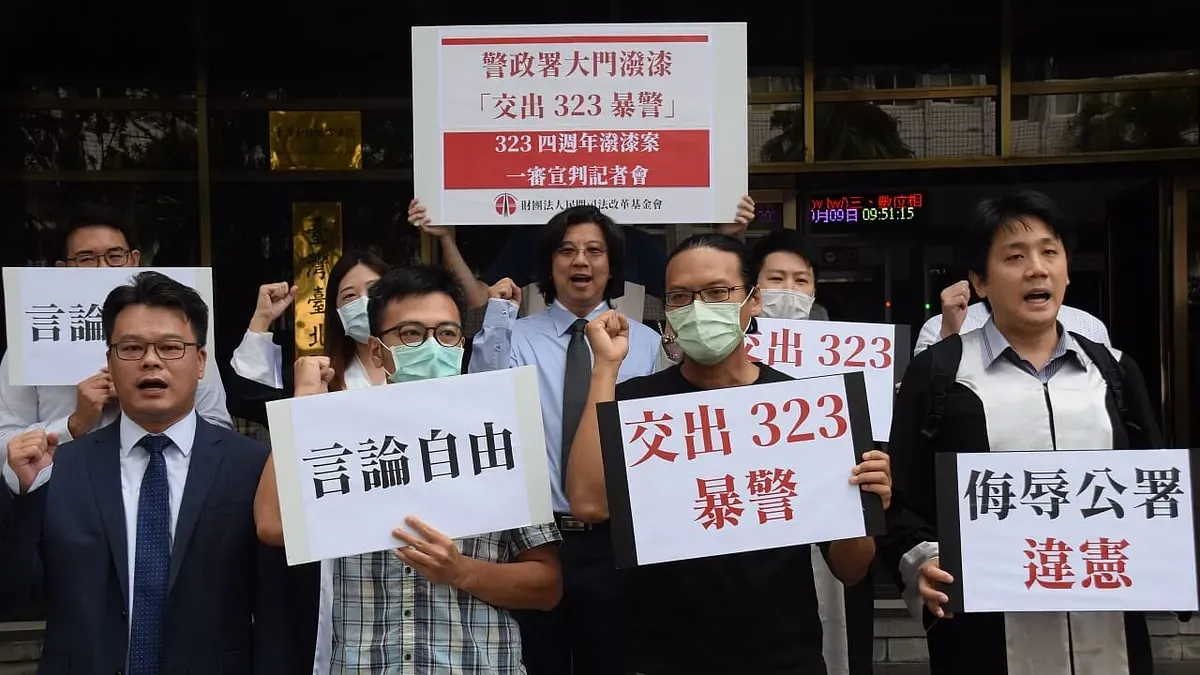
First-Instance Judgment in the March 24 Fourth-Anniversary National Police Agency Paint-Splashing Case ("Hand Over the March 23 Violent Police"): Six Defendants Convicted, Authoritarian Criminal Law Awaits Decriminalization
Last edited: 2026-11-07
At 9:30 a.m. today (the 9th), the Criminal Division of the Taipei District Court delivered its judgment in the March 23 fourth-anniversary paint-splashing case, sentencing each of the six defendants to 30 days of short-term detention for property damage, commutable to a fine.
The pro bono defense team expresses regret and disappointment at this judgment, and calls on the public to continue paying attention to the constitutional concerns surrounding the offense of insulting a public office—the provision under which the defendants were indicted—and to the fact that the police officers who used violence during the March 24 violent clearance of the Executive Yuan have yet to be held accountable.
Six and a Half Years After the March 23–24 Violent Clearance of the Executive Yuan, the Violent Officers Still Have Not Been Identified
Six and a half years have passed since the March 23–24 violent clearance of the Executive Yuan. Among the citizens injured that night by unlawful police violence, records in the Ministry of Health and Welfare's emergency medical system alone show that major hospitals dispatched at least 61 ambulance runs and that more than 200 people sought hospital treatment as a result of the clearance. On July 16, the Control Yuan released Investigation Report No. 109 Nei-Tiao 0077, issuing corrective measures against the National Police Agency and reaffirming that police unlawfully used violence to disperse the crowd that night.
However, over the past six and a half years, whether by bringing private prosecutions, seeking State compensation, filing complaints with the Control Yuan, or asking city councilors to question officials, citizens and civil society organizations have tried various channels to actively urge police and judicial authorities to help pursue accountability. To this day, however, not a single police officer who committed acts of violence against citizens that night has faced administrative punishment or criminal prosecution, nor has any police commander been held responsible.
This case occurred on the fourth anniversary of the March 23 incident. In response to the National Police Agency's failure to actively investigate the truth and pursue accountability for relevant individuals, the defendants splashed paint and wrote phrases such as "Hand over the March 23 violent police" and "Do not forget March 23" on the gates and walls of the National Police Agency, demonstrating their dissatisfaction with the government agency's dereliction of duty and evasion of responsibility. As a result, however, they were indicted for property damage and insulting a public office.
Six Defendants Convicted, Authoritarian Criminal Law Awaits Decriminalization
According to scholarly research, the offense of insulting a public office has existed ever since the Great Qing Criminal Code, which was modeled on Japan's old French-style Penal Code. More than 30 years have passed since Taiwan moved from authoritarianism to democracy, and the legitimacy of this authoritarian-tinged offense has long been questioned. The existence and application of this offense not only potentially infringe upon the people's freedom of speech in monitoring the government, but also substantially hinder social communication and dialogue.
The Constitution affords the utmost protection to political speech precisely to grant citizens with less power the opportunity to use speech to urge government action. Recently, we have witnessed governments in places like China, Hong Kong, Singapore, and Thailand incessantly employing state power to arrest and prosecute social activists and suppress freedom of speech. At this moment, Taiwan's achievements in democratic freedom and the practical realization of human rights are of particular importance to regional human rights development.
The court in this case rejected the pro bono defense team's motion to suspend the trial and petition the Grand Justices for an interpretation of the offense of insulting a public office, and today convicted the six defendants of property damage, even though the barricades and gates splashed with paint that night were quickly restored to their original condition. The pro bono defense team has not yet seen the reasoning of the judgment and is deeply puzzled by the outcome. We must emphasize, however, our deep regret that in contemporary Taiwan, which prides itself on freedom and democracy, the judicial system still convicted the defendants. Upon receiving the judgment, the pro bono defense team will discuss with the defendants whether to appeal. We still hope that Taiwan's precious democratic social and civic space can continue to draw strength through the stimulation and reflection of speech.
Attendees
Defendants
Chuang Cheng-yang, Chang Ti-hao
Attorneys
Lin Chien-hung, Lin Chun-hung, Li Ling-wei, Huang Yu-chung, Chen Li-ting, Chang Ning-chou, Chen Hung-chi
Press Contact
Attorney Lee Ming-ju, Staff Attorney, Judicial Reform Foundation
This article is an AI-generated translation of the original Chinese text. In the event of any discrepancy, the Chinese version shall prevail.
